Features
Africans are their own enemies (Part 2)

“A man’s enemies are those of his own household,” so the Bible says inMicah 7:6. Last week, we validated this with the treachery of top Ghanaian military and police officers in conniving with the CIA to depose Ghana’s first president, Osagyefo Dr. Kwame Nkrumah.
This week, the case of the Congolese nationalist, Patrice Lumumba whose compatriots cruelly backstabbed him buttresses the point.
They unashamedly connived with their oppressors to chase Lumumba out of office and assassinate him barely three months after gaining independence for them, depriving Africa of a gem of a leader.
He was a journalist and a poet but above all he was a freedom fighter like Nkrumah, in fact one of Nkrumah’s protégés.
He emerged when his country, then known as Belgian Congo, had suffered decades of oppressive colonial rule foisted on them by King Leopold II of Belgium in 1885 at the onset of the scramble for Africa.
The king did not only commandeer the Congo as his private property, but also enslaved and brutalised the natives, killing millions.
Those who failed to meet their quota of rubber harvest had their hands amputated.
Unwilling to submit to the regime of injustice, oppression and exploitation, Lumumba formed a political pressure group in 1958 at the age of 33 to agitate for change.
Even though he was from a minority tribe and very young, his charisma and courage attracted many heavyweights from the bigger ethnic groups to his cause.
They launched the Congolese National Movement, (Mouvement National Congolais), MNC, the first really all-Congolese political party.
In contrast, his two principal rivals, Joseph Kasavubu and MoiseTshombe, hailed from large, powerful, ethnic groups with political parties that were regional in character.
But they controlled large swathes of land populous enough to threaten Lumumba and his party despite its national character.
The same year he formed his party, Lumumba whose fame was growing with lightning speed, was invited by Dr. Nkrumah to the All-African People’s Conference in Accra held a year after securing independence for Ghana against all odds.
After independence, Dr. Nkrumah declared that Ghana’s freedom was meaningless unless it was linked up with the total liberation of Africa.
The conference, was therefore, convened to galvanise the rest of Africa to liberate themselves from the shackles of colonialism.
Two years after the summit, following mounting pressure on Belgium, France and the United Kingdom, they consented, albeit grudgingly, to demands by the colonies for multi-party elections.
As many as 26 African countries including the Congo and most francophone colonies, gained independence.
The MNC won a sizeable majority mandating it to form a government, with Lumumba becoming the first Prime Minister at 35 years.
Kasavubu was elected ceremonial president implying that the radical, leftist Lumumba, was more powerful to the dislike of the Belgians and their Western allies, especially the US.
Like his mentor, his speeches were alarmingly fiery, sharply stinging, fearlessly uncompromising, brutally sincere, and unnervingly electrifying.
The best is the one he gave on June 30, 1960, the day the Congo was granted its independence.
That day, King Boudewijn, the last Belgian king over the Congo, added insult to injury when he said the Congolese had been granted independence because his country’s project to civilise them had been accomplished. What?
As if the Belgians had done the Congo any favour by returning their stolen freedom to them, Kasavubu docilely thanked them for independence.
But Lumumba could not stomach the nonsense and vehemently protested, exposing the savagery of the Belgians vis-à-vis their claims of civilisation.
He stressed that independence had resulted from a relentless fight and not from the magnanimity of the Belgians. Among other things, he said:
“Although, this independence of the Congo is being proclaimed today by agreement with Belgium, … no Congolese will ever forget that independence was won in struggle, a persevering and inspired struggle, carried on from day to day, a struggle, in which we were undaunted by privation or suffering and stinted neither strength nor blood.
“It was filled with tears, fire, and blood. We are deeply proud of our struggle because it was just and noble and indispensable in putting an end to the humiliating bondage forced upon us.
“That was our lot for the eighty years of colonial rule and our wounds are too fresh and much too painful to be forgotten.
“We have experienced forced labour in exchange for pay that did not allow us to satisfy our hunger, to clothe ourselves, to have decent lodgings or to bring up our children as dearly loved ones.
“Morning, noon, and night we were subjected to jeers, insults, and blows because we were Negroes. … Our lot was worse than death itself.
“Who will ever forget the shootings which killed so many of our brothers, or the cells into which were mercilessly thrown those who no longer wished to submit to the … oppression used by the colonialists as a tool of their domination?
“All that, my brothers, brought us untold suffering. But we, who were elected by the votes of your representatives … to guide our native land, we, who have suffered in body and soul from colonial oppression, we tell you that henceforth, all that is finished with.
“We shall show the world what the black man can do when working in liberty, and we shall make the Congo the pride of Africa.
“I ask you all to sink your tribal quarrels: they weaken us and may cause us to be despised abroad.
“I ask you all not to shrink from any sacrifice for the sake of ensuring the success of our grand undertaking.
Like Nkrumah, he concluded that his country’s independence was a decisive step towards the liberation of the whole of Africa.
To the West, that speech meant a declaration of war. His candour was too piercing and humiliating for Belgium and its allies, especially the US.
To their chagrin, a firebrand like Nkrumah, or even more radical freedom fighter had emerged, threatening their interests.
He must be eliminated, dead or alive. How? Look for the enemies within and use them.
They enlisted Kasavubu and Tshombe, as well as Joseph Desire Mobutu, a 31-year-old army officer whom Lumumba had made his personal assistant.
Lumumba’s call for unity to develop the Congo fell on deaf ears. For almost immediately after independence, some units of the army mutinied against their Belgian officers, demanding improved service conditions and an indigenous hierarchy.
Tshombe used the ensuing confusion as pretext to lead the mineral-rich Katanga province to secede. Another province, Kasai, also broke away, leaving the Congo fragmented and fragile.
Belgium sent in troops, ostensibly, to protect its nationals, but in reality, to reinforce the secessionist regimes of Katanga and Kasai where they landed.
In line with their “divide and rule” tactic, the West backed Kasavubu and Tshombe’s push for regional autonomy against Lumumba’s moves to unify the country.
The embattled Prime Minister, called for help from the US unaware that the Americans were after him. Even his appeal to the UN proved futile,
While Lumumba was trying his best to save the situation, Kasavubu declared him dismissed from office. He retaliated, saying he had removed Kasavubu.
With the UN forces and the Belgians backing the rebels, Lumumba appealed to the Soviet Union for support to help his troops to quell the revolt, a move that alarmed Belgium, and its allies.
In the confusion, Mobutu staged a coup, not to reinstate the Prime Minister but to assassinate him with the connivance of the US and Belgium.
While under house arrest by rebel soldiers of Katanga and Belgian forces, Lumumba escaped, intending to flee to an area controlled by his forces.
But the Belgians and troops loyal to Mobutu, with the help of the CIA, hunted for him and murdered him and two of his aides in cold blood for no crime.
Mobutu ordered a mafia-style execution, looking on callously as they were shot, and their bodies hacked to pieces before being dissolved in acid.
That was on January 17, 1960, barely seven months after Lumumba gained independence for his country.
A Belgian officer who supervised the killings, took one of Lumumba’s teeth as a trophy to his country.
In June this year, after more than six decades, Belgium returned the tooth for burial after apologising for the atrocity meted out to Lumumba.
Mobutu became one of the worst despots in world history. He ruled for 32 years, killed a countless number of his compatriots like King Leopold did, and impoverished millions while he stashed away the country’s wealth in numerous personal foreign accounts.
As long as he remained a puppet of the West and did their bidding, they looked on unconcerned while the Congolese people languished in abject misery.
His country has never since found its feet.
By Tony Prempeh
Contact:
teepeejubilee@yahoo.com

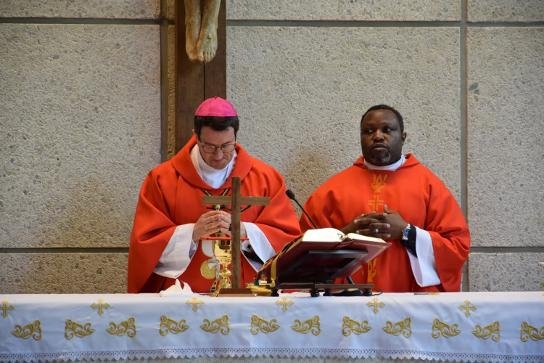
On Sunday, October 11, 2026, it was the turn of Ghanaian Catholics in Finland to lead the singing in the church service of the African Catholic Chaplaincy in Finland (ACCF).
It was indeed a spirit-filled feeling for worshippers present. And for the Ghanaian migrants, the occasion also brought back to them memories of church services in their home country, Ghana.
The ACCF has a roster for each country/community to sing from time to time. Next Sunday will be the turn of the Nigerian community. Other communities that usually sing are the Kenyan/Tanzanian community, the Cameroonian, the Ugandan, group, etc.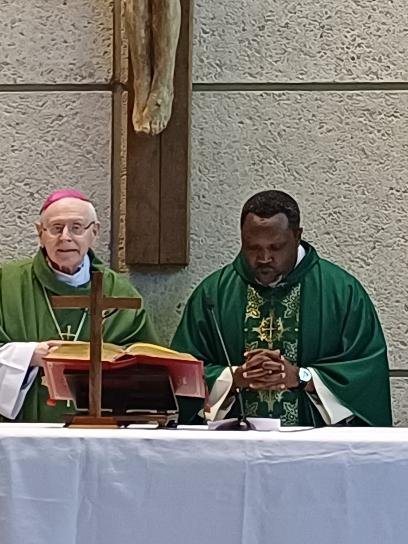
A powerful religious experience
The mass services of the Chaplaincy usually give a powerful religious experience and a display of cultural diversity, especially in occasions such as when the Bishop of Helsinki, Bishop Raimo Goyarrola, celebrated mass with the Chaplaincy on Pentecost Day, May 24, 2026.
There was a similar time of spiritual joy last month (September 27, 2026) when Emeritus Bishop Teemu Sippo, former Bishop of Helsinki, visited the Chaplaincy. Bishop Teemu was the main celebrant, assisted by the Chaplain, Reverend Father Thomas Otieno.
Last Sunday, Reverend Father Bernard Sor, a Ghanaian Catholic priest based in Austria, was the main celebrant in the mass service where he performed a rite of baptism. Fr Bernard had celebrated mass a few months ago when he visited his sister and her husband in Helsinki. 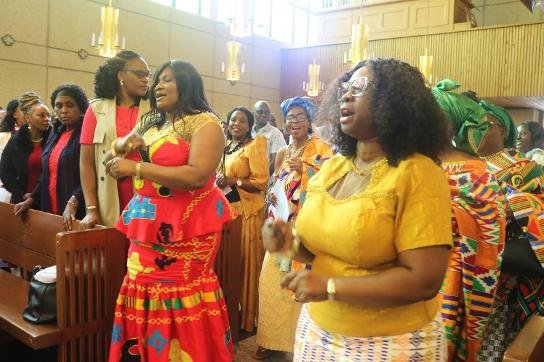
All these well-attended religious occasions indeed leave lasting memories. The homilies (peaching) by the priests usually emphasize religious tenets such as the importance of loving and serving God in truth, existing in peace with our fellow humans to promote unity in diversity, etc.
Unity in diversity and a colourful display of cultures
The African Chaplaincy church services usually produce impressive displays of diverse cultures from different parts of Africa and elsewhere. The events are often spiced by rich cultural displays of dances and colourful attires which are a delight to watch.
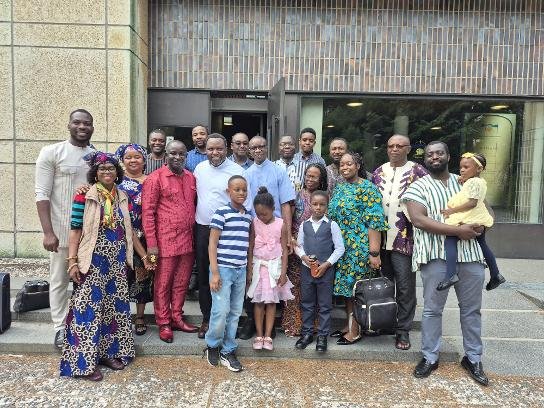
On special occasions, members of the Ghanaian Catholic community, in their gay and colourful kente attire and with adowa dance and music, usually lead the procession into the church. Other communities such as the Cameroonian, Nigerian, Kenyan and Tanzanian as well as Sudanese/South Sudanese groups also put up well-choreographed performances from their cultures.
The African Catholic Chaplaincy in Finland
The African Chaplaincy was founded on June 4, 2017, which was a Pentecost Sunday, in a Pontifical High Mass celebrated by Monsignor Emeritus Sippo S.C.I., the then Bishop of Helsinki, at the St. Mary’s Catholic Parish Church in Helsinki.
The Chaplaincy was created by Bishop Teemu in collaboration with the Diocesan body when they detected a great flocking of African immigrants to Finland, the majority of whom were Catholics. This was to give the immigrants a possibility to integrate into the Finnish society by worshiping as Catholics and in their African cultural identity.
The responsibility of the Chaplaincy was given by Bishop Teemu to Father Dr Leonard Wobilla Shwei, who is thus the first Chaplain and ably led the Chaplaincy. He was succeeded a few years ago by Father Thomas Otieno, who continues to move the Chaplaincy forward. Thank you!
GHANA MATTERS column appears fortnightly. Written in simple, layman’s terms, it concentrates on matters about Ghana and beyond. It focuses on everyday life issues relating to the social, cultural, economic, religious, political, health, sports, youth, gender, etc. It strives to remind us all that Ghana comes first. The column also takes a candid look at the meanings and repercussions of our actions, especially those things we take for granted or even ignore. There are key Ghanaian values we should uphold rather than disregard with impunity. We should not overlook the obvious. We need to search for the hidden or deeply embedded values and try to project them.
With Dr Perpetual Crentsil
SKIP THE QUEUE, TAP THE NEWS

You can now read the Ghanaian Times and The Spectator newspapers from the comfort of your device via TimesNewsPlus.
Join our WhatsApp Channel: https://whatsapp.com/channel/0029VbBElzjInlqHhl1aTU27
She did not find out he was cheating. She found out he was drowning.
It was two weeks after their beautiful wedding. The jollof was still in the fridge. A loan officer called her number-not his-and politely asked, “Madam, please tell your husband to pay his overdue loan. We have been calling him.”
That was how she discovered her new husband had entered their marriage with a hidden debt of over GH¢ 40,000. No cheating. No other woman. Just a financial secret.
And that is how many Ghanaian marriages begin to die. Not with a shout, but with a secret alert on a phone.
We prepare for the wedding. We do not prepare for the wallet.
What is money honesty?
Let me define it simply. Money honesty is not that you both earn the same. It is that you both know the same. It is the ability to sit down and say without fear:
“This is how much I earn.”
“This is how much I owe.”
“This is how I was raised to see money.”
“This is what scares me about money.”
Financial transparency is not about control. It is about clarity. You cannot build trust on top of secrets.
Many couples tell me, “Counsellor, we love each other, love will handle money.” I always answer, “Love is the car, but money honesty is the fuel. Love without honesty cannot move.”
How To Buy Your Marriage Insurance Today – My 5-Step Protocol
If you are engaged, newly married, or even 20 years in marriage, you can still fix this. At Counsellor Prince & Associates Consult—CPAC, this is what I give couples:
Step 1: The 90-Minute Money Naked Session.
No phones, no blame. Each partner writes down on paper: Monthly income, monthly debts, monthly family obligations, savings, and your biggest money fear. Then you exchange papers. Read it. Don’t react for 24 hours. Just absorb.
Step 2: Create OUR Money, YOUR Money, My Money.
You need three pots. OUR money for rent, food, school fees, utilities, properties, and the like— joint contribution. YOUR money and MY money—a small agreed allowance no one questions. This stops the feeling of being controlled.
Step 3: The No-Secret Debt Rule.
Agree from today: No new loan, no new hire purchase, no new family financial commitment above GHS 500 without telling each other first. Not permission, but information.
Step 4: Talk About Your Money Personality.
Are you a Spender or a Saver? Are you Risky or Safe? Most Ghanaian marriages are a Spender married to a Saver. Neither is wrong. But if you don’t understand your partner’s personality, you will call his saving “stinginess” and her spending “wastefulness.”
Step 5: Do a Monthly 30-Minute Money Date
Not an argument date. Light, with tea. “How did we do this month? What worried you? What should we plan for next month?” Couples who do this divorce far less.
My Final Word
Before you say “I Do” at the altar, have pre-marital counselling and also have the money talk on the sofa.
Ask your partner:
“If I lost my job today, how long can we survive?”
“What debt are you bringing into this marriage?”
“How much do you send to your family monthly and will that continue?”
If he or she gets angry that you asked, don’t get married yet. A person who is angry about accountability will be abusive about money.
Marriage insurance is not bought at Star Assurance or Enterprise. It is bought in honest conversations when no one is watching.
The wedding costs one day. The marriage costs a lifetime. Don’t enter a lifetime contract and covenant with hidden costs.
You can still insure your marriage today.
Source:
Counselor Prince Offei, CPAC’s founder, is a leading Mental Health Professional, Marriage Counsellor, Author, ADR Expert/Arbitrator, and Spectator Newspaper Columnist. He writes on relationships, marriage, parenting, special needs support, and their connection to mental health. For therapy, counselling, or enquiries, contact Counselor Prince & Associates Consult (CPAC) in Accra on 0559850604 / 0551428486.
SKIP THE QUEUE, TAP THE NEWS
You can now read the Ghanaian Times and The Spectator newspapers from the comfort of your device via TimesNewsPlus.
Join our WhatsApp Channel: https://whatsapp.com/channel/0029VbBElzjInlqHhl1aTU27