Editorial
Ghanaians deserve commendation for success of national cleaning exercise

- /home/u249204778/domains/spectator.com.gh/public_html/wp-content/plugins/mvp-social-buttons/mvp-social-buttons.php on line 27
https://spectator.com.gh/wp-content/uploads/2026/07/Some-of-the-school-children-desilting-choked-gutters.jpg&description=Ghanaians deserve commendation for success of national cleaning exercise', 'pinterestShare', 'width=750,height=350'); return false;" title="Pin This Post">
- Share
- Tweet /home/u249204778/domains/spectator.com.gh/public_html/wp-content/plugins/mvp-social-buttons/mvp-social-buttons.php on line 72
https://spectator.com.gh/wp-content/uploads/2026/07/Some-of-the-school-children-desilting-choked-gutters.jpg&description=Ghanaians deserve commendation for success of national cleaning exercise', 'pinterestShare', 'width=750,height=350'); return false;" title="Pin This Post">
Dear Editor,
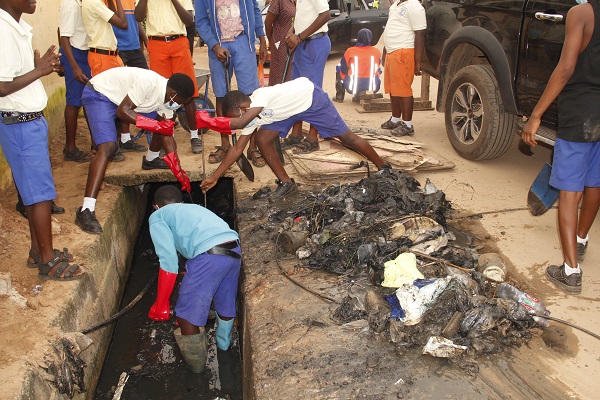
I wish to use this platform to commend Ghanaians for turning up massively to clean their respective communities as part of the national cleaning exercise declared by the president, John Dramani Mahama.
After cleaning my area, I decided to take a stroll across some of the neigbhouring communities.
I got so excited about the numbers that lined up the street and along gutters.
To my surprise, I met a few people who had moved to other areas to support. It was a good sign and reaction from people who have learnt serious lessons from the recent floods.
What we witnessed last Monday sends a clear message that if attitudes about sanitation don’t change, we may encounter more devastating disasters when it rains.
Truth is that the recent rain was quite heavy and continued for a longer time. However, the choked gutters and other drainage worsened the situation.
In one of the many videos that circulated on social media, one could sight a large heap of rubbish covering the surface of the flood water. We are the cause of this menace and Ghanaians must be seen to be showing concern.
With the sanitation issue being tackled gradually, I pray that government through the local assembly finds a way to collect the rubbish from the exercise, lest they wash into the drains again.
Again, the demolition exercises must continue. Building sited on waterways and resulting in flooding must be cleared. Government must try and restore all the wetlands taken over by developers.
Most of the time, the rich people that benefits from these activities do not suffer from the floods. It is the poor that suffers.
I hope that this exercise would be a monthly affair so that at least once in every month, citizens would come out like they did on Friday and Saturday to clean their environment.
Ayekoo to every Ghanaian that participated. Well done to all the Members of Parliament and Ministers of state that also took part. It was leadership by example.
Maxwell Boampong,
Accra Newtown







Dear Editor,
Ordering a ride through a ride-hailing app has become a convenient part of modern life. However, for some passengers, what begins as an ordinary journey to their destination can quickly turn into a frightening fight for survival.
In recent times, concerns over the safety and security of passengers have grown, with some people sharing disturbing accounts of alleged attacks by drivers of ride-hailing companies such as Bolt and Yango.
One such incident was narrated to me by a lady who said she narrowly escaped what could have been a deadly encounter with a driver.
According to her, she booked a ride and was on her way to her destination when the driver suddenly cancelled the trip. The driver then stopped the car, got out, and asked her to step out of the vehicle.
She said that, to her shock, the driver pointed a gun at her and ordered her to get back into the car.
Realising the danger she acted quickly, as she banged the car door and began raising an alarm. Her reaction apparently startled the driver, who immediately got back into the car and drove away.
Thankfully, she escaped unharmed. But the incident raises serious questions about passenger safety and the measures being taken by ride-hailing companies to protect their customers.
I therefore urge ride-hailing companies to strengthen their driver-vetting procedures and work closely with the Ghana Police Service to identify, investigate, arrest, and prosecute drivers who may use their platforms to facilitate criminal activities.
Passenger safety should not be treated as an afterthought. People who entrust their lives to ride-hailing services deserve to have confidence that every reasonable measure has been taken to protect them.
I also appeal to the general public to remain cautious and vigilant when ordering rides, particularly late at night. Passengers should verify the driver’s details and vehicle before entering, share their trip information with trusted family members or friends, and avoid ignoring any situation that makes them feel unsafe.
Convenience should never come at the expense of security. Ride-hailing companies, law enforcement agencies, and passengers all have a role to play in making our roads safer.
From Akosua.
Dansoman
The table salt has been a staple of Ghanaian households, restaurants and chop bars, for many generations.
It silently contributes to the escalating public health emergency. But the Ghana Health Service (GHS) says it is time to stop this behaviour.
Health officials are therefore calling on food sellers, restaurateurs, and parents to remove salt from dining tables as it is contributing to a silent epidemic of non-communicable diseases (NCDs).
Dr. Wallace Odiko-Ollennu, Programme Manager of the GHS Non-Communicable Disease Control Programme, correctly points out that making salt less accessible is crucial.
This practice of shaking extra sodium onto a plate before even tasting the dish is broken when extra salt and salty sauces are limited upon request.
By gradually retraining our palates to enjoy natural flavours, this structural modification establishes a psychological barrier and, most importantly, slows the onset of lifestyle disorders like diabetes and hypertension.
This most recent advocacy campaign is especially encouraging because of its approach of spiritual and cultural harmony. This is because Public health cannot live in a vacuum, as acknowledged by the partnership between the GHS, Communication Initiatives for Change (CIC)-Meatless Monday Ghana.
The campaign meets people where they are, family kitchens, and community squares by integrating scientific information with faith-based teachings and communal values.
We are told that a practical, gradual route to wellness is also provided by the editorial support of the “Meatless Monday” idea, which advocates for just one day per week to forgo meat in favour of fruits, vegetables, legumes, and complete grains.
It is a sustainable call for food balance rather than a dramatic demand for complete dietary abstinence. The route to greater health is being made available to every Ghanaian, especially when combined with the GHS’s reminder that regular activity may be found in daily tasks or a simple walk.
However, community workshops and policy proposals are limited. The individual bears the final accountability.
The Spectator endorses the advice that we need to be more conscious of what we eat and actively seek out routine health checks before issues worsen without our knowledge.
Eliminating table salt off our tables is a minor, inconvenient sacrifice that will have enormous benefits in the long-term for our country. It is therefore time for parents to change their kitchens, for food vendors to clear their tables, and for all of us to prioritise long-term health over instant, salty satisfaction
SKIP THE QUEUE, TAP THE NEWS
You can now read the Ghanaian Times and The Spectator newspapers from the comfort of your device via TimesNewsPlus.
Join our WhatsApp Channel: https://whatsapp.com/channel/0029VbBElzjInlqHhl1aTU27