News
University of Ghana launches UGA Network App to reconnect global alumni community

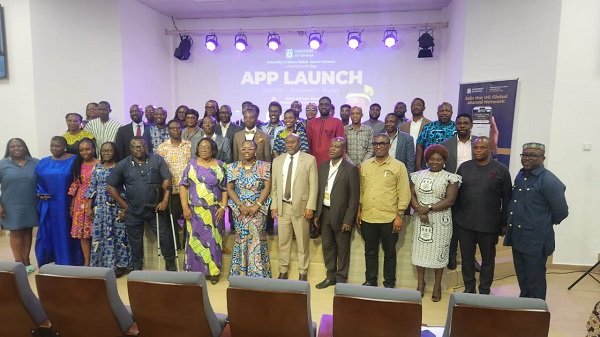
The University of Ghana has launched the UGA Network App, a new digital platform designed to reconnect its graduates and strengthen institutional ties with one of Africa’s largest alumni communities.
Speaking at the launch on May 28, 2026 at the West African Genetics Centre Auditorium on the University campus, Vice Chancellor Professor Nana Aba Appiah Amfo said the app addresses a long-standing gap in alumni engagement.
“For too long, the connection between our graduates and their alma mater has depended on chance,” she said.
Adding that “Not because the bond weakened, but because there was no official, trusted and simple mechanism to keep it alive.”
Prof. Amfo noted that since the university’s founding in 1948, it has shaped “life’s most meaningful moments” for many, from friendships and marriages to business ideas and careers.
She described the university as “a shared home, one that inspired pride, purpose, and a deep sense of belonging that does not diminish with distance or the passage of time.”
“The UGA Network App allows alumni to register, verify their status, and complete profiles within minutes. Users can search for fellow “Legonites” by year of graduation, college, or location, register for university events and reunions, participate in mentorship programs, and support university initiatives,” she added.
The Vice Chancellor said alumni are central to the university’s strategic priorities, including transformative student experience, impactful research, and resource mobilisation.
“Our alumni are our most powerful ambassadors. They validate, in the real world, the education this University provides,” she added.
Prof. Amfo called the app “a living platform” that will be refined based on user feedback.
She urged alumni to “scan the QR code, register on the platform, connect with one another, reconnect with the University, and become active participants in this renewed alumni movement.”
Director of the Institutional Advancement Directorate, Prof. Gordon Abekah-Nkrumah, said the launch marks a shift from fragmented, ad hoc alumni efforts by individual colleges and departments.
“With the launch of the UG Alumni Network App, we are laying the foundation for a more connected, more coordinated, more responsive, and more vibrant alumni ecosystem,” he said.
Prof. Abekah-Nkrumah noted that the platform was built in-house by the university’s Information Technology Directorate instead of procuring an off-the-shelf solution, “a path that reflects both prudence and confidence in our own institutional capacity.”
University leadership also acknowledged support from alumni associations in Ghana, North America, Nigeria, Liberia, Sierra Leone, Gambia, and the Francophone community, as well as from GRASAG and the SRC. Appreciation was extended to Mr. Philip Haywood Dadzie, Chief Executive Officer of Nest Realty, for supporting the launch.
Also speaking at the event, the Chief Executive Officer of Ghana Tourism Development Company and Professor of Marketing at the University of Ghana Business School said the app is “very appropriate.
“In the 21st century you know where to find each other, that’s online. If we can get our community very well together and be able to get in touch with them, I think it is very appropriate for us to have this particular software,” he concluded.
The UGA Network App is the official alumni engagement platform of the University of Ghana, managed by the Institutional Advancement Directorate, in collaboration with the Information Technology Directorate.
Built on a verified and secure alumni database, the platform protects personal information while ensuring credibility and trust for users.
By Edem Mensah-Tsotorme


For more than 60 years, the Adum Clinic has stood as a trusted pillar of healthcare in Kumasi, with generations of experienced doctors passing through its doors.
Now, in a bold step to meet the evolving medical needs of the public, the clinic has undergone a major renovation—expanding its services and reimagining its role in community health.
The Medical Superintendent, Dr Vida Teiko Nartey, told The Spectator that while the clinic has long offered endoscopy, general OPD, and dental services, the new phase introduces a broader spectrum of care.
“We are now adding antenatal services, diabetic care, hypertension treatment, and a wellness centre where patients can easily check their vitals,” she said.
Dr Nartey cautioned against sedentary lifestyles, noting their link to hypertension and other non-communicable diseases (NCDs).
“Lifestyle change is critical. We must encourage physical activity and healthier habits to reduce the burden of NCDs,” she emphasized.
The revamped clinic also boasts of an ultrasound and Doppler scan services, with plans to accept NHIS card bearers—a move expected to widen access for many residents.
As part of its commitment to giving back, Adum Clinic recently organised a free health screening. The exercise revealed that NCDs remain common among visitors, prompting doctors to advise lifestyle adjustments.
For Dr Nartey, the renovation was not just about infrastructure but about vision: “We want Adum Clinic to remain a place where modern medicine meets community care, ensuring that every patient feels supported in both treatment and prevention.”
With its renewed focus, Adum Clinic is positioning itself as more than a healthcare provider—it is becoming a hub for wellness, advocacy, and healthier living in Kumasi.
From Kingsley E. Hope, Kumasi

Falling standards? Why not? If you are not careful, you’ll mistake the teacher’s table for that of a very busy Makola trader. The trained teacher sells toffee, pencil, eraser, doughnut, meat-pie right in the classroom. We are thankful she doesn’t organise a chop bar in addition.
Anyhow, the school kids always thank the gods of Larteh that their teacher isn’t only a trained teacher but also a skilful trader in the kind of wares that gratify the palate of teens. They could always walk to the table of the teacher and pay for a piece of doughnut while lessons are in progress.
The teacher would as a matter of urgency suspend the lesson, serve the kid, dish out his change, dream about the day’s profit and ask the children to sing a song. Lessons close!
Half the time, such a teacher thinks only about profit margins and how to replenish stock. Sometimes she is discreet about her trade relations and does not expose her wares like a Kwahu merchant. Everything is under the table and children from other classes whose teachers are either males or do not have the Makola mentality also come and buy and interrupt lessons.
It would be one of the wonders of the world if a kid in such a classroom grows up to be a doctor of medicine unless Jesus Christ descends to rescue him from scholastic damnation.
Such teachers are ruining the future of Sikaman children and reports reaching Palava have it that they are now in their numbers. They are no longer fit to be called teachers and the right place for them is Makola or Kasoa Central Market. In fact, the solid foundation of the kids are often shattered irreparably and most of them would probably end up as taxi drivers and kebab specialists when they could become surgical specialists.
What about teachers who drink before classes?
For some, it is “raw quarter” before classes begin, and they sweat like labourers even when the weather is very cool. No kind of air-conditioner can calm their sweat glands. I bet akpeteshie is one hell of a drink.
When a teacher takes it “raw”, he laughs when he should be crying and cries when he should be laughing. If he is dancing adowa you’ll think it is agbadza. No formula at all!
I am happy the Education Service has plans to weed out drunken teachers, among others who are destroying the future of kids.
The story is told of a habitually drunken teacher. Once he looked visibly drunk when he started teaching his pupils about verbs and the fact that verbs are “doing words.”
He undertook to illustrate this in practical terms and started jumping. He was supposed to ask the question, “Children, what am I doing?” to which the kids would answer, “You are jumping.”
However, befuddled by the effect of “double quarters” of the stuff, he started jumping high enough and asked, “Children, what am I jumping?”
The kids were confused but managed to reply in alacrity, “You are doing!”
Anyone witnessing the lesson would have become very impressed with the performance of both teacher and pupils. If the witness were an agama lizard, it would have nodded its head again and again in appreciation and said to itself, “The kids have a very bright future.”
When I visited a few schools recently I was glad to meet Mrs Lucy Peprah, a product of the University of Ghana, Legon. She also holds a Post-Graduate Certificate in Education from the University of Cape Coast in addition to a certificate in Educational Administration from the University of Pittsburgh, Pennsylvania, USA.
Trek your way and get right between Abelenkpe and Alajo, in Accra, reaching quite near to Susubiribi Hotel and you are likely to spot “SOLID FOUNDATION Primary and JSS”. It is one of the schools that are properly run and the secret behind its glowing success is Mrs Lucy Peprah.
After having a chat with Mrs Peprah, one thing I became convinced about is that those who do not have adequate knowledge in education should not be allowed to establish private basic schools which have mushroomed all over the place, many of them hopelessly sub-standard.
In actual fact, basic schools should not be run by businessmen because they only think about profit and not what the children can get out of their educational units. Educationists of the calibre of Mrs Lucy Peprah or even a bit lower could be those who have to be granted permission to establish schools because, first and foremost, they know the value of education and know why and how education should be dispensed.
Having taught in many training colleges before finally becoming Principal of St Monica’s and Holy Child Training Colleges at Ashanti Mampong and Takoradi respectively, and having once been the Chairperson of the National Conference of Principals of Teacher Training Colleges, there can be no doubt that such an experienced person or her counterparts would run their schools as would make the pupils shine.
It is all evident in “Solid Foundation” which has the best of infrastructure comprising well-ventilated classrooms, a twelve-unit tiled WC toilet facility, a well-equipped science laboratory, language and computer centre, a modern Home-Science centre and workshop.
The teaching staff are well-motivated and this has reflected in the excellent academic performances of the school.
Mrs Peprah believes that discipline is a key to success and she instils it in both staff and pupils. And with an experienced educationist in the person of Mr Mark Yankey as Supervisor, the grand overall effect on the pupils is there for all to see.
She plans to start a Senior Secondary School within the next two years and the school would be offering courses in catering, home management and dressmaking.
“I think this woman is one person who should be useful to the Education Service as a think-tank on how to improve standards in our schools since her institution is one of the living examples of the ideal basic academy.”
Mrs Peprah said something that kept me thinking a bit. She is of the opinion that computers should not be taught at the basic level.
“It is a special area which should be left to the specialised schools.”
She also said, “I am not against the offshoot of private schools in the country. I only hope that they would lead to a healthy competition and not commercialisation.”
At a later date, I shall publish a full interview on her views on falling standards of education, the performance of public schools, the role of education officers and the success or otherwise of the educational reform programmes.
Meanwhile, Sikaman Palava lauds the intended move by the authorities to weed out teachers whose conduct are appalling due to alcoholism, absenteeism, speciality in seducing and impregnating school children, recruiting pupils to work on their farms, incompetence and any quality that is seen to be retrogressive to the forward march of the country’s educational system.
This article was first published on Saturday June 15, 1996