Hot!
Blood not for sale at hospitals

- /home/u249204778/domains/spectator.com.gh/public_html/wp-content/plugins/mvp-social-buttons/mvp-social-buttons.php on line 27
https://spectator.com.gh/wp-content/uploads/2023/09/A-participant-undergoing-medical-screening.jpg&description=Blood not for sale at hospitals', 'pinterestShare', 'width=750,height=350'); return false;" title="Pin This Post">
- Share
- Tweet /home/u249204778/domains/spectator.com.gh/public_html/wp-content/plugins/mvp-social-buttons/mvp-social-buttons.php on line 72
https://spectator.com.gh/wp-content/uploads/2023/09/A-participant-undergoing-medical-screening.jpg&description=Blood not for sale at hospitals', 'pinterestShare', 'width=750,height=350'); return false;" title="Pin This Post">
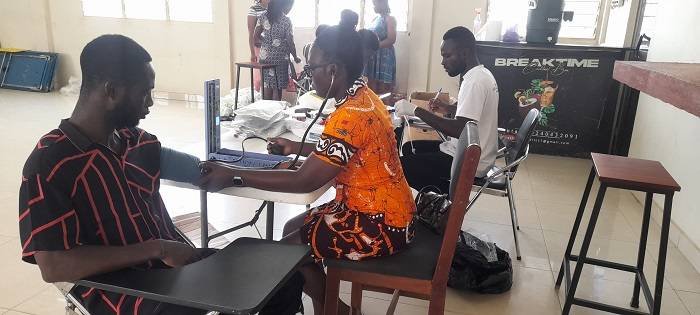
A participant undergoing medical screening
The Deputy in-charge of the Laboratory Unit of the St Joseph Hospital in Koforidua, Selina Quashie, has urged the public to ignore speculations that blood was for sale in hospitals in the country.
According to Madam Quarshie,a Medical Laboratory Scientist, such speculations deterred people from donating to the blood banks, hence the blood shortages in the hospitals which has led to the death of many, especially pregnant women and accident victims.
She said what was usually paid by relations or friends of recipients were processing fees, adding that the notion was untrue and appealed to the public, especially corporate institutions to debunk such reports and donate to help save lives in the hospitals.
Madam Quashie made these statements during a blood donation exercise organised by the Koforidua Technical University and the St Joseph Hospital to encourage workers, lecturers and students to donate blood to the hospital in the municipality.
She disclosed that some tribes believed donating blood would cause men to lose their manhood or that the blood were sold to ‘Sakawa’, adding that some parents of students in the second cycle institutions advise their children not to donate because of the notion.
“As we speak, we only have just 10 pints of blood, five positives, ‘O’ positives, three ‘B’ positives and two ‘A’ positives. We don’t have O negatives, so if an emergency happens it will be difficult to save lives,” she said,adding that it was an unfortunate situation.
Madam Quashie said blood was an essential commodity that could not be bought at the market or the pharmacy and stated that there was the need for people to donate to save lives.
She stated that donating blood gave the public the opportunity to know their health status, adding that it was necessary to engage in the exercise to enable a person to know and receive help if necessary.
The Vice Chancellor of the Koforidua Technical University, Professor David Kofi Essumang called on all tertiary institutions in the country to organise blood donation exercises to support the hospital to have enough blood for their operations, adding that the country’s maternal mortality was high due to inadequate blood at the blood banks in hospitals across the country.
“It is unacceptable that women who have gone to deliver or victims of accidents who required blood will die as a result of inadequate blood.
He said the exercise was therefore necessary to enable the university to donate to stock the hospital’s blood bank with enough blood and revealed that management of KTU would organise the exercise annually to support the hospital.
“We make blood available to the hospital facilities so that when we are in need of blood, we will also fall on them to support us,” he said and stated that the universities played a major role in the health delivery system in the country and hence should support.
From Ama Tekyiwaa Ampadu Agyeman, Koforidua



The Tema Regional Police Command has arrested a 32-year-old man for allegedly posing as a soldier and extorting money from unsuspecting members of the public at Ashaiman.
The suspect, identified as Bright Atsu Kudiabor, was arrested by the Ashaiman Police on Wednesday, September 16, 2026, at about 7:00 a.m.
According to the Police, he was arrested at an area known as “I Shall Return”, where he was allegedly parading himself as a soldier and demanding money from people.
The Police said Kudiabor, who is an ex-convict, was initially arrested by personnel of the Ghana National Fire Service in Ashaiman with assistance from other members of the public.
A search conducted on him after he was handed over to the Police reportedly led to the recovery of a set of military camouflage uniform.
The suspect is currently in Police custody and assisting with investigations.
The Tema Regional Police Command said he would be processed for court after investigations are completed.
The Police urged the public to remain vigilant and report anyone who falsely presents themselves as a soldier or a member of another security agency to deceive or extort money from the public.
By: Jacob Aggrey

Volta Regional Minister, James Gunu, says the Volta Region holds enormous agricultural potential and efforts must be geared towards connecting farmers to the needed resources to unlock that potential.
He said focus must be on linking farmers to resources, technology, financing and markets to increase production, create jobs and build sustainable livelihoods.
Hon. Gunu made the remarks at the national launch of the Ghana Tomato Self-Sufficiency Initiative (GHATSI) held at Anloga in the Volta Region on Tuesday, September 15.
The initiative, under the theme “Produce at Home. Feed the Nation. Export the Surplus,” seeks to boost local tomato production, processing and marketing while reducing Ghana’s heavy reliance on imported tomatoes.
The launch was attended by the Minister for Food and Agriculture, Eric Opoku, his Deputy, John Setor Dumelo, Feed Ghana Coordinator, Bright Demordzi, Members of Parliament, traditional leaders, MMDCEs, farmers and other stakeholders.
Mr.Gunu expressed appreciation to the Minister for Food and Agriculture for the support announced for the region, including two excavators, 200 cartons of organic fertiliser, and GH¢200,000 for Ms. Kuatudzo Esther Dela, a tomato farmer and processor from Ziope.
He described the initiative as an important step towards making agriculture a stronger driver of food security, job creation and economic growth in the Volta Region.
By Edem Mensah-Tsotorme