News
Plight of deaf women in Ghana

- /home/u249204778/domains/spectator.com.gh/public_html/wp-content/plugins/mvp-social-buttons/mvp-social-buttons.php on line 27
https://spectator.com.gh/wp-content/uploads/2023/09/Ms-Yahrleft-and-Mrs-Adjei-right.jpg&description=Plight of deaf women in Ghana', 'pinterestShare', 'width=750,height=350'); return false;" title="Pin This Post">
- Share
- Tweet /home/u249204778/domains/spectator.com.gh/public_html/wp-content/plugins/mvp-social-buttons/mvp-social-buttons.php on line 72
https://spectator.com.gh/wp-content/uploads/2023/09/Ms-Yahrleft-and-Mrs-Adjei-right.jpg&description=Plight of deaf women in Ghana', 'pinterestShare', 'width=750,height=350'); return false;" title="Pin This Post">
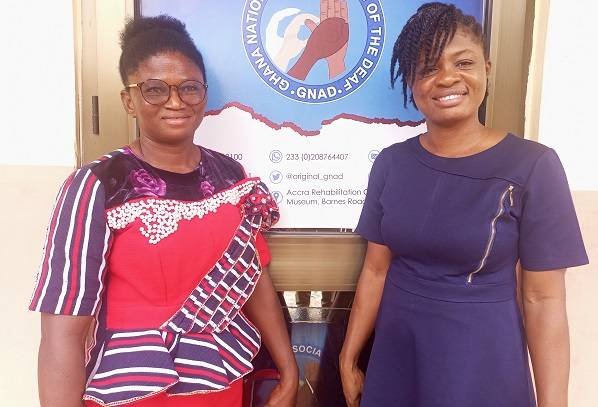
Ms Yaghr(left) and Mrs Adjei (right)
Women in Ghana go through multiple challenges ranging from emotional, psychological and economic trials.
They are often at the bottom of the social order with poor access to health, education, credit and access to land.
The situation is even more worrying if they have any form of disability.
In the case of the deaf women, they suffer discrimination and stigmatisation in areas such as health, education and commerce due to their inability to communicate effectively.
Deaf women are sometimes misdiagnosed at the hospitals, cheated at the market places while others are denied education, an act which defeats the Sustainable Development Goals five and 10 which talks about gender equality and reduced inequalities.
Population
In Ghana, according to the 2021 Population and Housing Census (PHC), about 470,737 people have some degree of hearing loss. Out of the number, 385,794 have some difficulties, 65,495 have a lot of difficulties while 19,448 cannot hear at all.
Two deaf women, Ms Christiana Yaghr and Mrs Mabel Mintaah Adjei, shared their experiences with The Spectator newspaper last Thursday, bringing to the fore the challenges they face in the health, education and other sectors of the country.
According to them the basic and common challenge to the deaf community is communication which they described as the pivot that all other problems revolved.
Mrs Adjei’s biggest concern is the treatment often meted to them at health facilities.
She explained that deaf women were sometimes delayed at the hospital because health practitioners do not understand them and vice versa.
“We are unduly delayed at the hospitals to the extent that when those who can hear come to meet us at the hospital, they are attended to, leaving us sometimes to our fate,” she said.
Mrs Adjei said deaf women are denied information on breast cancer, menstruation, mental, sexual and reproductive health as well as other ailments associated with women.
“Due to the inability to communicate, some deaf mothers do not know how to breastfeed their babies after giving birth or even know the right food to give the babies after weaning them; this is a big challenge,” she said.
Mrs Adjei said some hearing people refuse to transact business with the deaf, adding that “we can do everything hearing people do, we can engage in marketing, advertisement and other businesses.”
According to Ms Yaghr who is currently studying Special Education at the University of Education, Winneba, her friend who was deaf, had to be operated on thrice during childbirth because she could not get the information being passed on to pregnant women at the antenatal sessions.
She said as a result, most deaf women do not visit the hospitals when they are either sick or pregnant.
Plight
Shedding more light on their plight, Ms Yaghr said, deaf women most often prefer to buy at the shopping malls and stores instead of the open markets because they feel safe and comfortable there.
She said at the shopping malls, they use a lot of gestures to express what they want to buy but at the open markets the market women sometimes try to cheat them which occasionally ends up in misunderstandings.
“We sometimes try to read the lips of the market women and ask the price of the items from different people before settling on whom to buy from,” she added.
She noted that it was unfortunate some market women think they cannot calculate the things they buy, for which reason they attempt to inflate the prices.
This, according to her, makes it uncomfortable for them to buy at the market, hence the decision to buy from shopping malls and other outlets.
With regard to education, they both agreed that the fees were not expensive but what affects them was hiring a sign language interpreter.
Mrs Adjei who is studying Basic Education, Distance Learning option at the University of Education, Winneba says “I pay my sign language interpreter GH¢700 a month, so you can imagine the money I would have paid my interpreter after my education,” she added.
Both women called on the Ghana National Association of the Deaf (GNAD) to lead the charge to fight stigmatisation and discrimination against the deaf women, stating that “our leaders must take our issues to the authorities.”
Advocacy
They said, once the advocacy on the adoption of Ghanaian Sign Language (GSL) is intensified and gains recognition by government as the official language for the deaf and legally backed and approved as one of the national languages, it would mitigate some of the challenges encountered by them, especially the women.
“We have to start teaching sign language in schools to make it easier for the hearing population to know the right terminologies for the deaf and be able to communicate with them,” Ms Yaghr said.
“It is my hope that once the GSL is recognised and approved, Ghanaian sign language will be inculcated into the school’s curriculum and taught in schools.
“This will allow more hearing people to learn and appreciate sign language as well as study about deafness and promote socialisation and bridge the gap between the deaf and hearing community in the country,” she said.
Ms Yaghr said there was no difference between those who can hear and deaf women, and called on government to see to the healthcare and welfare needs of deaf women in the country.
She admitted that GNAD had organised some training on women’s health but was not enough as they were not able to reach out to hearing-impaired women in other parts of the country.
Mrs Adjei urged her colleague women to further their education as most of them had refused to continue after Junior High School (JHS), saying an educated woman was an empowered woman.
She again urged them to be confident, believe in themselves, have a positive mindset and use their talents judiciously.
By Jemima Esinam Kuatsinu



From policy to practice: Making productivity a national movement in Ghana- Part 1
Management Development and Productivity Institute (MDPI), Ghana
Productivity is not a corporate buzzword. It is the bedrock of national transformation. Until Ghana moves productivity from the language of policy documents into the lived reality of every worker, farmer, entrepreneur, and public servant, our development aspirations will remain aspirations.
Introduction: A Nation with Ambition but an Execution Gap
Ghana has never suffered from a shortage of ambition. From the bold industrialisation dreams of the Nkrumah era to the Ghana Beyond Aid agenda and successive medium-term development frameworks, the country has produced visionary policy blueprints that articulate what a prosperous, self-reliant Ghana should look like. Yet a persistent and troubling gap remains between policy design and policy delivery — between what is promised and what is practised.
Ghana’s labour productivity, while growing in pockets, continues to lag behind peers in sub-Saharan Africa and falls far short of what is required to accelerate structural transformation. According to the Africa Productivity Report, productivity growth on the continent remains constrained by low technology adoption, weak institutional frameworks, and limited investment in human capital. Ghana is not immune to these forces.
The question before us, therefore, is not whether Ghana needs a productivity revolution. It plainly does. The question is: how do we move from policy intent to national practice? How do we turn productivity from a technical concern of economists and planners into a movement that every Ghanaian owns and champions?
Why policy alone is not enough
Ghana has had a National Productivity Policy. It has had the Ghana Shared Growth and Development Agenda. It has the Coordinated Programme of Economic and Social Development Policies. These are serious, well-intentioned frameworks. So why does the average Ghanaian worker not feel them?
The answer lies in what management scholars call the implementation deficit — the widening chasm between policy as written and policy as lived. Several structural weaknesses deepen this gap in Ghana. First, our productivity agenda has remained largely top-down, conceived by technocrats and rolled out through bureaucracies without sufficient grassroots ownership.
Second, institutions mandated to drive productivity, including the Management Development and Productivity Institute (MDPI), the Ghana Enterprise Agency (GEA), and sector-specific agencies, have historically been under-resourced relative to their mandates. Third, the culture of measurement is weak: what is not measured is rarely improved, and in many of our workplaces and public institutions, productivity is neither tracked nor rewarded.
There is also the matter of culture. Productivity is ultimately a behavioural phenomenon. It thrives where there is discipline, accountability, a sense of urgency, and institutional trust. Building that culture in Ghana requires more than new policies. It requires sustained leadership, behavioural change, and a shift in what we celebrate as a society.
Lessons from the Kaizen Philosophy: Small changes, big results
One of the most instructive case studies in translating productivity policy into national practice comes from an unlikely source, Japan’s post-war reconstruction. Faced with the ruins of industrial capacity and a shattered economy, Japan did not simply craft more ambitious plans. It changed the way every worker, manager, and citizen thought about their daily work. The Kaizen philosophy, meaning “change for the better,” spread from factory floors to hospitals, schools, government offices, and eventually entire supply chains.
The Africa Kaizen Initiative (AKI), championed by the African Union Development Agency-NEPAD and supported by Japan’s International Cooperation Agency (JICA), has begun introducing these principles to the African continent, including Ghana. The approach is deliberate: start with enterprises and individuals, embed a culture of continuous improvement at the operational level, and then allow that culture to scale upward into sectors, value chains, and national systems.
The lesson Ghana should draw is powerful: national productivity movements do not begin with national policies. They begin with the person at the desk, the farmer in the field, the nurse on the ward, the teacher in the classroom, deciding that today, they will do their work a little better than yesterday. Policy creates the enabling environment. But the movement must be human.
Five pillars for making productivity a national movement
Drawing on global best practices and Ghana’s specific development context, I propose five pillars for transforming productivity from a policy commitment into a national movement.
1. Embed productivity in education and early career development
No nation sustains a productivity culture without instilling its values from the earliest stages of human development. Ghana’s educational curriculum at the basic, secondary, and tertiary levels must give explicit attention to time management, work ethic, quality consciousness, problem-solving, and continuous improvement. Technical and Vocational Education and Training (TVET) programmes should become rigorous schools of craft excellence, not holding grounds for those who could not access universities. Employers, universities, and TVET institutions must collaborate to define what “productive work” looks like in Ghana’s context and ensure graduates are equipped to deliver it.
2. Build a national productivity measurement system
You cannot improve what you do not measure. Ghana needs a robust, regularly updated national productivity database that tracks productivity across sectors, enterprises, and regions. The Ghana Statistical Service, MDPI, and sector ministries must collaborate to develop key productivity indicators, including output per worker, total factor productivity, and process efficiency ratios, and to report on them publicly. This data should inform budget allocation, incentive design, and policy adjustments. Transparency about where Ghana stands and which sectors are improving fosters accountability and healthy competition.
By Ethel Ansah-Antwi
It will be interesting to check the number of times the phrase “plans are far advanced” and the other one “it is in the pipeline” appear in responses of politicians to questions from their constituents and their public releases.
It appears they are taught this in special classes organised for them in how to respond to questions during public interactions like town hall meetings etc. Whenever you hear someone speaking on TV or Radio and using such phrases, the probability of him or her being a politician, a government spokesman or an official of some sort is very high.
They know they are lying to you but they will still use such language to make you believe that the issues that are of concern to you are being addressed. The worst of them are those with the title Government Spokesman. They will tell you lies with a straight face and attempt to defend the indefensible.
It reminds me of a cartoon someone sent to me. It showed a woman seriously admonishing his little boy and saying to him “If you do not stop this lying, you will grow up to become a Government Spokesman.”
A very interesting observation from the lady but it is a factual statement. How many times have we not heard statements from government spokesmen, only for us to realise as they say, a few moments later, that they were a pack of lies or to be charitable, a pack of misleading statements.
This attitude is so entrenched in our society, irrespective of the government in power. What worries me is that, these persons, would still go to church on Sundays and mosques on Fridays. They may even be leaders in those churches and mosques. How they are able to live with their conscience, is something worth researching into.
We may have to design a system that will compel politicians to be transparent so that these political statements that seek to deceive the public, can be reduced if not completely eradicated. The funny thing is that, they never say how long the pipe is. All they say is that, it is in the pipeline.
The integrity of the political leaders, must be evident for people to trust in the democratic experiment we have embarked on in this Fourth Republic. The culture in other places is that, leaders who are found to have lied, resign voluntarily.
This is where we have to become deliberate in pushing for such a culture to be adopted and entrenched in our society for good governance to thrive.
Let our political discourse be shaped by language that projects truth and transparency. This is the only way, the citizens will begin to have faith that they have lost in the democracy we are practicing.
Let us do all we can, as a people, to make values of integrity and accountability become part of the values we cherish as a nation, to compel our leaders to aspire to live by them to help all of us.
This is because, should democracy fail in this fourth republic, the consequences will be disastrous. Let us pray for leaders as the Bible instructs so that the deceitful phrases of it is in the pipeline and plans are far advanced, when those declaring them know they are lying, will be a thing of the past. God bless.
By Laud Kissi-Mensah

 Entertainment1 week ago
Miss Ghana 2026 winners presented to Tourism Minister
- News1 week ago
Eight Injured after Toyota Hiace somersaults on Tema–Akosombo highway
- Features1 week ago
Environmental stewardship is an act of worship: The Islamic response to climate change, environmental degradation (Part 3)