News
Shama District gets rice factory


- /home/u249204778/domains/spectator.com.gh/public_html/wp-content/plugins/mvp-social-buttons/mvp-social-buttons.php on line 27
https://spectator.com.gh/wp-content/uploads/2023/06/Untitled.jpg&description=Shama District gets rice factory', 'pinterestShare', 'width=750,height=350'); return false;" title="Pin This Post">
- Share
- Tweet /home/u249204778/domains/spectator.com.gh/public_html/wp-content/plugins/mvp-social-buttons/mvp-social-buttons.php on line 72
https://spectator.com.gh/wp-content/uploads/2023/06/Untitled.jpg&description=Shama District gets rice factory', 'pinterestShare', 'width=750,height=350'); return false;" title="Pin This Post">
Inset: Mr. Jesse Prah (second left) assisting Mr. Darko-Mensah (3rd left) to inaugurate the rice factory
A rice processing plant, owned by Jesse Prah Enterprise at Anto, in the Shama District of the Western Region, has been inaugurated by SNV Ghana under the European Union (EU) GrEEn Project.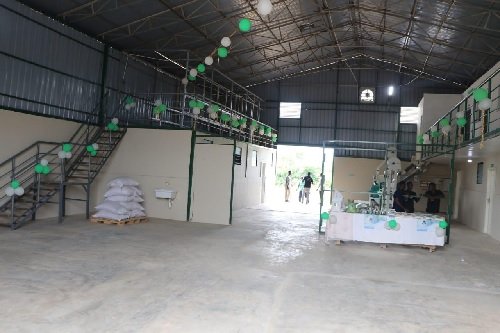
Sited on a two-acre land, the facility, producing ‘Roland Rice, is equipped with a rice mill, de-stoner, a rice de-husker, polisher and a pelletiser machine, also converts rice husk into feed for pigs.
It is expected to create jobs for youth in the Shama District and provide local rice growers access to a mill to improve rice production in the region.
As part of GrEEn project objectives of supporting green businesses and entrepreneurs, SNV Ghana rolled out the GrEEn Innovation Challenge in 2021, to award a matching grant of up to EUR 25,000 to small and medium scale businesses that have innovative products and services.
Key areas include agriculture, renewable energy and energy efficiency and Water, Sanitation and Hygiene (WASH).
Jesse Roland Prah Enterprise, a rice farmer, was among 12 SMEs in the Ashanti and Western regions, who received the matching grant of 25,000 Euros.
Additionally, it received six-month free business advisory support from SNV Ghana under the GrEEn Incubation Programme facilitated by Duapa Werkspace, a business hub in Takoradi.
Speaking at the ceremony last Friday, Senior Adviser, Incubation and Acceleration at SNV, Ms. Genevieve Parker-Twum, remarked “Jesse, has really done well. He took all that he was taught to good use. From EU, SNV Ghana, we say congratulations to Roland rice”.
Chief Executive, Jesse Prah Enterprise (Roland Enterprise), Roland Prah, said: “We have the finest and most nutritious rice in the country, and with this facility, production is going to increase. I want to encourage the youth to invest in agriculture.”
He expressed his gratitude to SNV Ghana and the EU for their support.
Western Regional Minister, Mr Kwabena Okyere Darko-Mensah, said government believed in production, and that, if the private sector was supported, it could go far.
From Clement Adzei Boye, Anto


The Office of the Special Prosecutor (OSP) has taken note of public allegations of extortion and related conduct made against the Minority Leader of Parliament, Alexander Afenyo-Markin.
The allegations were made by the Chief Executive of the Ghana Gold Board (GoldBod), Sammy Gyamfi.
In a brief statement, the OSP said it has also received a joint petition submitted by two persons, as well as two separate petitions from other persons, in relation to the same allegations.
“Given the nature of the allegations, the OSP will assess the case and determine whether it falls within its statutory mandate and whether further investigative action is warranted,” the statement said.
The development comes amid a heated public feud between the Minority in Parliament and the leadership of GoldBod over the operations of the Domestic Gold Purchase Programme.
The Minority, led by Afenyo-Markin, has accused GoldBod and the Bank of Ghana of causing a loss of over $1.7 billion, citing the International Monetary Fund’s August 2026 report. The Minority has vowed to pursue the matter as Parliament has reconvened for an emergency sitting.
GoldBod, on the other hand, has rejected claims by some NPP MPs, including Tano South MP Dr Gideon Boako, that it owes the Bank of Ghana GH¢1 billion in overdrafts, describing the claim as “false and malicious.”
In the latest twist, GoldBod CEO Sammy Gyamfi has accused the Minority Leader of extortion and related conduct, an allegation that has triggered petitions to the OSP.
The OSP is mandated under Act 959 to investigate and prosecute specific cases of alleged or suspected corruption and corruption-related offences involving public officers and politically exposed persons.
By Edem Mensah-Tsotorme

General Secretary of the New Patriotic Party (NPP), Justin Kodua Frimpong, has filed his nomination to contest the position of General Secretary again as the party begins its rebuilding efforts ahead of the 2028 general elections.
He was accompanied by party stalwarts and supporters who were in high spirits, expressing confidence that he is the right person to hold the position.
Speaking after filing his nomination, Mr Kodua Frimpong assured the rank and file of the party that he would not disappoint them.
“I can assure you that the faith the rank and file of the party have had in me, I will never disappoint them,” he said.
He also pledged to run a clean campaign devoid of personal attacks.
“I can assure you that our internal campaign will be devoid of personal attacks,” he told his fellow contestants and the rank and file of the party as he seeks to retain his position.
His tenure has seen the party through the 2024 general elections, where the NPP lost power to the National Democratic Congress (NDC) after eight years in government.
The party is currently in a rebuilding phase, with internal elections scheduled to elect new national executives to lead its reorganization towards the 2028 polls.
The General Secretary position is considered one of the most influential in the party’s administrative structure, responsible for the day-to-day running of the party secretariat and implementation of party decisions.
By Edem Mensah-Tsotorme