Hot!
Ghana’s COVID-19 recoveries hit 10,473 …records 85 deaths with 14,007 confirmed cases

- /home/u249204778/domains/spectator.com.gh/public_html/wp-content/plugins/mvp-social-buttons/mvp-social-buttons.php on line 27
https://spectator.com.gh/wp-content/uploads/2020/06/Recovery-Recovery-Dr-Patrick-Kuma-AboagyeD-GGHS-.jpg&description=Ghana’s COVID-19 recoveries hit 10,473 …records 85 deaths with 14,007 confirmed cases', 'pinterestShare', 'width=750,height=350'); return false;" title="Pin This Post">
- Share
- Tweet /home/u249204778/domains/spectator.com.gh/public_html/wp-content/plugins/mvp-social-buttons/mvp-social-buttons.php on line 72
https://spectator.com.gh/wp-content/uploads/2020/06/Recovery-Recovery-Dr-Patrick-Kuma-AboagyeD-GGHS-.jpg&description=Ghana’s COVID-19 recoveries hit 10,473 …records 85 deaths with 14,007 confirmed cases', 'pinterestShare', 'width=750,height=350'); return false;" title="Pin This Post">
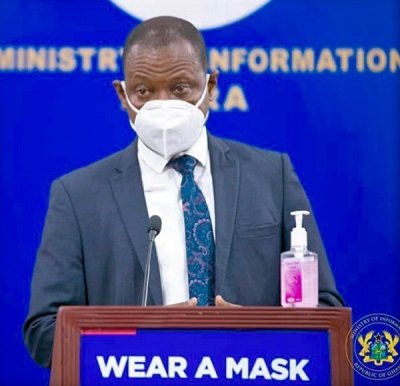
Ghana’s recovery rate for COVID-19 has skyrocketed to 10,473 from 4,548 following an amendment of the Ghana Health Service (GHS)’s national discharge policy.
The reform which is in conformity with the World Health Organisation (WHO) guidelines allows for asymptomatic patients who are admitted to go home 14 days after treatment without a second test.
For symptomatic patients, if they respond to treatment 14 days after testing positive, they are discharged after a further three days without showing any symptoms.
However, a second test would be conducted on discharged patients from home.
Per a latest update on its website, 15 more casualties have been recorded shooting the death toll to 85 as the national case count hits, 14,007.
With the high number of discharges and recoveries, Ghana’s active case now stands at 3,449.
Of the number, 22 are in severe conditions, six in critical state and five on ventilators at the various treatment centres.
A regional breakdown between March and June this year has 6,068 out of 7,860 persons who tested positive in the Greater Accra Region recovered and discharged.
About 1,760 patients of the 2,637 cases recorded in the Ashanti Region have been discharged, 950 from the Western Region, 619, Central, and 251 from the Volta Region.
The Eastern Region has 209 out of its 358 patients recovered, Western North, 57, Northern 32, Upper East 23, Oti 21 and Bono East Region with 13 patients recuperated.
The Upper West, Savannah and Bono regions have 100 per cent recovery with the North East recording a 50 per cent recovery rate as one person has improved of the two cases recorded there.
The Ahafo Region on the other hand is yet to have any of its eight cases improved or discharged.
The WHO, in new studies, has established that after 10 days of the disease onset, the virus may not be infectious and asymptomatic patients may not be active carriers hence their chances of spread is extremely limited because they do not sneeze or cough.
Source: Ghanaian Times



The Tema Regional Police Command has arrested a 32-year-old man for allegedly posing as a soldier and extorting money from unsuspecting members of the public at Ashaiman.
The suspect, identified as Bright Atsu Kudiabor, was arrested by the Ashaiman Police on Wednesday, September 16, 2026, at about 7:00 a.m.
According to the Police, he was arrested at an area known as “I Shall Return”, where he was allegedly parading himself as a soldier and demanding money from people.
The Police said Kudiabor, who is an ex-convict, was initially arrested by personnel of the Ghana National Fire Service in Ashaiman with assistance from other members of the public.
A search conducted on him after he was handed over to the Police reportedly led to the recovery of a set of military camouflage uniform.
The suspect is currently in Police custody and assisting with investigations.
The Tema Regional Police Command said he would be processed for court after investigations are completed.
The Police urged the public to remain vigilant and report anyone who falsely presents themselves as a soldier or a member of another security agency to deceive or extort money from the public.
By: Jacob Aggrey

Volta Regional Minister, James Gunu, says the Volta Region holds enormous agricultural potential and efforts must be geared towards connecting farmers to the needed resources to unlock that potential.
He said focus must be on linking farmers to resources, technology, financing and markets to increase production, create jobs and build sustainable livelihoods.
Hon. Gunu made the remarks at the national launch of the Ghana Tomato Self-Sufficiency Initiative (GHATSI) held at Anloga in the Volta Region on Tuesday, September 15.
The initiative, under the theme “Produce at Home. Feed the Nation. Export the Surplus,” seeks to boost local tomato production, processing and marketing while reducing Ghana’s heavy reliance on imported tomatoes.
The launch was attended by the Minister for Food and Agriculture, Eric Opoku, his Deputy, John Setor Dumelo, Feed Ghana Coordinator, Bright Demordzi, Members of Parliament, traditional leaders, MMDCEs, farmers and other stakeholders.
Mr.Gunu expressed appreciation to the Minister for Food and Agriculture for the support announced for the region, including two excavators, 200 cartons of organic fertiliser, and GH¢200,000 for Ms. Kuatudzo Esther Dela, a tomato farmer and processor from Ziope.
He described the initiative as an important step towards making agriculture a stronger driver of food security, job creation and economic growth in the Volta Region.
By Edem Mensah-Tsotorme