Features
What booze can do to you


Ethanol, the chemical compound present in most alcoholic drinks, is a neurotoxin, that is, a substance that can damage or destroy the nervous system. Someone who is drunk is, in fact, suffering from a form of poisoning.
In large quantities, ethanol causes coma and death. For instance, among students in Japan, the practice of ‘ikkinomi, or alcohol chugging, causes deaths every year.
The body is able to convert ethanol into harmless substances, but this is not accomplished immediately. If alcohol is consumed at a faster rate than the body can handle, ethanol builds up in the system and begins to interfere noticeably with brain function. In what way?
Speech, vision, coordination, thought, and behaviour are all connected with an incredibly complex series of chemical reactions in the brains neurons, or key cells. The presence of ethanol modifies those reactions, suppressing or enhancing the role of certain neutrontransmitters chemicals that relay signals from neuron to neuron.
The stream of information in the brain is thus altered, preventing the brain from functioning normally. That is why when a person drinks too much, he or she develops slurred speech, blurred vision, sluggish movement, and weakened behavioural restraints and inhibitions, all common symptoms of intoxication.

EXPOSURE
With prolonged exposure to alcohol, brain chemistry adapts to counter the poisonous effect of ethanol and to maintain normal nerve function. This leads to tolerance, whereby the same amount of alcohol has less of an effect than it would have had previously.
Dependence occurs when the brain has adapted so much to the presence of alcohol that it cannot operate properly without it. The body craves alcohol to maintain the chemical balance.
When a person is deprived of alcohol, his brain chemistry is totally destabilised and withdrawal symptoms, such as anxiety, trembling, or even seizures, set in.
Besides causing modifications of brain chemistry, alcohol abuse can lead to cell atrophy and destruction, altering the brain’s very structure. While partial recovery is possible with abstinence, some of this damage seems to be irreversible.
Neurons that die are apparently never replaced, further affecting memory and other cognitive functions.
Damage to the brain is not just the result of long term exposure to alcohol.
Research seems to indicate that even relatively short periods of alcohol abuse can be harmful.
LIVER DISEASE
AND CANCER
The liver plays a vital role in metabolising food, combating infection, regulating blood flow and removing toxic substances, including alcohol, from the body.
Prolonged exposure to alcohol damages the liver in three stages. During the first state, the breaking down of ethanol slows the digestion of fats, causing them to build up in the liver.
This is called steatohepatitis, or fatty liver. In time, chronic inflammation of the liver, or hepatitis, sets in. While alcohol can cause hepatitis directly, it also appears to lower the body’s resistance to Hepatitis B and Hepatitis C viruses.
If unchecked, inflammation causes cells to burst and die. Compounding this damage, alcohol seems to trigger the natural system of programmed cells death called apoptosis.
This final stage is cirrhosis. The vicious cycle of continuous inflammation and cell destruction causes irreversible scarring. Eventually, the liver becomes humpy, instead of remaining spongy.
Finally, scar tissue prevents blood from flowing normally, leading to liver failure and death.
Alcohol’s effect on the liver has another insidious side effect -the liver is less capable of playing its defensive role in counteracting the effect of cancer-forming agents.
In addition to favouring the development of cancer of the liver, alcohol greatly increases the risk of cancer of the mouth, the pharynx, the larynx, and the oesophagus.
What is more, alcohol makes the mucous membranes in the mouth more easily penetrated by cancerous substances in tobacco, elevating the risk for smokers.
Women who drink daily are at greater risk of breast cancer. According to one study, the risk for those who drank three or more alcoholic beverages per day was 69 per cent higher than that of nondrinkers.
POISONED BABIES
A particularly tragic outcome of alcohol abuse is its effect on the unborn. “Alcohol is far worse for the developing fetus than any other abused drug,” reported by the ‘International Herald Tribune.’
When a pregnant woman drinks, her developing chin also drinks and the toxic effect of alcohol is especial, devastating at this format stage of the fetus.
Alcohol causes irreversible damage to its central nervous system. Neurons do not form properly. Cells are killed off. Other cells end up located in the wrong place.
The result, fetal alcohol syndrome (FAS), is the foremost cause of mental retardation in newborns. Difficulties encountered by FAS children include intellectual impairment, language problems, developmental delay, behavioural dysfunction or deficit, slow growth, hyper activity, and hearing and sight disorders. Many babies are also born with characteristic facial deformities.-Credit: AWAKE
This article was first published on Saturday, November 5, 2005





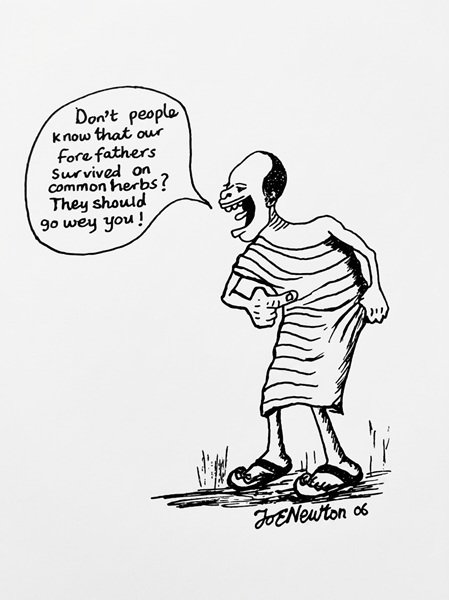
THE typical itinerant salesman in Sikaman is a herbalist. He is normally a slim macho with the capacity to perambulate the expanse of area covering the triangle of Accra-Tema-Ashiaman. In short, he can walk a total of 60 miles a day, marketing a product that cures every disease, including poverty. 
The door-to-door herbal pharmacist advertises his product by word of mouth. He has nothing to do with the Food and Drugs Board (FDB). After all, his concoctions do not feature on FM stations.
Those herbalists who cannot walk to propagate the herbal gospel, liaise with drivers of mass transportation and their mates. They are, therefore, given the chance to sell their products on Benz buses that ply the routes.
Normally, the herbalist starts his sales message with a prayer and Bible study. He asks the passengers to bow down their heads in supplication to God the father, the son, the Holy Spirit.
When a herbalist asks the passengers to close their eyes and bow their heads, Moslems on board naturally feel offended. They feel that the herbalist has no right to assume that every passenger is a Christian. They think such an assumption is an affront to Islam.
So a Moslem on board will raise the hand for a point of order. He’ll remind the herbalist that it would be in his own interest to mind his language.
“Be careful the way you address people in a public place. Not every person here is a Christian,” he’d state assertively.
Of course, the herbalist will promptly ignore him, but would all the same “watch” his tongue. Who knows whether or not the Moslem brother is inspired by Quoranic zeal to defend the tenets of Islam to the hilt?
When he starts saying, “Wallahi!” and “Inshallah!” it could be the beginning of proclaiming Islam as supreme, a point which must be driven home with talibanic precision.
So the herbalist must tread carefully lest he steps on fire.
The herbalist could even add a measure of mirth to it all, by announcing that Christians on board today have very interesting company on the journey, but that should not detract from the business of the day.
The Moslem brother will weigh the words carefully and offer a wry smile.
He must be careful the occasion does not degenerate into the use of semantics and proverbial oration to deride his conviction that public utterances must be mindful of religious sensibilities. He has made his point very clear and expects that it is taken in good faith in the interest of a peaceful journey.
The herbalist will now open the New Testament and preach salvation, stating clearly that salvation can come only through Jesus Christ and NOBODY else.
The Moslem brother will now start twitching his moustache. The visible and almost revolutionary reflexes of his upper lip can be an indication that sentiments have begun superseding reason, and the outcome could well be tragic now shift uneasily in his seat.
The time has come for him to also express his right to the religion of his fore-bears. He’ll put his hand into his pocket and rise to his feet. The time has indeed come!
This article was first published on Saturday, September 9, 2006
When the cause of a particular problem like sickness, disease, sudden illness, a social issue etc. are not known, it stands to reason that resolving it becomes a huge challenge.
Citizens would understand the government when public announcements are made to the effect that government is trying to find a solution to the issue, even though it is taking a while for it to be resolved because citizens are rational beings.
On the other hand, if the solution to a particular issue is known to everybody but the government for whatever reason, is dragging its feet in resolving it, citizens become frustrated and begin to lose trust in their leaders.
One such issue is the heavy traffic along a section of the Kasoa – Odokor road. A short stretch of bad road between the traffic light at the Weija Government Hospital and the entrance to the entrance of the overhead that leads to the N1, is the cause of the problem but nothing is being done about it, day after day, week after week, month after month. Thus is clearly unacceptable.
Another issue that requires urgent attention is the lack of pavements along a lot of streets in parts of the various Municipal Assemblies. Exercise is a prerequisite for long life and healthy living and for those of us who it has become a way of life, this issue of people putting up structures right to the edge of the drains beside the roads, are making life difficult for us.
We are compelled to walk along the roads, putting our lives at serious risk. Pedestrians should never be compelled to compete with vehicles on our streets and roads. Roads and streets are made for vehicles and pavements are made for pedestrians. That is the norm. Any attempt to normalise a situation where pedestrians are mingling with vehicles is insanity.
It is the road regulations that makes it so and therefore district or municipal assemblies are to take responsibility and ensure that spaces for pavements are not encroached upon. Citizens have rights that must be protected by their leaders and making pavements available to pedestrians, is one of them.
When we hear of teachers having sex with students, it appears it is something recent. It is not a new phenomenon. It has been there since Adam. Perhaps this issue is getting much attention due to the proliferation of social media. It was an open secret in times past when Teachers were in relationships with female students and some married them immediately after completion of school.
Some teachers were also known to be having unholy interactions with female pupils but due to the times that these acts occurred, human rights issues and the awareness around it, allowed such unscrupulous teachers to get away with their crimes.
Now we are in a different era and so a Headmaster is now in hot waters. He is alleged to have raped about 19 female students and as usual, some officials tried to cover it up and are also in hot waters and their actions or inactions in the matter are under investigation.
Why the man has been allowed to roam freely without being arrested is simply mind boggling. It appears that the law applies differently, depending on who you are. This issue came to public attention sometime in August this year, yet the police had not arrested or invited this man for question regarding the rape allegation.
It has come out that he is a Constituency Secretary of the ruling party and the question in the public domain is that, is it because he is a political figure that is why he is still walking around without questioning? I believe in the rule of law so let us hold our breadth and let the proper thing be done.
The police must however be seen to be active in this matter. God bless.
SKIP THE QUEUE, TAP THE NEWS
You can now read the Ghanaian Times and The Spectator newspapers from the comfort of your device via TimesNewsPlus.
Join our WhatsApp Channel: https://whatsapp.com/channel/0029VbBElzjInlqHhl1aTU27