News
UNODC partners GFA Foundation on Prison advocacy and mentorship programme

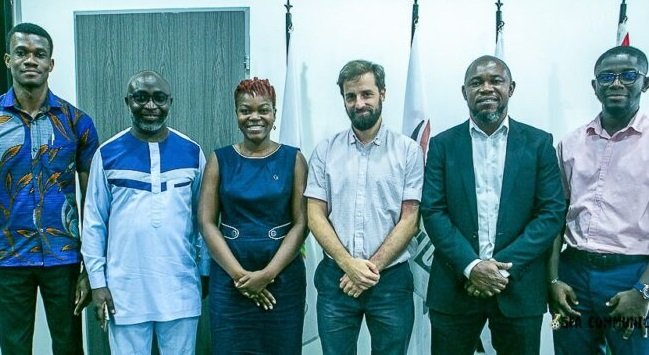
The GFA Foundation and the United Nations Office on Drugs and Crime (UNODC) have agreed to work together to advocate for anti-discrimination and the elimination of stigmatization for prisoners and prisons.
This partnership was agreed, in principle, during a meeting at the Home of Football (GFA Head Office) between the Director of the GFA Foundation and the UNODC Team led by Mr. Christoph Capelle, an Associate Expert in Crime Prevention and Criminal Justice and the Coordinator of the prison and penal reform project in Ghana.
Welcoming the Team to the Home of Football, the Director of the GFA Foundation, Mr. Malcolm Frazier Appeadu briefed the team about the GFA Foundation – Ghana Prisons Project which has covered 6 prisons across the country already.
He indicated that the Foundation is liaising with the Ghana Prisons Service to commence the second and third pillars of the project, which are the coaches and referees training programs as well as the advocacy and mentorship initiatives.
He said that the GFA Foundation will welcome partners for the execution of the second phase of the project which will include Ankaful Maximum Security Prison, Kumasi Central Prison, Sekondi Central Prison and three other prison facilities.
In his response, Mr. Christoph Capelle commended the GFA for the GFA Foundation – Ghana Prisons Project which seeks to use the power of football to promote the wellbeing, reformation, rehabilitation and reintegration of inmates of Ghana’s prisons into society.
Mr. Capelle said that UNODC is looking forward to a collaboration with the GFA Foundation on possible programs for both the medium and long term to support football and sports jobs and skills development in Ghana’s prisons.
He extended an invitation to the GFA Foundation to be part of an assessment of overall prison rehabilitation programmes including the use of sports by their international consultant at the Ankaful Maximum Security Prison.
There will be a football match and donation of footballs, sports items and equipment to the prison facility.
Present at the meeting were Mr. Kwame Koramoah, an officer at the GFA Foundation and Integrity Office, Helena Adobea Ofori, Associate Programme Officer, UNODC and Caleb Elorm Agodzo, Administrative Officer, UNODC.
It will be recalled that in 2020, The UNODC and FIFA signed a Memorandum of Understanding (MOU) to tackle corruption and crime in and through sports and pledged to consider ways in which football can be used as a vehicle to strengthen youth resilience to crime and substance use through the provision of life skills training.
The MOU was renewed last year by FIFA President Gianni Infantino and UNODC Executive Director Ghada Waly in New York on the sidelines of the United Nations General Assembly.

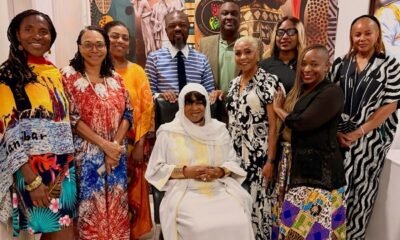






The Diaspora Affairs Office at the Office of the President has hosted a delegation of African diaspora women who are in Ghana ahead of a planned Presidential Conferment of Citizenship ceremony.
The Director of Diaspora Affairs, Kofi Okyere Darko, explained in a Facebook post that the visit was a gesture of appreciation by the delegation to the Government of Ghana for its continued efforts to reconnect Africans in the diaspora with their ancestral homeland.
He indicated that the ceremony, scheduled for next Monday, will officially grant Ghanaian citizenship to members of the delegation as part of the country’s broader engagement with the African diaspora.
The delegation was led by Erica Bennett, Founder of the Diaspora Africa Forum.
According to Mr Okyere Darko, her years of advocacy have played an important role in strengthening ties between Africa and people of African descent living abroad.
He noted that the group’s journey towards citizenship represents not only a legal process but also a cultural and spiritual return to their roots.
Also present at the meeting was Natalie Jackson, an attorney who is also expected to receive Ghanaian citizenship during the ceremony. She works closely with renowned civil rights lawyer Ben Crump.
Mr Okyere Darko emphasised that Ghana remains committed to strengthening relationships with the African diaspora and promoting unity, identity, and shared heritage among people of African descent worldwide.
By: Jacob Aggrey

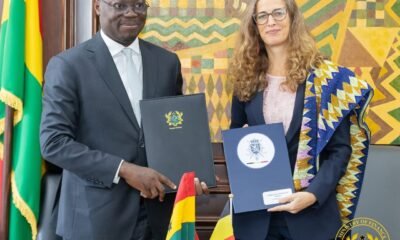
Ghana has signed a debt restructuring agreement with the Kingdom of Belgium as part of efforts to restore the country’s economic stability after the financial crisis that hit the nation in 2022 and 2023.
The Minister of Finance, Cassiel Ato Forson, today disclosed that he signed the agreement on behalf of the Government of Ghana.
He explained that Ghana experienced a very difficult period during the crisis, which forced the government at the time to declare a debt default.
However, he indicated that the country is now recovering and witnessing a significant economic turnaround.
According to him, stronger systems are also being put in place to ensure that Ghana does not return to such a situation again.
Dr Forson noted that the agreement with Belgium is the eighth deal Ghana has concluded with countries under the Official Creditor Committee as part of its external debt restructuring programme.
He expressed appreciation to the Government of Belgium for its support and partnership with Ghana during the process.
The Finance Minister thanked Carole van Eyll, Ambassador of Belgium to Ghana, for her role in strengthening relations between the two countries.
The agreement forms part of Ghana’s broader effort to restructure its external debts and stabilise the economy following the crisis.
By: Jacob Aggrey

 News1 week ago
Finance Minister outlines new gold policies to boost reserves and curb smuggling
- News1 week ago
Sam George launches the 2026 Meteorological Awareness Month; presents the 2026 seasonal forecast for southern Ghana
- Hot!1 week ago
Breaking: Footballer who killed two children in Abesim handed lifetime sentence