Hot!
Uganda signs anti-LGBTQ bill into law

- /home/u249204778/domains/spectator.com.gh/public_html/wp-content/plugins/mvp-social-buttons/mvp-social-buttons.php on line 27
https://spectator.com.gh/wp-content/uploads/2023/05/FxR-TvcX0AIlqoh.jpg&description=Uganda signs anti-LGBTQ bill into law', 'pinterestShare', 'width=750,height=350'); return false;" title="Pin This Post">
- Share
- Tweet /home/u249204778/domains/spectator.com.gh/public_html/wp-content/plugins/mvp-social-buttons/mvp-social-buttons.php on line 72
https://spectator.com.gh/wp-content/uploads/2023/05/FxR-TvcX0AIlqoh.jpg&description=Uganda signs anti-LGBTQ bill into law', 'pinterestShare', 'width=750,height=350'); return false;" title="Pin This Post">
The new law contains a provision that would punish “aggravated homosexuality” with the death penalty. The legislation has been met with broad international condemnation.
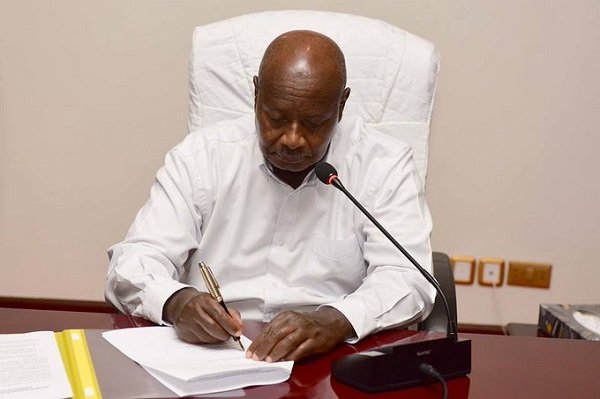
gandan President Yoweri Museveni signed new anti-LGBTQ legislation on Monday.
Museveni “has assented to the Anti-Homosexuality Bill 2023. It now becomes the Anti-Homosexuality Act 2023,” the Ugandan presidency said on Twitter.
Uganda’s ‘Anti-Homosexuality Act’
Uganda’s head of state had called on lawmakers to amend the bill, and a new draft of the legislation was presented earlier this month.
The amended version clarifies that merely identifying as gay would not be cause for imprisonment.
Museveni had also advised lawmakers to remove a provision that made “aggravated homosexuality” subject to capital punishment, but this suggestion was rejected by Uganda’s parliament. The provision pertains to repeat offenders and those found to have had sex while HIV-positive.
Uganda has not carried out capital punishment in many years.
Same-sex relations were already illegal in Uganda under a law that dates back to the British colonial period.
Uganda enacts harsh anti-gay law with death penalty | Watch (msn.com)
The new law introduces a 20-year sentence for “promoting” homosexuality.
“With a lot of humility, I thank my colleagues the Members of Parliament for withstanding all the pressure from bullies and doomsday conspiracy theorists in the interest of our country,” parliament speaker Anita Among said.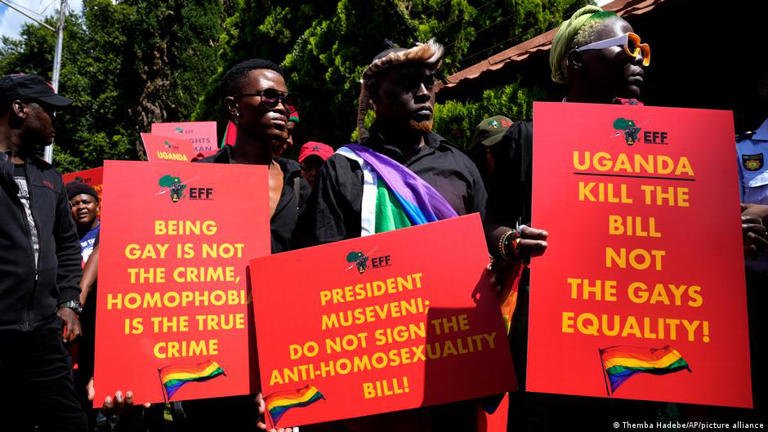
However, Ugandan LGBT rights activist Clare Byarugaba said it was “a very dark and sad day for Uganda.
“We shall continue to fight this atrocious legislation through the judiciary until human rights for all are upheld,” she said.
“We shall win, because as Martin Luther King Jr. reminded us, the moral arc of the universe always bends towards justice.”
Law draws international condemnation
The new law has been widely condemned by rights groups and Western countries.
US President Joe Biden slammed the new legislation, branding it a “tragic violation of universal human rights.” He threatened to cut US aid and investment in Uganda, calling for the law’s immediate repeal.
The Global Fund to Fight AIDS, Tuberculosis and Malaria, the UN’s HIV/AIDS program and the US AIDS relief program all expressed concern over the harmful impact of the newly signed law.
Amnesty International said that the law “flagrantly violates the human rights of LGBTI people in Uganda, including the right to a private life, protection against discrimination and the right to equal protection before the law.”
The British Foreign Office said it was “appalled” by the new law, while Canada’s foreign minister called it “abhorrent, cruel and unjust.”
International partnerships under threat
The new law has also jeopardized Uganda’s international standing.
“This law is contrary to international human rights law and to Uganda’s obligations under the African Charter on Human and People’s Rights, including commitments on dignity and non-discrimination, and the prohibition of cruel, inhuman or degrading punishment,” EU foreign policy chief Josip Borrell said in a statement.
“The Ugandan government has an obligation to protect all of its citizens and uphold their basic rights. Failure to do so will undermine relationships with international partners.”
When Museveni signed a less restrictive anti-LGBTQ law in 2014, Western governments suspended some aid, reduced security cooperation with Uganda and imposed stronger visa restrictions on its citizens.
Source: zc, sdi/kb (Reuters, AFP, AP)


General Secretary of the New Patriotic Party (NPP), Justin Kodua Frimpong, has filed his nomination to contest the position of General Secretary again as the party begins its rebuilding efforts ahead of the 2028 general elections.
He was accompanied by party stalwarts and supporters who were in high spirits, expressing confidence that he is the right person to hold the position.
Speaking after filing his nomination, Mr Kodua Frimpong assured the rank and file of the party that he would not disappoint them.
“I can assure you that the faith the rank and file of the party have had in me, I will never disappoint them,” he said.
He also pledged to run a clean campaign devoid of personal attacks.
“I can assure you that our internal campaign will be devoid of personal attacks,” he told his fellow contestants and the rank and file of the party as he seeks to retain his position.
His tenure has seen the party through the 2024 general elections, where the NPP lost power to the National Democratic Congress (NDC) after eight years in government.
The party is currently in a rebuilding phase, with internal elections scheduled to elect new national executives to lead its reorganization towards the 2028 polls.
The General Secretary position is considered one of the most influential in the party’s administrative structure, responsible for the day-to-day running of the party secretariat and implementation of party decisions.
By Edem Mensah-Tsotorme

The University of Ghana Medical Centre (UGMC) has disputed claims made on social media by comedian Michael Blackson concerning the treatment given to his late mother, saying a review found that the allegations did not accurately reflect what happened during her stay at the hospital.
In a statement issued in Accra on August 5, 2026, the management of UGMC expressed condolences to Mr. Blackson and his family over the death of his 83-year-old mother, who died at the facility on July 16, 2026.
The hospital said it had taken the concerns raised by Mr. Blackson seriously and conducted a thorough review in line with its clinical and administrative procedures.
According to the statement, the facts presented by Mr. Blackson on social media contained “numerous inaccuracies” and did not accurately reflect the medical care provided to his mother.
UGMC explained that she was referred to the facility from another hospital and received treatment there from May 27 to July 16, 2026, a period of about eight weeks.
The hospital stated that it would not release details of her diagnosis, treatment, medical records or other aspects of her care because it had a duty to protect patient confidentiality, even after death.
It said the decision was intended to respect the dignity of the deceased and the privacy of her family.
UGMC further stated that all clinical decisions at the facility are made by qualified healthcare professionals based on medical judgment, established standards of care and the best interests of the patient.
The statement added that such decisions are made in consultation with authorised family representatives where necessary and that billing and financial procedures are governed by institutional policies and are separate from clinical decision-making.
The hospital noted that it values feedback from patients and their families and considers both positive and negative comments important for improving the quality of care.
Mr. Blackson had earlier used social media to criticise the care his mother received at UGMC, prompting the hospital’s response.
By: Jacob Aggrey