News
Two groups support Moses Bentum…but he still needs help

- /home/u249204778/domains/spectator.com.gh/public_html/wp-content/plugins/mvp-social-buttons/mvp-social-buttons.php on line 27
https://spectator.com.gh/wp-content/uploads/2021/04/Moses-Bentum.jpg&description=Two groups support Moses Bentum…but he still needs help', 'pinterestShare', 'width=750,height=350'); return false;" title="Pin This Post">
- Share
- Tweet /home/u249204778/domains/spectator.com.gh/public_html/wp-content/plugins/mvp-social-buttons/mvp-social-buttons.php on line 72
https://spectator.com.gh/wp-content/uploads/2021/04/Moses-Bentum.jpg&description=Two groups support Moses Bentum…but he still needs help', 'pinterestShare', 'width=750,height=350'); return false;" title="Pin This Post">
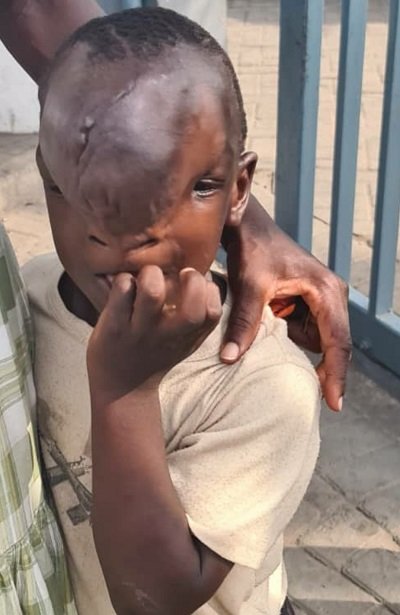
Following The Spectator’s publication on the plight of six-year-old Moses Bentum who is unable to attend school due to his facial deformity, two groups have moved in to offer some financial support.
They are members of the 2004 Year Group of the Accra Training College (ATRACO) and social group ‘XXVI Planners’ based in Madina who have donated a total amount of GH¢ 2,000 to support his medical bills.
Both donations were to pay for an MRI scan which according to his mother, Ms. Felicia Setuagbe, would among others determine the extent of damage done to his head and how much would be needed for the two surgeries he has to undergo to correct his face.
The rest of the money would also take care of some initial expenses and his upkeep in readiness for the process ahead.
The Group Leader of the 2004 ATRACO year group, Ms Vivian Adegbedu, said as teachers who handled children, they were sad to hear that Moses couldn’t go to school because of his condition hence their decision to support him with their widow’s mite to enable him to join his friends in school and also live a happy life, after surgery.
A Representative of the XXVI Planners, Xorlali Tettey, also said they were touched by the plight of the boy and as parents, they felt the need to do the little they could to support Moses and his mother in such challenging times.
Moses’ mother, Ms. Setuagbe, expressed appreciation to both groups and asked for God’s blessings for them.
She, however, asked that the group should return to support them when the bill for the two surgeries Moses has to undergo is given by the Korle-Bu Teaching Hospital so that her son could live a normal life.
She further called on public spirited persons to help her son who was diagnosed of brain tumour months after delivery to smile because his situation had always made him sad, timid and shy.
Moses was diagnosed of a brain tumour in his childhood and has undergone surgery three years ago in India to stop further growth of the the tumour. Currently, he needs two more surgeries to put his face in shape.
From Dzifa Tetteh Tay, Tema

News
Two petition police to investigate Nitiwul over alleged inflammatory comments on Agbogbloshie redevelopment

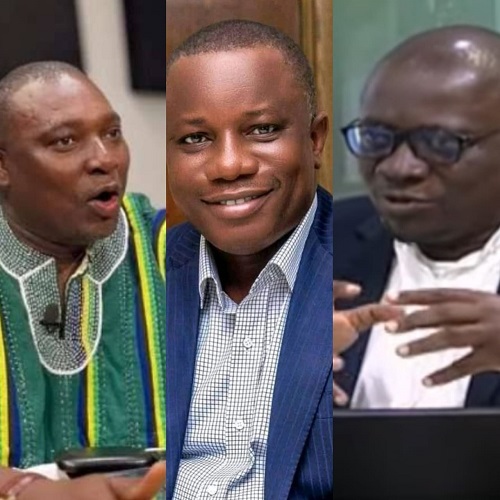
Two Ghanaian citizens, Solomon Owusu and lawyer Andrew Appiah-Danquah, have petitioned the Criminal Investigation Department (CID) of the Ghana Police Service to investigate the Member of Parliament for Bimbilla, Dominic Nitiwul, over comments he allegedly made about the redevelopment of the Konkomba Yam Market at Agbogbloshie in Accra.
In the petition dated September 16, 2026, the two accused Mr Nitiwul of making public statements that they believe could provoke ethnic tensions, cause fear and alarm, and disturb the public peace.
They are asking the police to invite the former Defence Minister to assist with investigations into a video of his remarks that has been circulating on social media and other electronic platforms.
According to the petitioners, their concern is not that Mr Nitiwul criticised the government or the proposed redevelopment of the market.
Rather, they object to what they describe as his repeated presentation of the redevelopment exercise as an action deliberately targeting members of the Konkomba ethnic group.
They cited comments in which he questioned why the area occupied by Konkombas had been marked for the proposed 24-hour market while other areas had allegedly been left untouched.
They quoted him as asking what the Konkombas had done to the government and whether they were not Ghanaians.
The petitioners further cited his call on President John Dramani Mahama to stop the Accra Mayor from “targeting the Konkomba tribe”.
They pointed to his comments that the affected traders were “not moving tomorrow” and should “continue to bring their yams”.
According to the petition, Mr Nitiwul warned that it would be “politically suicidal” for President Mahama to allow the Mayor to proceed with the proposed action.
The two petitioners argued that the statements could create the impression that the government and the Accra Metropolitan Assembly (AMA) were deliberately seeking to discriminate against or remove Konkombas from Accra.
They said such a perception could heighten tensions between traders and public officials, particularly if authorities proceed with enforcement or demolition activities at the affected location.
The petitioners identified possible risks including confrontation, resistance to lawful administrative measures, damage to property, injuries, mobilisation along ethnic lines and a disturbance of public peace.
Call for investigation under Criminal Offences Act
Owusu and Appiah-Danquah are asking the CID to investigate whether Mr Nitiwul’s statements could amount to offences under sections 207 and 208 of the Criminal Offences Act, 1960 (Act 29).
They cited Section 207, which deals with the use of threatening, abusive or insulting words or behaviour in circumstances where a breach of the peace is intended or likely to occur.
They referred to Section 208, which concerns the publication of statements, rumours or reports that are likely to cause fear and alarm or disturb the public peace where the person publishing them knows or has reason to believe they are false.
The petitioners stressed that they were not asking the police to presume Mr Nitiwul’s guilt.
They said the purpose of the investigation should be to establish the facts, including whether the claims he made about the redevelopment were accurate.
Petitioners want site plans and documents examined
They have asked the CID to obtain and examine the official redevelopment plans, site plans, affected-property schedules, demolition or relocation notices and relevant maps.
They want the police to inspect the affected area independently to determine which structures and adjoining areas have been marked for the project.
The petitioners further want the CID to speak with officials of the AMA, including the Mayor and officers responsible for the redevelopment, as well as leaders and members of the Konkomba Yam Market and people operating in adjoining areas.
They are also asking investigators to determine whether the redevelopment exercise affects only members of the Konkomba community or whether people and structures belonging to other groups are also affected.
Call for examination of Nitiwul’s sources
The petitioners want Mr Nitiwul to provide the information and documents on which he relied before making the allegations.
They are asking the police to establish whether he personally inspected the entire proposed project area, whether he sought clarification from the AMA and whether he knew that people outside the Konkomba community were also affected.
They want investigators to determine what steps he took to verify the accuracy of his claims before making them public.
The petitioners have asked the police to assess the circulation and impact of the video, including whether it generated fear, hostility, mobilisation or threats of resistance.
They further urged the police to take preventive measures if necessary to avert confrontation, ethnic tension or a breach of the peace at the affected location.
Constitutional rights
The two petitioners acknowledged Mr Nitiwul’s constitutional right to freedom of speech and expression.
They stressed that their petition was not intended to suppress political criticism or dissent, adding that a police investigation would allow the facts surrounding his statements to be established.
They also argued that his position as a sitting MP and former Defence Minister meant that his public comments could have a significant impact on his constituents and members of the affected community.
They noted, however, that the statements were made outside Parliament and should therefore be assessed as public communication rather than statements made during parliamentary proceedings.
The petitioners have asked the CID to register their complaint, provide them with a reference number, preserve and authenticate the full video recording and transcript, and take any further lawful action based on the outcome of the investigation.
They have indicated their readiness to provide the video, transcript, screenshots, links and other relevant documents to assist the investigation.
By: Jacob Aggrey
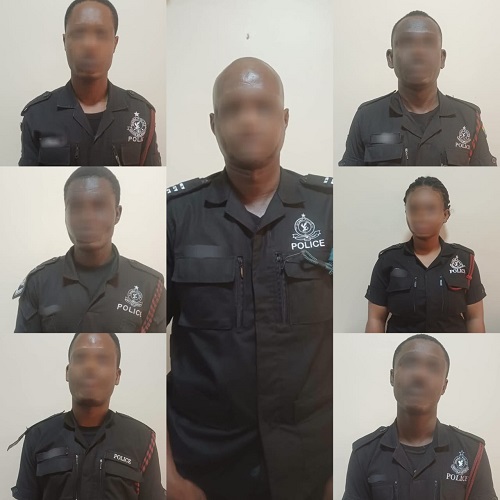
The Ghana Police Service has interdicted seven police personnel in connection with an alleged extortion incident in Accra.
The officers, who were members of a patrol team, are alleged to have demanded money from a victim and compelled him to withdraw the money from an ATM for them.
The interdicted officers are Inspector Courage Boateng, General Sergeant Stephen Addo, General Corporal Moses Anyravi, General Corporal Prosper Adiabo, General Lance Corporal Samuel Anokye, General Constable Henrietta Coleman and General Constable Bernard Amoako.
According to the Police, the interdiction is to make way for an ongoing investigation by the Police Professional Standards Bureau (PPSB).
The Ghana Police Service has assured the public that the matter will be thoroughly investigated and appropriate action taken based on the outcome of the investigations.
By Edem Mensah-Tsotorme

 Entertainment1 week ago
Sarkodie to SarkNation: You don’t have to tear someone down to prove your loyalty
- News7 days ago
Ghanaian journalist celebrates Texas town’s ‘Eden of the Far West’ tag after mayor’s nod
- Entertainment5 days ago
Fiifi Coleman Productions adapt ‘I Told You So’ stage play into feature film