Features
Tackling the brouhaha over non – admission of 499 law school candidates


After Ghana became independence in 1957, the development of Legal Education in the country was discussed leading to the enactment of the Legal Practitioner Act 1958 which gave birth to the General Legal Council (GLC).
The Council was charged with the responsibility of organising legal education in the country and the first African Chief Justice of Ghana, Sir Kobina Arku Korsah, appointed Professor J H Lang, as the first Director of Legal Education and the establishment of courses on instruction. Since then, there has been other satellite campuses at the Kwame Nkrumah University of Science and Technology (KNUST) in Kumasi which is aimed at opening a second School of Law in the Ashanti Region and another campus at the Ghana Institute of Management and Public Administration (GIMPA) near Legon in Accra. The Kumasi campus was officially inaugurated in November 2010 by Her Ladyship Mrs Justice Georgina Theodora Wood, former Chief Justice of Ghana.
THE OBJECTIVE OF THE GHANA SCHOOL OF LAW
The Ghana School of Law located in the heart of the Central Business District (CBD) of Accra, precisely Makola, is the only institution that provides training for law graduates in the Barrister of Law programme. The professional law course is designed for law graduates who have obtained an LLB degree and have passed the entrance examination. On completion of this course, the graduate is qualified to practise law in Ghana. It is instructive to know that persons who have studied law outside the shores of Ghana and have first degree in law, would have to pass through the Ghana School of Law before they can practise the profession in Ghana.That is the requirement by the General Legal Council in Ghana.
ENTRY REQUIREMENT AND THE VISION OF THE SCHOOL
For one to qualify for admission to the Ghana School of Law for the professional law course, he or she must be successful in the entrance examination. There is no way a person can gain an admission to the law school without writing and passing an examination. Applicants who are admitted to undertake the professional law course are enrolled as Barristers at Law and Solicitors of Supreme Court upon their successful completion of the course.
The vision of the Ghana School of Law is to become a Centre of Excellence in Africa and the world at large for professional legal training and research. This laudable vision has by far and large been accomplished since its establishment by Ghana’s first president Osagyefo Dr Kwame Nkrumah in 1958. No wonder, nationals from other neighbouring African countries as well as other advanced foreign countries continue to knock on our doors to seek admission to the school to train as professional lawyers of high repute. The quality of training given to applicants is so high that upon completion of their course, they can work in any parts of the world.
FIRST OF ITS KIND IN SUB-SAHARAN AFRICA
It is interesting to state that the Ghana School of Law is the first of its kind and the leading law school in Sub-Saharan Africa and serves students from other Commonwealth countries in the sub-region. That is why the authorities continue to attach great importance to the quality of applicants who are seeking admission to the school.
CONTROVERSY OVER THE NON ADMISSION OF APPLICANTS
However, in recent times, the school has come under attack for certain acts that tend to undermine its credibility and placing it in a bad light. The school, we are told is putting impediments in the way of applicants who have written the entrance examination and have genuinely passed. If what we are hearing is the gospel truth, then the school must sit up and regularise its operations and put things in order, otherwise it will dent its high reputation in the international circles and earn a bad name.
Recent news circulating all over, especially in the social media indicated that some aggrieved candidates numbering about 499 who claimed to have passed the 2021 entrance examination to the Ghana School of Law, had been unjustifiably denied admission to the school for reasons they are not familiar with. According to the aggrieved candidates, there was no debate that the admission pass mark into the school was 50 per cent which has been the case since the introduction of the entrance exams as a criterion for admission to the GSL sometime in 2012. Additionally, there was equally no debate that the 50 per cent requirement that a candidate had obtained was a culmilative raw score of 50 per cent from the two sections of the paper.
AGGRIEVED CANDIDATES PETITION PRESIDENT
A lead convener of the group, Mr. Tonny Baah, told a news conference in Accra recently that they had petitioned the Office of the President on October 15, 2021 to use his Executive Power to come to their aid in their quest for justice and to vindicate their fundamental human rights as enshrined in Chapter 5 of the 1992 Constitution. He expressed the confident that President Nana Addo Dankwa Akufo-Addo who for all intent and purposes, had proven to be a renowned human rights lawyer and freedom fighter, would rise up to the occasion and do justice to their legitimate grievances.
“We appeal to the President who also happens to be a member in permanent good standing at the bar, to cause his official representative at the General Legal Council, the Attorney-General, Godfred Dame, who is clothed with powers under the Legal Professional Act, 1960 (Act 32), to order the General Legal Council and for that matter the Ghana School of Law, to comply with their own rules of engagement by admitting the remaining 499 candidates who passed the entrance examination,” he said.
HANDLING THE CONTROVERSY WITH DISPATCH
The current brouhaha that has characterised the process of admission to the Ghana School of Law need to be handled in a more professional manner in order not to create disaffection within the law profession. We believe that the President of the Republic of Ghana who himself is a member of the legal luminaries in this country will intervene immediately and cause an investigation into this thorny issue to resolve the impasse. This is an issue which should not be allowed to drag whatsoever.
OUR LEGAL SYSTEM IS AMONG THE BEST IN THE WORLD
It is a fact that our legal system is rated among the best in the world due to the vigorous and rigorous training we offer to prospecting lawyers in this country. As a result of the meticulous training of our lawyers, many of them are serving in other capacities in a number of foreign countries across the globe. Others are holding responsible positions in this country and are doing very well in areas they find themselves. The training of lawyers in this country demands a lot of investment both financially and physically. It is on the basis of this investment that the case of these aggrieved applicants should be re-examined so that they can have the opportunity to complete their course successfully and serve their motherland faithfully and dutifully.
Our dear country, Ghana, needs more lawyers to help prosecute its development agenda and, therefore, there is no need to stifle the chances of potential aspirants.
Contact email/WhatsApp of author:
0277753946/0248933366
By Charles Neequaye

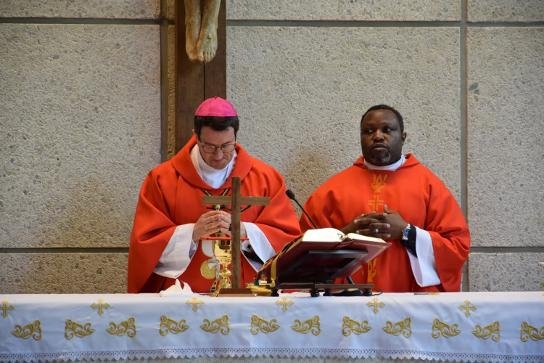
On Sunday, October 11, 2026, it was the turn of Ghanaian Catholics in Finland to lead the singing in the church service of the African Catholic Chaplaincy in Finland (ACCF).
It was indeed a spirit-filled feeling for worshippers present. And for the Ghanaian migrants, the occasion also brought back to them memories of church services in their home country, Ghana.
The ACCF has a roster for each country/community to sing from time to time. Next Sunday will be the turn of the Nigerian community. Other communities that usually sing are the Kenyan/Tanzanian community, the Cameroonian, the Ugandan, group, etc.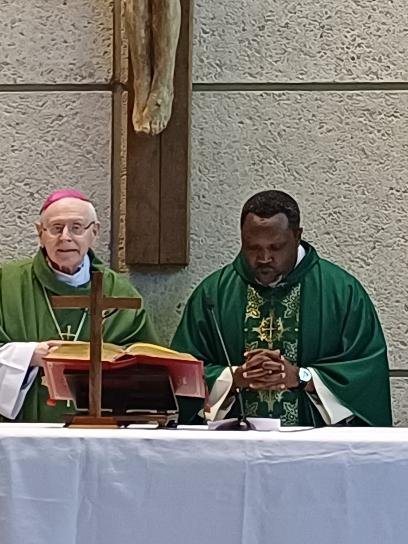
A powerful religious experience
The mass services of the Chaplaincy usually give a powerful religious experience and a display of cultural diversity, especially in occasions such as when the Bishop of Helsinki, Bishop Raimo Goyarrola, celebrated mass with the Chaplaincy on Pentecost Day, May 24, 2026.
There was a similar time of spiritual joy last month (September 27, 2026) when Emeritus Bishop Teemu Sippo, former Bishop of Helsinki, visited the Chaplaincy. Bishop Teemu was the main celebrant, assisted by the Chaplain, Reverend Father Thomas Otieno.
Last Sunday, Reverend Father Bernard Sor, a Ghanaian Catholic priest based in Austria, was the main celebrant in the mass service where he performed a rite of baptism. Fr Bernard had celebrated mass a few months ago when he visited his sister and her husband in Helsinki. 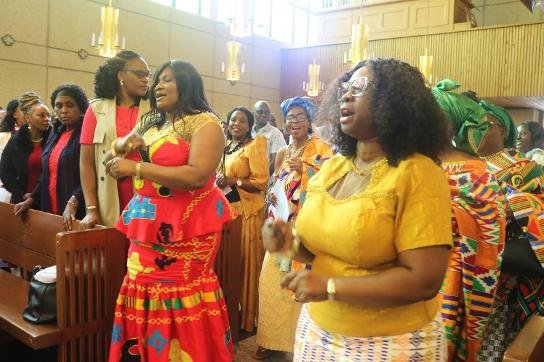
All these well-attended religious occasions indeed leave lasting memories. The homilies (peaching) by the priests usually emphasize religious tenets such as the importance of loving and serving God in truth, existing in peace with our fellow humans to promote unity in diversity, etc.
Unity in diversity and a colourful display of cultures
The African Chaplaincy church services usually produce impressive displays of diverse cultures from different parts of Africa and elsewhere. The events are often spiced by rich cultural displays of dances and colourful attires which are a delight to watch.
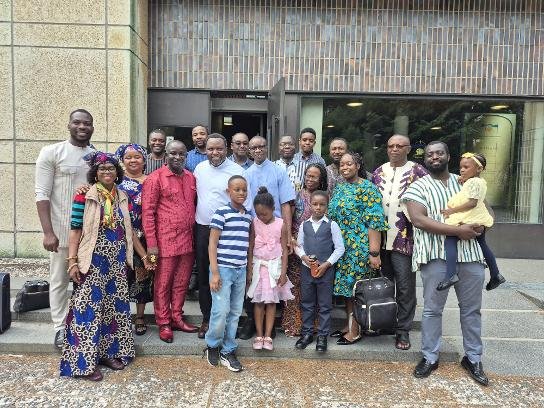
On special occasions, members of the Ghanaian Catholic community, in their gay and colourful kente attire and with adowa dance and music, usually lead the procession into the church. Other communities such as the Cameroonian, Nigerian, Kenyan and Tanzanian as well as Sudanese/South Sudanese groups also put up well-choreographed performances from their cultures.
The African Catholic Chaplaincy in Finland
The African Chaplaincy was founded on June 4, 2017, which was a Pentecost Sunday, in a Pontifical High Mass celebrated by Monsignor Emeritus Sippo S.C.I., the then Bishop of Helsinki, at the St. Mary’s Catholic Parish Church in Helsinki.
The Chaplaincy was created by Bishop Teemu in collaboration with the Diocesan body when they detected a great flocking of African immigrants to Finland, the majority of whom were Catholics. This was to give the immigrants a possibility to integrate into the Finnish society by worshiping as Catholics and in their African cultural identity.
The responsibility of the Chaplaincy was given by Bishop Teemu to Father Dr Leonard Wobilla Shwei, who is thus the first Chaplain and ably led the Chaplaincy. He was succeeded a few years ago by Father Thomas Otieno, who continues to move the Chaplaincy forward. Thank you!
GHANA MATTERS column appears fortnightly. Written in simple, layman’s terms, it concentrates on matters about Ghana and beyond. It focuses on everyday life issues relating to the social, cultural, economic, religious, political, health, sports, youth, gender, etc. It strives to remind us all that Ghana comes first. The column also takes a candid look at the meanings and repercussions of our actions, especially those things we take for granted or even ignore. There are key Ghanaian values we should uphold rather than disregard with impunity. We should not overlook the obvious. We need to search for the hidden or deeply embedded values and try to project them.
With Dr Perpetual Crentsil
SKIP THE QUEUE, TAP THE NEWS

You can now read the Ghanaian Times and The Spectator newspapers from the comfort of your device via TimesNewsPlus.
Join our WhatsApp Channel: https://whatsapp.com/channel/0029VbBElzjInlqHhl1aTU27
She did not find out he was cheating. She found out he was drowning.
It was two weeks after their beautiful wedding. The jollof was still in the fridge. A loan officer called her number-not his-and politely asked, “Madam, please tell your husband to pay his overdue loan. We have been calling him.”
That was how she discovered her new husband had entered their marriage with a hidden debt of over GH¢ 40,000. No cheating. No other woman. Just a financial secret.
And that is how many Ghanaian marriages begin to die. Not with a shout, but with a secret alert on a phone.
We prepare for the wedding. We do not prepare for the wallet.
What is money honesty?
Let me define it simply. Money honesty is not that you both earn the same. It is that you both know the same. It is the ability to sit down and say without fear:
“This is how much I earn.”
“This is how much I owe.”
“This is how I was raised to see money.”
“This is what scares me about money.”
Financial transparency is not about control. It is about clarity. You cannot build trust on top of secrets.
Many couples tell me, “Counsellor, we love each other, love will handle money.” I always answer, “Love is the car, but money honesty is the fuel. Love without honesty cannot move.”
How To Buy Your Marriage Insurance Today – My 5-Step Protocol
If you are engaged, newly married, or even 20 years in marriage, you can still fix this. At Counsellor Prince & Associates Consult—CPAC, this is what I give couples:
Step 1: The 90-Minute Money Naked Session.
No phones, no blame. Each partner writes down on paper: Monthly income, monthly debts, monthly family obligations, savings, and your biggest money fear. Then you exchange papers. Read it. Don’t react for 24 hours. Just absorb.
Step 2: Create OUR Money, YOUR Money, My Money.
You need three pots. OUR money for rent, food, school fees, utilities, properties, and the like— joint contribution. YOUR money and MY money—a small agreed allowance no one questions. This stops the feeling of being controlled.
Step 3: The No-Secret Debt Rule.
Agree from today: No new loan, no new hire purchase, no new family financial commitment above GHS 500 without telling each other first. Not permission, but information.
Step 4: Talk About Your Money Personality.
Are you a Spender or a Saver? Are you Risky or Safe? Most Ghanaian marriages are a Spender married to a Saver. Neither is wrong. But if you don’t understand your partner’s personality, you will call his saving “stinginess” and her spending “wastefulness.”
Step 5: Do a Monthly 30-Minute Money Date
Not an argument date. Light, with tea. “How did we do this month? What worried you? What should we plan for next month?” Couples who do this divorce far less.
My Final Word
Before you say “I Do” at the altar, have pre-marital counselling and also have the money talk on the sofa.
Ask your partner:
“If I lost my job today, how long can we survive?”
“What debt are you bringing into this marriage?”
“How much do you send to your family monthly and will that continue?”
If he or she gets angry that you asked, don’t get married yet. A person who is angry about accountability will be abusive about money.
Marriage insurance is not bought at Star Assurance or Enterprise. It is bought in honest conversations when no one is watching.
The wedding costs one day. The marriage costs a lifetime. Don’t enter a lifetime contract and covenant with hidden costs.
You can still insure your marriage today.
Source:
Counselor Prince Offei, CPAC’s founder, is a leading Mental Health Professional, Marriage Counsellor, Author, ADR Expert/Arbitrator, and Spectator Newspaper Columnist. He writes on relationships, marriage, parenting, special needs support, and their connection to mental health. For therapy, counselling, or enquiries, contact Counselor Prince & Associates Consult (CPAC) in Accra on 0559850604 / 0551428486.
SKIP THE QUEUE, TAP THE NEWS
You can now read the Ghanaian Times and The Spectator newspapers from the comfort of your device via TimesNewsPlus.
Join our WhatsApp Channel: https://whatsapp.com/channel/0029VbBElzjInlqHhl1aTU27