News
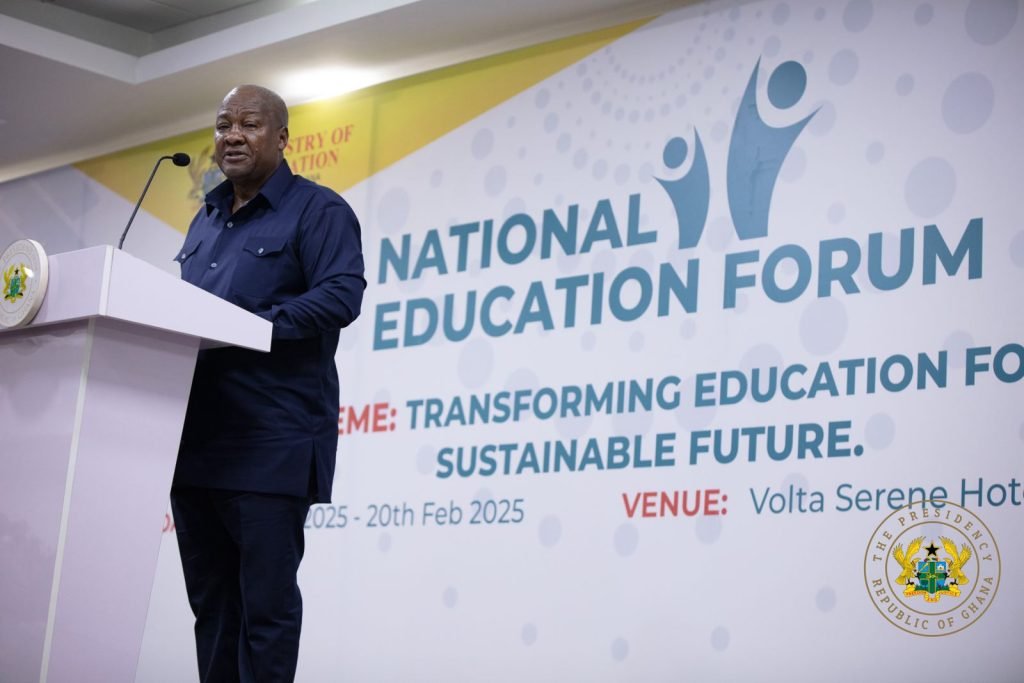
SPEECH: President JD Mahama launches National Education Consultative Forums

Let me express my sincerest apologies on behalf of the planning committee of the forum to our stakeholders of the faith-based organisations for the unpardonable omission committed in your delayed invitation to this forum.
Although the omission was quickly remedied, you still deserve an unqualified apology for this oversight. Since you are the purveyors of God’s mercy on earth, I’m sure you are forgiving us.
Thank you very much. We know you are important stakeholders because you own some of the schools, so this educational forum is important to see how we can bring everybody together.
So today, we begin an important journey of consensus-building in an important sector: education. For many years, we’ve watched education standards decline significantly. We have, individually and collectively, expressed our views on how we believe the education sector’s problems can be addressed.
The Presidency, Republic of Ghana
Press Releases
SPEECH: President JD Mahama launches National Education Consultative Forums
18 February 2025
Let me express my sincerest apologies on behalf of the planning committee of the forum to our stakeholders of the faith-based organisations for the unpardonable omission committed in your delayed invitation to this forum.
Although the omission was quickly remedied, you still deserve an unqualified apology for this oversight. Since you are the purveyors of God’s mercy on earth, I’m sure you are forgiving us.
Thank you very much. We know you are important stakeholders because you own some of the schools, so this educational forum is important to see how we can bring everybody together.
So today, we begin an important journey of consensus-building in an important sector: education. For many years, we’ve watched education standards decline significantly. We have, individually and collectively, expressed our views on how we believe the education sector’s problems can be addressed.
What we have lacked, however, is a unified platform on which the various shades of opinion and perspectives can be combined and distilled to yield the most optimal outcomes for our children.
In the years before my election, I indicated my desire to convene a national dialogue on the best approach to giving Ghanaian children a shot at a better life through quality and relevant education.
I committed to ensuring that all concerned about education in Ghana have an opportunity to contribute meaningfully to shaping the policies and programs that will deliver the kind of education we all want. I’m gratified that this has become a reality. I stand before you today with great pleasure and a deep sense of purpose to officially open the National Education Consultative Forum.
This moment marks a significant step in fulfilling one of the commitments of our 120-day social contract with the good people of Ghana, a commitment to build consensus on the urgent and necessary reforms needed to reset our education sector.
Education is not just a tool for personal development. It is the bedrock upon which the progress and prosperity of any nation rests. It defines the present and determines the future of our country.
Education must remain a tool for empowerment, equality, and transformation in Ghana. It is also an important instrument for social mobility. Education must inspire hope and deliver opportunity for all, whether born in Accra or the most remote part of our nation.
We recognise that the education system we inherited has not kept pace with the needs of 21st-century society and the Fourth Industrial Revolution. As the world evolves, so must our education system. What worked in the past no longer suffices for the challenges and opportunities of today and tomorrow. This realisation has brought us together today. We are united in our belief that education reform is not an option but a necessity.
Ladies and gentlemen, the National Consultative Forum on Education is a platform for bringing all stakeholders together.
Governments, policymakers, teachers, students, parents, traditional leaders, religious leaders, political party representatives, development partners, and all members of civil society.
We are here because we recognise that reimagining Ghana’s education system is not a task that any single entity can undertake alone. Education reform is a shared responsibility, a collective journey that requires all voices, perspectives, and hands on deck.
This consultative process, I believe, will bring out the best solutions born out of dialogue, partnership, and mutual understanding to deal with our current and future challenges.
Our goal today is to engage in an honest and productive discussion about the current state of education in Ghana, to diagnose the challenges, and to craft a bold and actionable roadmap for reform.
Our educational system’s current challenges require strategic priorities, fresh solutions derived from objective, nonpartisan issue analysis, and a renewed sense of urgency. The moment to act together is now, and we must use this forum to answer critical questions such as: How do we ensure that every child in Ghana receives a quality education regardless of where they are born or live?
How do we equip our schools and teachers with the necessary tools and resources to provide a quality education? How do we close the gaps in foundational learning and prepare our students for further studies, the world of work, and future opportunities?
How do we ensure innovative pedagogies, inclusive, engaging, and adaptive pedagogies framed around social-emotional learning and universal design for learning, which are central to our teachers’ classroom practice?
How do we develop an assessment system that promotes critical thinking and problem-solving rather than just regurgitating what was learned? How do we restore school leaders’ autonomy against mutually agreed-upon performance standards? How do we remove excessive political interference in the governance of our education system?
How can we ensure adequate and sustainable financing for education and achieve innovative infrastructure provision at optimal cost?
How do we provide our students with the technical and vocational skills to enter the world of work? Where do we place moral education, patriotism, and family values in our curriculum?
How do we increase the role of faith-based organisations in managing their schools? We expect you to focus on these and many more questions and provide us with answers in the roadmap.
Ladies and gentlemen, the big question at the centre of the issues associated with the aforementioned questions is how to ensure the provision of a balanced education for Ghana’s children and young people, an education that transforms them into globally competitive citizens.
An education system that adequately prepares them and nurtures them as Ghanaians with uncompromising values and character qualities of honesty, creativity, and responsible citizenship, as well as 21st-century problem-solving and critical thinking skills.
An education system that ensures that our leaders, by age 10, are well-grounded and proficient in language literacy, mathematics literacy, scientific literacy, and cultural literacy as the foundation for their future learning.
As we all, as stakeholders, consider educational issues across basic, secondary, and tertiary education, we must remember that quality education not only focuses on developing pupils’ intellects but also ensures holistic personality development.
It develops his heart, mind, and hand for the benefit of himself and the larger society. The mind promotes critical thinking and creativity necessary for productive decision-making.
The heart fosters the moral, emotional, and social orientation needed to strengthen societal and family values, enhance social cohesion, and promote mutual respect.
The hand develops in learners skills and practical competencies necessary for building and strengthening our service and productive sectors of our economy. For this reason, I agree with Ellen G. White, the American author, when she says, and I quote, “Our education takes too narrow and too low a range.”
There is a need for a broader scope and a higher aim. True education means more than just pursuing a certain course of study. It means more than preparing for the life that is now. It has to do with the whole being and the whole period of existence possible to man. It means it refers to lifelong learning. It is the harmonious development of the physical and mental.
It prepares the student for the joy of service in this world. Unquote. Education must prepare our students for service.
That is our task. Finding answers to the questions above and others will inform the discourses of this forum. It must be our collective responsibility to make recommendations that are far-reaching, transformative, and necessary for developing the global Ghanaian.
This is a call to action for every stakeholder present today, every Ghanaian across the country, and every Ghanaian in the diaspora.
Their future depends on our decisions and actions today. I’m happy that some of our members, our citizens from the diaspora, like Professor Champon, have travelled to join us at this forum.
Also, Professor Benega is all the way from Australia. You are all welcome. As a government, we are fully committed to this process.
The outcomes of this conference assure you that your recommendations will not gather dust on a shelf. They will not become symbolic recommendations but form the foundation of a comprehensive reform agenda to build an inclusive, equitable, and transformative education system for Ghana and all Ghanaians.
Therefore, we will prioritise the actionable reforms proposed here, using clear timelines and measurable outcomes to guide our actions.
To build trust and transparency, the public will receive regular updates on progress. We will also increase the allocation of resources to critical areas, including foundational learning, with a focus on the four literacies I mentioned: language, mathematics, science, and culture.
Teacher education and capacity development would also receive attention. Infrastructure development and education technology were also included. There was a deepened partnership with parents, traditional authorities, and local communities. I’m happy that the Honorable Education Minister has already announced that PTAs can engage with schools.
The children at the schools are properly managed. PTAs can start to do their work by engaging with the schools to deepen their management. We should deepen partnerships with parents, traditional authorities, and local communities to support every child’s learning journey through the practice of learning teams.
To ensure that school leaders have the autonomy to perform their duties against a national school leader standard, we shall work with stakeholders, including the Conference of Heads of Assisted Secondary Schools and other teachers’ unions, to develop.
We aim to prioritise research and its evidence in decision-making. Additionally, we will continue the teacher transformation initiatives that began in 2014 under the T-TEL project, ensuring that this transformation is implemented across all sectors of the education system, including TVET.
Ladies and gentlemen, as we embark on this crucial dialogue, let us not lose sight of the bigger picture. The task before us is not merely about fixing what is broken but about constructing an education system that is fit for purpose in today’s dynamic world.
Let us envision an education system where every child, regardless of their background, has the opportunity to achieve their full potential.
Let us envision an education system where teachers are celebrated, supported, and empowered to inspire the next generation.
Let us envision an education system in which schools are the centres of innovation and learning that prepare students for not just exams but lifelong learning.
This vision must drive our discussions and decisions today and tomorrow during this forum.
Distinguished ladies and gentlemen, as I officially open this National Consultative Forum on Education, I urge each of you to approach this task with objectivity, courage, creativity, and an unwavering commitment to our nation’s future.
Let us be bold in our ideas, collaborative in our approach, and relentless in our pursuit of excellence.
Together, we can build an education system that resonates with ordinary Ghanaians’ aspirations and prepares our nation for the challenges and opportunities of the 21st century.
The future of this country is in our hands. Let us seize this moment and work together to create a legacy of hope, opportunity, and transformation for future generations. One resolution at a time, one transformation at a time, Ghana will win in developing this country’s young people for service.
Thank you.





THE Gospel Advocates (TGA), a non-denominational evangelistic Christian organisation last Saturday donated a number of educational logistics to the Dodi Asantekrom Basic School in the Eastern region of Ghana.
The gesture was to mark the seventh anniversary of the organisation made up of professionals committed to preaching the gospel of Jesus Christ to students in senior high schools, particularly in rural communities.
TGA also seeks to inspire students towards attaining academic excellence and guiding them towards optimising the various learning opportunities and academic programmes available at the tertiary level.
Among the items donated were 100 desks, 10 cupboards, 10 desktop computers, two laptops, 10 teachers’ tables and chairs and others.
The group also held its annual outreach programme that had a significant impact in the community through initiatives such as feeding 500 children with hot meals and assorted drinks, providing free medical screening and drugs for 500 adults and youth and conducting health education and sensitisation for both children and adults.
TGA also took upon itself to restock the community clinic with essential medicines and distributed food items, plastic bowls, cups and clothing to members of the community.
The initiative, according to officials of the group, was supported by ORSAM Limited, Doctors Save Lives Foundation, Johnson Tord Foundation, El-Shaddai Mothercare, Exceed Alliance Limited, GB Foods Ghana Limited, Qualiplast Limited, Phyto-Riker (Gihoc) Pharmaceuticals Limited, Cosa Bright Ghana, Kabs Pharmacy, Tobinco Pharmaceuticals, Pill Bay Pharmacy and Bamah 3.7.7.
“We are deeply grateful for their immense support and partnership in bringing hope, relief, and practical assistance to the people of Dodi Asantekrom,” the officials said.
In a statement, the President and Chairman of The Gospel Advocates, Mr. Selom Kpikpitse, said the donation to Dodi Asantekrom forms part of TGA’s broader mission to propagate the gospel of Jesus Christ among students and youth in rural communities through teachings, music and arts.
He explained that the meals provided to over 500 pupils were in line with the organization’s annual “Feed the Kidz Project,” which demonstrates Christ’s love.
Receiving the items on behalf of the school, the Headmaster, Mr. Otumfour Newton, expressed gratitude to TGA and its sponsors, saying that “the items would significantly enhance teaching and learning while improving the overall welfare and development of the pupils.”
Mr. Newton also commended the team for the free medical screenings for adults and youth in the community, and other community engagements.
Medical supplies were also donated to the Dodi Asantekrom CHPS compound and received on behalf of the facility by Mr. Amefu, a Physician Assistant.
By Spectator Reporter
Join our WhatsApp Channel now!
https://whatsapp.com/channel/0029VbBElzjInlqHhl1aTU27


AS Ghana celebrates its 69th Independence Day, the country reflects on the vision of its first President, Kwame Nkrumah. Beyond political freedom, Nkrumah dreamed of building a modern, self-reliant nation.
He launched ambitious projects aimed at industrialisation, job creation, and to position Ghana as a leader in Africa.
Many of these projects were interrupted or abandoned after the 1966 coup that removed him from power. Today, these projects remain reminders of bold ambitions and opportunities for revival.
1. The Black Star Line
One of Nkrumah’s earliest initiatives was the Black Star Line, Ghana’s first national shipping company. Established in 1957, it aimed to boost trade and reduce dependence on foreign vessels. Nkrumah envisioned a fleet of Ghanaian ships transporting goods across Africa and beyond.
The project, however, suffered from poor management, financial challenges, and political instability. After the 1966 coup, the Black Star Line collapsed, leaving a gap in Ghana’s maritime sector. Today, the country still relies heavily on foreign shipping, showing how Nkrumah’s foresight was ahead of its time.
2. Railway expansion
Perhaps Nkrumah’s most enduring domestic dream was a nationwide railway network. He wanted lines connecting northern and southern Ghana, linking agricultural zones to factories, and connecting mines to ports. Railways were to be the backbone of industrialisation, enabling efficient transport of goods and people.
Much of this vision remains unrealised. Expansion stalled after 1966, and the network has suffered decades of neglect.
- Juapong textile factory
- Tomato and fruit processing plants: Designed to add value to agricultural produce, but operations collapsed due to inconsistent supply and lack of technical expertise.
Modernisation efforts by successive governments, including the construction of the Tema–Mpakadan line and rehabilitation of parts of the Western Line, have only partially restored his vision. A fully integrated railway system, particularly linking northern regions, remains a work in progress.
3. Accra–Tema Industrial corridor
The Accra–Tema Motorway, constructed in the early 1960s, was intended to anchor an industrial corridor connecting factories, ports, and residential areas.
The motorway itself was completed and remains a key route, but many industrial zones along the corridor were never built, limiting the economic impact of the project.
4. Defunct factories and industrial ambitions
Through the Ghana Industrial Holding Corporation (GIHOC), Nkrumah established numerous state-owned factories to reduce imports, create jobs, and industrialise the country. Many of these factories, however, became defunct due to poor management, political changes, and economic challenges.
Some notable examples include:
- Textile factories: Aimed at making Ghana self-reliant in clothing production, but most shut down after Nkrumah’s overthrow.
- Brick, tile, and cement factories: Intended to supply building materials for rapid urbanisation; many closed or underperformed.
- Sugar and meat processing plants: Built to supply local demand and reduce imports, yet most never reached full capacity.
These defunct factories are a testament to the challenges of maintaining large-scale industrial projects in a changing political and economic environment. They also illustrate the potential that existed to make Ghana self-sufficient in manufacturing.
Meridian Hotel
The Meridian Hotel in Tema. Built in 1960 by Ghana’s first President, Osagyefo Dr. Kwame Nkrumah. One of the most sought-after hotels at the time, it was a popular location for dignitaries and tourists. The iconic hotel was so popular it inspired the famous Wulomei song Meridian.
Sadly, it has been abandoned for over two decades after it was closed down in the late 1990s. Meanwhile, residents in the area have called on the government to demolish the building if there are no plans to revamp it.
Lessons and way forward
These abandoned projects and defunct factories are not just stories of failure. They highlight Nkrumah’s bold vision and the importance of continuity in national development. Independence brought freedom, but building a self-reliant, industrialised Ghana requires sustained planning, political stability, and investment in infrastructure and human capital.
As Ghana marks its 69th Independence Day, revisiting these projects is both a reflection on history and a call to action. Reviving or modernising parts of these initiatives could strengthen infrastructure, create jobs, and make the country more competitive in the regional and global economy.
Nkrumah’s projects were not merely monuments of ambitions but blueprints for economic sovereignty. As Ghanaians, it is not just enough to remember past events leading to independence but completing and reviving works that began in 1957.
It reminds us that true nation-building—connecting the country, industrialising the economy, and asserting Ghana’s role in Africa—is an ongoing journey.
By Esinam Jemima Kuatsinu
Join our WhatsApp Channel now!
https://whatsapp.com/channel/0029VbBElzjInlqHhl1aTU27