Features
Soil is the solution

What do you think of when you hear the word “desertification”? Sand dunes slowly encroaching on bountiful farmland? The Sahara and Gobi taking over Africa and Asia? Rivers and streams drying up? That’s certainly part of it. But the key impact of desertification is the degradation of land – to the point where soil becomes so damaged that it no longer supports life.
Soil is so much more than dirt. And healthy soil is essential to a healthy planet. The ground beneath our feet is teeming with a hidden world of plants, animals and microbes – many too tiny to see. But our survival depends on them. This overlooked reservoir feeds our agriculture and food industries. It helps to regulate greenhouse gas emissions and keeps plants, animals and humans strong.
But today, more than one fifth of the planet’s land – including more than half of our agricultural land – is suffering. Each year, more than 12 million hectares of land are lost to desertification, land degradation and drought.
This loss hurts over 3 billion people, particularly poor and rural communities in the developing world. At the same time, when land is hastily converted to cropland, without considering the overall health of our environment, then carbon and nitrous oxide are released into the atmosphere.
Climate change accelerates, biodiversity withers and infectious diseases blossom. This all jeopardizes water supplies, livelihoods and our ability to face natural disasters and extreme weather events.
Unless we act now, it’s only going to get worse. Over the next 25 years, land degradation could reduce global food productivity by as much as 12%, leading to a 30% increase in world food prices. We will never achieve the Sustainable Development Goals if we remain complacent.
But there is much to be hopeful about – and much that we can achieve together. As we have seen with the rapid development of COVID-19 vaccines, when the will is there and resources are deployed, humankind can achieve truly astounding feats.
Restoring 350 million hectares of degraded land by 2030 could take between 13 and 26 gigatons of greenhouse gases out of the atmosphere. For every dollar spent on land restoration – including through low-skilled and labour-intensive projects – at least 9 dollars of economic benefits can be expected.
Restoring land not only generates green job opportunities across a wide range of industries – but will also enable us to grow more nutritious food, provide clean water security, address biodiversity loss, and mitigate and adapt to climate change.
Whether we’re talking about city dwellers, who need reliable supplies of fruits and vegetables, or island hoteliers, who count on protected beaches and swaying palm trees to draw in tourists, or hospital patients, whose lives depend on nature-derived medicines, one thing is clear. There is no person on earth – or for that matter any being – whose existence is not tied to land.
So, what can you do to help protect our land and soil? One simple step is not to waste food – because when farmers work the land to produce food we’re not eating, that just exhausts our soil unnecessarily. And if you’re an urbanite, you can work with your local officials to make your city greener – through such innovative methods as rooftop gardens and vertical forests.
Here at the United Nations, promoting land regeneration is a critical part of our work. In the coming months, major conferences to follow up on the three Rio Conventions – the UN Convention to Combat Desertification (UNCCD), UN Framework Convention on Climate Change (UNFCCC) and Convention on Biological Diversity (CBD) – will all be held during the same year for the first time ever. This a unique opportunity to reflect on the health of our planet – and on what we can do to improve it and protect our very existence.
For my part, I will host a high-level meeting on desertification, land degradation and drought, in the iconic United Nations General Assembly Hall in New York. This meeting – the first of its kind in more than a decade – will build on previous achievements, highlight gaps in our collective efforts and spur momentum towards the three big Rio-related conferences. It will remind us that land degradation is real and needs to be fought. It will show how three seemingly different issues – climate, biodiversity and desertification – are actually intrinsically linked. And it will drive up ambition for global action.
The General Assembly is the only body where all 193 Member States of the United Nations sit as equals. So, there is no better place to tackle the problems that transcend borders and affect us all. When it comes to the very earth we stand on – the life-giving soil that sustains us – there is no time to waste.
High-level conferences may not improve the situation overnight. But in making sure we’re all on the same page, sharing best practices and taking real steps together, we can change course. Ultimately, we will reverse desertification, land degradation and drought – because there is no other choice. But we will need to work together. We will need to change some of our practices. And I hope the United Nations can count on your support.
By Volkan Bozkir
The writer is the President of the UN General Assembly


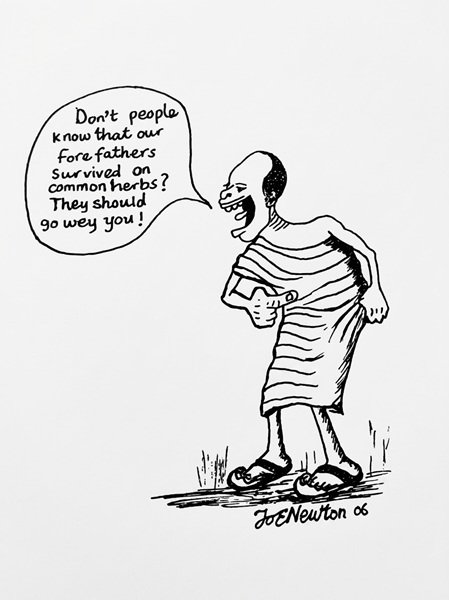
THE typical itinerant salesman in Sikaman is a herbalist. He is normally a slim macho with the capacity to perambulate the expanse of area covering the triangle of Accra-Tema-Ashiaman. In short, he can walk a total of 60 miles a day, marketing a product that cures every disease, including poverty. 
The door-to-door herbal pharmacist advertises his product by word of mouth. He has nothing to do with the Food and Drugs Board (FDB). After all, his concoctions do not feature on FM stations.
Those herbalists who cannot walk to propagate the herbal gospel, liaise with drivers of mass transportation and their mates. They are, therefore, given the chance to sell their products on Benz buses that ply the routes.
Normally, the herbalist starts his sales message with a prayer and Bible study. He asks the passengers to bow down their heads in supplication to God the father, the son, the Holy Spirit.
When a herbalist asks the passengers to close their eyes and bow their heads, Moslems on board naturally feel offended. They feel that the herbalist has no right to assume that every passenger is a Christian. They think such an assumption is an affront to Islam.
So a Moslem on board will raise the hand for a point of order. He’ll remind the herbalist that it would be in his own interest to mind his language.
“Be careful the way you address people in a public place. Not every person here is a Christian,” he’d state assertively.
Of course, the herbalist will promptly ignore him, but would all the same “watch” his tongue. Who knows whether or not the Moslem brother is inspired by Quoranic zeal to defend the tenets of Islam to the hilt?
When he starts saying, “Wallahi!” and “Inshallah!” it could be the beginning of proclaiming Islam as supreme, a point which must be driven home with talibanic precision.
So the herbalist must tread carefully lest he steps on fire.
The herbalist could even add a measure of mirth to it all, by announcing that Christians on board today have very interesting company on the journey, but that should not detract from the business of the day.
The Moslem brother will weigh the words carefully and offer a wry smile.
He must be careful the occasion does not degenerate into the use of semantics and proverbial oration to deride his conviction that public utterances must be mindful of religious sensibilities. He has made his point very clear and expects that it is taken in good faith in the interest of a peaceful journey.
The herbalist will now open the New Testament and preach salvation, stating clearly that salvation can come only through Jesus Christ and NOBODY else.
The Moslem brother will now start twitching his moustache. The visible and almost revolutionary reflexes of his upper lip can be an indication that sentiments have begun superseding reason, and the outcome could well be tragic now shift uneasily in his seat.
The time has come for him to also express his right to the religion of his fore-bears. He’ll put his hand into his pocket and rise to his feet. The time has indeed come!
This article was first published on Saturday, September 9, 2006
When the cause of a particular problem like sickness, disease, sudden illness, a social issue etc. are not known, it stands to reason that resolving it becomes a huge challenge.
Citizens would understand the government when public announcements are made to the effect that government is trying to find a solution to the issue, even though it is taking a while for it to be resolved because citizens are rational beings.
On the other hand, if the solution to a particular issue is known to everybody but the government for whatever reason, is dragging its feet in resolving it, citizens become frustrated and begin to lose trust in their leaders.
One such issue is the heavy traffic along a section of the Kasoa – Odokor road. A short stretch of bad road between the traffic light at the Weija Government Hospital and the entrance to the entrance of the overhead that leads to the N1, is the cause of the problem but nothing is being done about it, day after day, week after week, month after month. Thus is clearly unacceptable.
Another issue that requires urgent attention is the lack of pavements along a lot of streets in parts of the various Municipal Assemblies. Exercise is a prerequisite for long life and healthy living and for those of us who it has become a way of life, this issue of people putting up structures right to the edge of the drains beside the roads, are making life difficult for us.
We are compelled to walk along the roads, putting our lives at serious risk. Pedestrians should never be compelled to compete with vehicles on our streets and roads. Roads and streets are made for vehicles and pavements are made for pedestrians. That is the norm. Any attempt to normalise a situation where pedestrians are mingling with vehicles is insanity.
It is the road regulations that makes it so and therefore district or municipal assemblies are to take responsibility and ensure that spaces for pavements are not encroached upon. Citizens have rights that must be protected by their leaders and making pavements available to pedestrians, is one of them.
When we hear of teachers having sex with students, it appears it is something recent. It is not a new phenomenon. It has been there since Adam. Perhaps this issue is getting much attention due to the proliferation of social media. It was an open secret in times past when Teachers were in relationships with female students and some married them immediately after completion of school.
Some teachers were also known to be having unholy interactions with female pupils but due to the times that these acts occurred, human rights issues and the awareness around it, allowed such unscrupulous teachers to get away with their crimes.
Now we are in a different era and so a Headmaster is now in hot waters. He is alleged to have raped about 19 female students and as usual, some officials tried to cover it up and are also in hot waters and their actions or inactions in the matter are under investigation.
Why the man has been allowed to roam freely without being arrested is simply mind boggling. It appears that the law applies differently, depending on who you are. This issue came to public attention sometime in August this year, yet the police had not arrested or invited this man for question regarding the rape allegation.
It has come out that he is a Constituency Secretary of the ruling party and the question in the public domain is that, is it because he is a political figure that is why he is still walking around without questioning? I believe in the rule of law so let us hold our breadth and let the proper thing be done.
The police must however be seen to be active in this matter. God bless.
SKIP THE QUEUE, TAP THE NEWS
You can now read the Ghanaian Times and The Spectator newspapers from the comfort of your device via TimesNewsPlus.
Join our WhatsApp Channel: https://whatsapp.com/channel/0029VbBElzjInlqHhl1aTU27