Relationship
Silent wounds in marriage: 7 red flags of a narcissistic wife you should not ignore


- /home/u249204778/domains/spectator.com.gh/public_html/wp-content/plugins/mvp-social-buttons/mvp-social-buttons.php on line 27
https://spectator.com.gh/wp-content/uploads/2026/06/Wife-monitoring-husbands-phone.webp&description=Silent wounds in marriage: 7 red flags of a narcissistic wife you should not ignore', 'pinterestShare', 'width=750,height=350'); return false;" title="Pin This Post">
- Share
- Tweet /home/u249204778/domains/spectator.com.gh/public_html/wp-content/plugins/mvp-social-buttons/mvp-social-buttons.php on line 72
https://spectator.com.gh/wp-content/uploads/2026/06/Wife-monitoring-husbands-phone.webp&description=Silent wounds in marriage: 7 red flags of a narcissistic wife you should not ignore', 'pinterestShare', 'width=750,height=350'); return false;" title="Pin This Post">
Marriage is meant to be a sanctuary — a place where two people feel safe, seen, and supported. But what happens when the person who promised “forever” slowly becomes the source of your deepest emotional wounds?
As a marriage counsellor and mental health professional in Accra, I sit with men who whisper, “I feel invisible in my own home,” or “I’m constantly blamed for things I didn’t do.” Often, these men are not describing a “difficult wife.” They are describing years of living with narcissistic patterns — patterns that don’t bruise the skin, but shatter the soul.
Let me be clear: Narcissism exists on a spectrum. Confidence is healthy. Pride is human. But narcissistic personality traits become destructive when they are consistent, rigid, and designed to control, manipulate, or diminish the other partner. Research from the American Psychological Association shows that emotional abuse from narcissistic partners can cause anxiety, depression, low self-esteem, and even trauma symptoms similar to PTSD.
This article is not about demonising women. It is about naming pain so healing can begin. If you see yourself in these 7 red flags, know this: You are not weak, you are not crazy, and you are not alone.


Although school holidays are a great time to relax and rejuvenate they can also be stressful for parents searching for ways to keep children “amused”. So here are my top five tips to survive the school holidays.
- Plan activities
Sit down with your kids and plan activities that they can look forward to. Make a list of free activities, activities they can do at home, and activities with a budget. Check your local papers or log the internet to see what’s happening in your area. Put the full list on the fridge and refer kids to the “activities at home” section when you’re hit with the “I’m bored” syndrome!
- Holiday budget
Organise a holiday budget and discuss this with the children. It’s important for children to understand that you don’t have a bottomless pit of money and that, in fact, you don’t need lots of money to have fun. You may like to plan some activities with a dollar tag attached but there are plenty of free activities in parks, museums, and libraries.
- Don’t become a full time entertainer
Don’t fall into the trap of “full time entertainer”. Children need to learn to amuse themselves and to find interesting and fun things to do in a safe environment.
Depending on your child’s age you may need to help them start an activity but don’t take it over. And remember, it’s important to show an interest when your child is busy and absorbed and not just when they’re bored and seeking an audience.
- Set rules
Set ground rules for computer and TV use such as turn taking and time limits. Although it’s ok for children to watch a little more TV or use the computer more often during the holidays, it’s important that children have a balance of indoor and outdoor activities. Set a time limit and monitor programs and computer games. If turn taking is a problem, set a timer and allocate a time limit for each child.
- Set child free time
It’s easier to look after children’s needs if we also look after our own needs as parents. Set aside some child free time. Organise a play at a friend’s house or enlist the help of relatives to give you a break. If our own needs as adults are neglected, it’s much more difficult to be calm, patient, and consistent with our children.
-source: informedfamilies.org
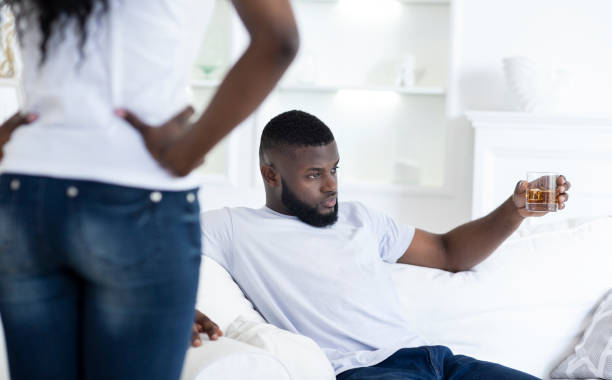
Marriage is meant to be a place of rest. A place where two people face the world together, not where one person battles the world alone while the other battles a bottle.
As a marriage counsellor and mental health professional in Accra, I have sat with wives who say, “The man I married disappears every evening,” and husbands who whisper, “I don’t know who I am living with anymore.”
They are not just describing drinking. They are describing alcoholism-and its slow, painful erosion of mental health, trust, and family life.
Let us be clear: Alcohol use is not the same as alcoholism. Many Ghanaians drink socially at funerals, weddings, and weekends without harm. Alcoholism, also called Alcohol Use Disorder, is when drinking becomes compulsive, despite consequences to health, job, and relationships.
The World Health Organisation (WHO) estimates that alcohol contributes to over three million deaths yearly worldwide, and in Ghana, alcohol-related harm is a growing public health concern.
The hangover fades by morning. The damage to marriage and children does not. This article is a continuation from last week’s edition and is for every spouse, parent, and child living “beyond the hangover.”
C. How alcoholism destroys the marriage itself
Alcohol does not just hurt individuals. It attacks the 3 pillars of marriage:
1. Trust dies: Broken promises become normal. Money disappears. “I was at work” becomes a lie. Over time, trust erodes and suspicion replaces intimacy.
2. Communication collapses: Sober conversations are impossible when one partner is drunk. Important issues — money, parenting, sex — are either avoided or become fights. The marriage becomes silent or hostile.
3. Intimacy fades: Emotional intimacy dies when one partner is unreliable. Physical intimacy suffers because alcohol reduces libido, causes erectile dysfunction, and creates shame. Many couples become “roommates with resentment.”
4. Financial strain: Beer, spirits, hospital bills, and job loss drain the family budget. Children go without school fees while money is spent on alcohol. This creates a second layer of conflict and hopelessness.
Marriage counsellors call this “the disease of more.” More drinking, more lies, more damage — until someone says “enough.”
What can you do if alcoholism has invaded your marriage?
This is not about shame. Alcoholism is a medical and psychological condition, not so much a moral failure. Healing is possible, but it requires truth, boundaries, and support.
1. Stop enabling, start supporting recovery
Enabling is covering up: paying debts, lying to family, cleaning up messes. Support is different: “I love you, but I will not live with active addiction. I will support you in getting treatment.”
2. Set clear, non-negotiable boundaries
Example: “I will not argue with you when you’re drunk. I will leave the room. I will not give you money for alcohol. Our children will not be exposed to drunken behavior.” Boundaries protect your mental health and your children.
3. Get professional help from CPAC — for both of you
The alcoholic spouse needs medical detox, counselling, and support groups like Alcoholics Anonymous. The sober spouse needs individual therapy to heal from trauma, anxiety, and codependency. Couples therapy only works when the alcoholic is committed to sobriety.
4. Protect the children
Children need one stable, emotionally healthy adult. Be that adult. Get them counselling if needed. Teach them that “Daddy/Mummy’s drinking is not your fault.” Break the cycle of secrecy by giving them safe adults to talk to.
5. Know when to seek safety
If drinking leads to violence, threats, or driving under influence with children, safety comes first. Contact police, social welfare, or a trusted family member. In Ghana, the Domestic Violence and Victim Support Unit – DOVVSU can help. No marriage is worth your life.
6. Hope is real, but it requires action
I have seen marriages recover when both partners do the work. Sobriety + therapy + accountability = healing. I have also seen spouses find peace through separation when addiction refused treatment. Both choices can be acts of love — love for yourself and your children.
A final word to the spouse reading this
Beyond the hangover is pain. But beyond the pain, there is a path to healing. You did not cause your partner’s alcoholism. You cannot control it. You cannot cure it. But you can choose how you respond.
You deserve a home with peace, not panic. Your children deserve a childhood with memories, not trauma. Your mental health is not a small thing — it is the foundation of your life.
If this article touches your story, please do not suffer in silence. Speak to a counsellor (Counselor Prince & Associates Consult — CPAC), doctor, pastor, or trusted friend today. Naming the problem is the first step toward freedom.
Marriage was designed to be a place of healing, not hurting. And healing is still possible.
Source:
Counselor Prince Offei, founder of CPAC, is a leading Mental Health Professional, Marriage Counsellor, Published Author, ADR Expert/Arbitrator, and Spectator Newspaper Columnist. He writes weekly on relationships, marriage, parenting, special needs support, and their connection to mental health and psychological well-being.
For therapy, counselling, mediation, or enquiries, contact Counselor Prince & Associates Consult (CPAC) in Accra on 0559850604 or 0551428486.
Website: https://princeoffei22.wixsite.com/website