News
Rev. Abakah donates to Bethel Methodist Society

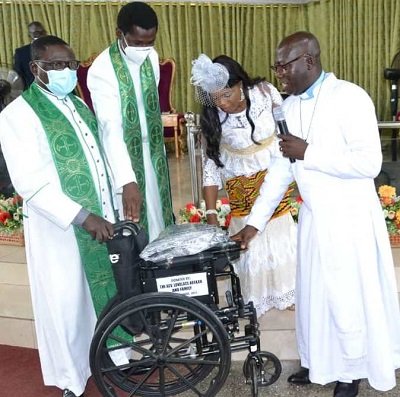
Rev. And Mrs Lovelace Abekah of Bethel Methodist Society Church at Community 8, Tema, last week presented a wheel chair to the Society’s sick bay as an appreciation for the love and care shown their family by the church members while fellowshipping with them.
According to Rev. Abakah, the gesture was to strengthen the existing bond between his family and the church in view of his transfer to the Jaway Whart at Half Assini in the Western Region to continue with service to God and humanity.
The Superintendent Minister of the church, Very Rev. Maj. Ebo Ephraim , said the thanksgiving service for the out going Rev. Minister (rtd) was necessary as part of the process leading to Rev Abekah’s travel in Methodist practice.
According to him, Rev. Abakah was commissioned on Sunday, June 27, 2021, at Community 8 Bethel Society Church, this year after passing through series of examinations and interviews at the Diocesan and Synod levels after which he was cleared at the Connexional level to undergo a three-year training in Theological Extension at the Trinity Theological Seminary.
He continued that, to become a fully ordained Minister in the Methodist Church, “one has to begin his or her travelling or itinerant ministry for three years under two Superintendent Ministers before his or her ordination.
According to him, Rev Abakah was a committed and hard working Christian who could be trusted in the ministry.
Delivering his last sermon on the theme ‘Is not about me’, Rev Abakah admonished the church and Christians to consider the experience of Joseph in the bible when he was sold out by his brothers into slavery neither did they know that God allowed it so he could change the destiny of their family .
The out-going Rev. said Joseph could have neglected his brothers or family and enjoyed the wealth and power he commanded for himself but he came to the rescue of his family and society.
He said many a time God blessed us as individual’s or family for us to bless others especially those in need for the glorification of His name but we to looked down on others and even put the venerable to shame.
‘ When God blesses us and instead of us blessing others in need, we turn to say do you know how I suffered to get what I have or how where I am today forgetting who got you where you are” he stressed .
To him, “God blesses us in many ways for us to be a channel and provide hope, a source of encouragement, a light at the tunnel in someone’s life and we should not claim our blessings or grace to be coming from our own personal efforts”.
The church also presented a citation and other gifts to them as an appreciation for their dedicated service.
By Victor A Buxton


A member of the National Democratic Congress (NDC), Dr. Sammy Ayeh has picked up nomination forms to contest for the position of Deputy National Communications Officer position.
Announcing his intention, Dr. Ayeh said he is offering himself to help communicate the party’s vision clearly and connect its message with the aspirations of Ghanaians.
He expressed deep gratitude to the party’s National Communications Officer, Lawyer Sammy Gyamfi, describing him as an able leader on whose shoulders he has risen.
“His exceptional leadership, mentorship and confidence in me have shaped my journey and strengthened my resolve to serve,” Dr. Ayeh stated.
He said if elected, he will seek to build on that foundation by strengthening research-driven communication, empowering grassroots communicators, and enhancing strategic media engagement.
Dr. Ayeh humbly appealed to party members and supporters for their support.
By Edem Mensah-Tsotorme

The Data Protection Commission has called on the Minority Caucus in Parliament, the Ministry of Foreign Affairs, JoyNews and other media houses to protect the personal information of 1,964 Ghanaians evacuated from South Africa.
In a press release issued on Tuesday, October 20, 2026, the Commission expressed concern over the public disclosure of the evacuees’ personal details, including their names, signatures and records of financial assistance received.
It warned that making such information public could expose the affected individuals to identity theft, fraud and other forms of harm, especially given the threats to their safety that some of them may have faced.
The Commission explained that the 1992 Constitution protects the dignity and privacy of every individual. It also cited the Data Protection Act, 2012 (Act 843), which sets out rules for the lawful collection, use and disclosure of personal information.
While acknowledging the importance of transparency, parliamentary oversight, the right to information and press freedom, the Commission stressed that these principles do not automatically justify the unrestricted publication of personal details.
It said the disclosure of the records by the Minority Caucus, the Ministry of Foreign Affairs, JoyNews and other media organisations must be assessed based on the law, the purpose of the disclosure and the privacy rights of the individuals involved.
The Commission further noted that although the Ministry of Foreign Affairs and Parliament are registered data controllers in good standing, their registration does not exempt them from their legal responsibilities under the Data Protection Act.
It has therefore urged all the parties involved to take appropriate steps to protect the affected individuals, including immediately restricting access to or removing personal details from publicly available records where their continued disclosure is not legally justified.
The Commission announced plans to conduct a regulatory review to determine whether the disclosures had a lawful basis, what safeguards were applied and whether the privacy rights of the evacuees had been adequately protected.
It said it would engage the relevant parties as part of the review and take appropriate regulatory action if any breach of the law is established.
The Commission reiterated that protecting personal information and respecting human dignity must remain central to efforts to promote public accountability.
By: Jacob Aggrey