News
Regularly check and update your SSNIT records…Public Sector workers told

Public sector workers especially those nearing retirement have been encouraged to regularly check and update their records with the Social Security and National Insurance Trust (SSNIT) to avoid unnecessary ininconvenience during the payment of their retirement benefits.
This they must do by checking their monthly financial statements to reconcile anomalies abbio-dataataf their beneficiaries before their tirement was due.
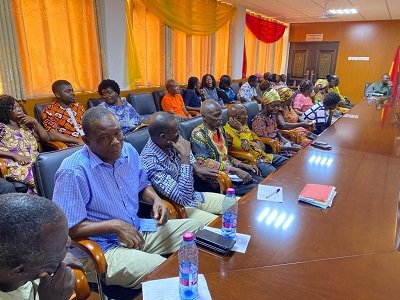
This came to light at a day’s sensitization workshop for 40 public sector workers who would be retiring this year in the Bono Region, at Sunyani on Tuesday.
The workshop was organised by the National Pensions Regulatory Authority in partnership with SSNIT and the Bono Regional Coordinating Councl .
The participants were taken through the formulusedse ideterminingng their Pensions and computation of their retirement benefits as well as lodging their benefits claim among others.
Major concerns raised by the retirees weabout to age differences on their records with SSNIT and that of their employers, and they were guided with the procedure to follow in resolving such issues.
The. Sunyani Zonal Manager of NPRA William Ohene-Adjei in a remark urged workers on SSNIT to encourage othe,rs especially thself-employeded to en onnto the scheme to secure their future
According to him the scheme was making prudent investments for the interest of workers and its sustainability.
The SSNIT Corporate Affairs representative for the sunyani Area Levina Korama Kinny on her part indicated that SSNIT is working hard to expand the scheme to cover more people especially the self employed in order to reduce old age destitutes in the country.
The Deputy Director of the Bono Regional Coordinating Council Michael Kwabena Gyamfi commended NPRA and SSNIT for the training saying it will go a long way in addressing challenges pensioners go through in accessing their benefits.
From DANIEL DZIRASAH SUNYANI


A new international whitepaper on democracy in Africa has placed Ghana’s Minority Leader, Alexander Afenyo-Markin, at the centre of a major research study on the role of opposition parties in strengthening democratic governance across the continent.
The study is being conducted by the African Chamber of Content Producers (ACCP) in partnership with the Universal Peace Federation (UPF) Ghana.
It uses Ghana’s 2025/2026 parliamentary session as a case study to examine how opposition parties can contribute to peace, development and democratic stability.
President of the ACCP, Nana Dwomoh-Doyen Benjamin, said the research forms part of a wider continental project aimed at identifying successful governance models in Africa.
He explained that the chamber is interested in promoting positive African stories and finding practical democratic systems that other countries can adopt.
Mr. Dwomoh-Doyen said political differences should not create division or hostility among leaders and citizens.
He stated that despite belonging to different political sides, people must work together in the interest of national development.
According to him, Ghana’s democratic journey and parliamentary system made the country an important case for the study.
The whitepaper, titled “A Strong and Responsible Opposition in Africa: A Ghanaian Case Study (2025/2026 Review)”, reviews the Minority Leader’s parliamentary activities, including his statements, motions and media engagements.
Researchers are also conducting public opinion surveys in Accra, Kumasi and Tamale as part of the study.
Head of ACCP’s Liberia branch, Dr. Murphy T. Jackson, said African countries should formally recognise and support the office of the Leader of the Opposition through legal structures and institutional resources.
He noted that such systems would help reduce the chances of unconstitutional changes of government on the continent.
Head of Research at ACCP Ghana, David Adofo, described Ghana’s opposition institution as one of the strongest in Africa.
He said although the current research focuses on Ghana, future studies would examine opposition institutions in other African countries.
Deputy Secretary General of UPF-Ghana, Tegha King, stressed the importance of a responsible opposition in national development.
Speaking on behalf of the Universal Peace Federation and the International Association of Parliamentarians for Peace (IAPP), he said opposition parties should not be seen as enemies of progress.
According to him, respectful debate, alternative policy ideas and cross-party dialogue are necessary for strong democratic institutions and national peace.
The research comes at a time when some African countries are experiencing political instability and military takeovers.
Despite these challenges, Ghana continues to be recognised as one of Africa’s stable democracies, having recorded several peaceful transfers of power since 1992.
The completed whitepaper will later be submitted to an international peer-reviewed journal, while the abstract has already been made available upon request.
By: Jacob Aggrey
News
NuGhana Expat Center to launch ‘AfroTango Platform’ to support diasporans in Ghana and Africa — Nana Kofi Opoku-Agyemang

The Executive Director of the NuGhana International Expat Center, Nana Kofi Opoku-Agyemang, has disclosed that the organisation is preparing to launch the “AfroTango Platform” to support diasporans with integration in Ghana and across Africa.
According to him, the platform is intended to help diasporans navigate African systems, which many often find difficult to understand after relocating from Western countries.
“The AfroTango Platform will provide a structured bridge, offering orientation, vetted service referrals, and a trusted community to help them integrate smoothly for business or relocation,” he said.
Mr. Opoku-Agyemang made the disclosure while speaking about a proposal submitted by the NuGhana International Expat Center to the government of President John Dramani Mahama for the establishment of a specialised multi-agency Diaspora Protection and Human Capital Task Force.
According to their statement, the proposal has been submitted to the President and shared with key institutions, including the Bureau of National Intelligence (BNI), the Ministry of the Interior, the Office of National Security, the Ghana Immigration Service (GIS), the Ministry of Foreign Affairs, the Office of Diaspora Affairs, and the Black Star Experience Secretariat.
Mr. Opoku-Agyemang explained that the proposed task force would help protect diasporans and foreign nationals from organised fraud and exploitation while also helping the country benefit from their expertise, investments, and professional skills.
He noted that many diasporans relocating to Ghana often face challenges such as land disputes, business fraud, and difficulties finding trusted people to guide them through local systems.
President of the African Chamber of Content Producers (ACCP), Nana Dwomoh-Doyen Benjamin, who endorsed the proposal, described the initiative as timely and necessary.
According to him, the leadership of NuGhana understands the realities and expectations of diasporans because of their experience living in Western countries.
He appealed to the government to consider the proposal seriously, stating that it could help protect lives and investments while encouraging more diasporans to contribute to national development.
The statement identified key challenges facing diasporans, including organised land and business scams, the absence of a unified system to engage skilled professionals entering the country, and fears over investment security.
Some diasporans who spoke on condition of anonymity also welcomed the initiative and said a state-backed protection system would give them more confidence to relocate and invest in Ghana.
NuGhana said it has already built a human capital and risk database over the past four years to catalogue diasporans and foreign nationals according to their professions, skills, investment interests, and reported incidents.
The organisation added that it is ready to engage the President’s designated team to demonstrate its database and begin a pilot phase of the proposed framework.
By: Jacob Aggrey