News
President c’ssions Suhum Interchange

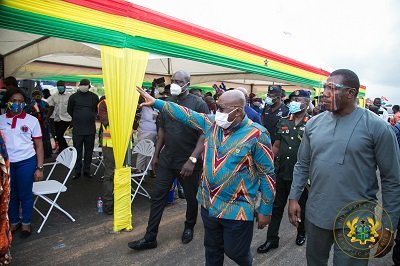
The President, Nana Addo Dankwa Akufo-Addo on Friday commissioned the Suhum Interchange and opened it to traffic.
The interchange, fully funded by the Government of Ghana consolidated fund, was part of the 31.7km Kwafokrom-Apedwa Junction Project.
It is one of the many projects along the Central corridor designated as National Route 6 (N 6) under the Ghana Highway Authority’s functional classification of road.
The project was executed by the Messrs China International Water and Electric Corporation (CWE) with Conptram Engineering Planning and Associates as the consultants.
The opening of the interchange which consisted of two bridges carrying a total of four lanes, with each of the bridges having 10 span reinforced concrete box grinder bridges with a total length of 250 metres, would provide safe and uninterrupted flow of traffic.
It would also facilitate trade between the northern and southern parts of the country and within the West African sub-region.
At a short ceremony to officially open the interchange to traffic, President Akufo-Addo explained that the project, which commenced in September 2008, was initially scheduled to be completed in March 2012.
However, it suffered several challenges mainly associated with payment delays, hence several suspension of the project by the contractor.
He revealed that work resumed in June 2017, on the south bound carriageway including the interchange after some negotiations and payments of arrears were made to the contractor, while the northern bound carriageway including the construction of eight footbridges along the road corridor were all repackaged with work commencing in January 2019, adding that the entire Kwafokrom to Apedwa junction project would be finally expected to be completed in April 2021.
President Akufo-Addo noted “the commissioning was evident of government’s commitment to continue with and complete successfully major infrastructural projects we have inherited from previous governments so that the expected socio-economic benefits can be enjoyed by all”.
He stated that the interchange would alleviate the plight of the general public who use the Accra to Kumasi road and afford residents the comfort of going about their normal activities without fear of being knocked down by vehicles and hence urged motorists and road users to follow the traffic and control management schemes that has been deployed on the road to ensure safety for all.
“Indeed, the improved conditions of our highways owes a collective duty on us the citizenry to be mindful of our responsibilities on the road and I urge motorists to be extra careful on our highways and also resist the temptation of overspeeding on good road sections, adding that improved roads should not be a catalyst of national development nor instruments of death and pain.
He however expressed gratitude of the workers, security agencies, contractors, and the supervising agencies, the GHA for a good work done on the project.
For his part, the Minister for Roads and Highways, Mr Kwesi Amoako-Atta said the project generated thousands of jobs to a number of local companies, adding that the government was committed to completing many road projects.
He called on motorists to be mindful of their act on the road and charged the police to undertake speed checks regularly to ensure safety on the road.
The Project Manager of CWE, Du Huglai said they were committed to completing the entire project if they receive more funding from government.
Source: Ghanaian Times


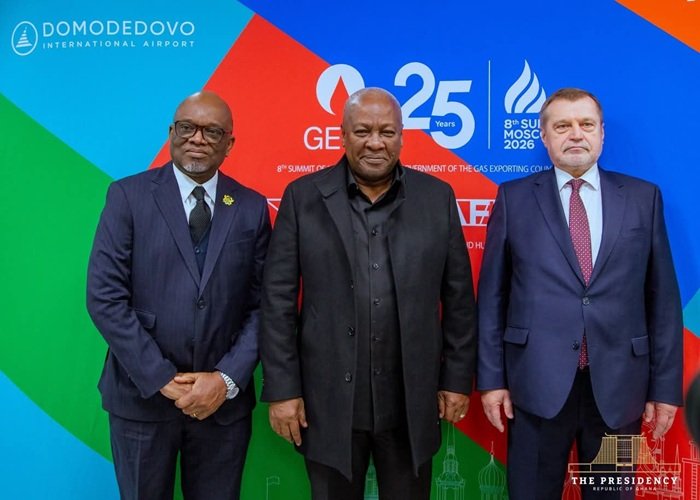
President John Mahama has arrived in Moscow, Russia, from Ethiopia to participate in the 3rd Russia-Africa Summit.
The summit is being hosted by Russian President Vladimir Putin.
During the visit, President Mahama will join fellow African leaders at the Economic and Humanitarian Forum and summit plenary sessions.
He is also scheduled to hold high-level bilateral talks with President Putin and attend a Kente exhibition organised by the Russia-Ghana Parliamentary Forum.
As part of the visit, the President will receive honorary doctorate degrees from the Russian University of Transport and the Peoples’ Friendship University of Russia.
He will also engage Russian businesses and state institutions to advance bilateral cooperation between Ghana and Russia.
By Edem Mensah-Tsotorme
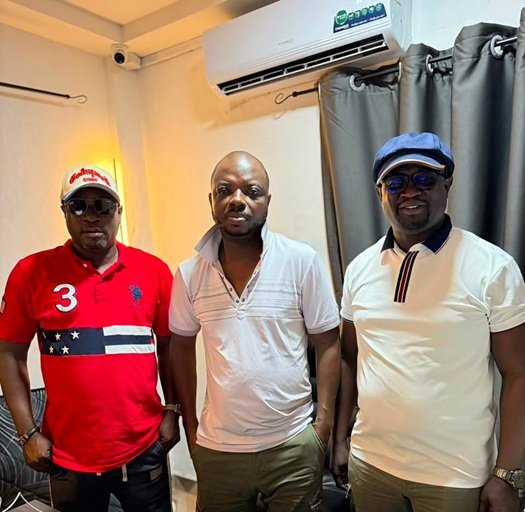
The Greater Accra Regional Organiser of the New Patriotic Party (NPP), Moses Abor, has met with the Bono Regional Chairman of the party, Kwame Baffoe, popularly known as Abronye DC, to address concerns arising from recent social media developments.
In a statement shared , Mr. Abor said he yesterday visited Chairman Baffoe over comments he made on his show, which had raised concern among some party activists.
According to him, he also engaged Charles Opoku Presidoo and ironed out grievances he had earlier held regarding the matter.
Mr. Abor said he was pleased that in the spirit of unity and the party’s shared commitment to return to power in 2028, they had a constructive conversation and addressed the concerns amicably.
“With the matter now resolved, I encourage all Party activists to let the matter rest and redirect our energy toward holding the NDC accountable for its failures and misleading claims,” he said.
He urged party members to continue making the case to Ghanaians on why Dr. Mahamudu Bawumia is the right person to lead the country in 2028.
By Edem Mensah-Tsotorme