News
OSP declares Ken Ofori-Atta wanted again, triggers INTERPOL Red Notice for his extradition

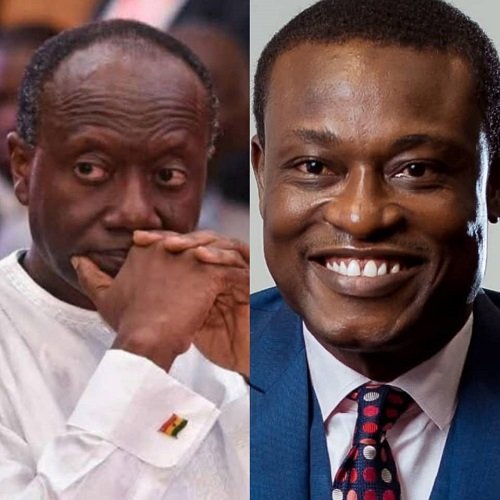
Former Finance Minister, Ken Ofori-Atta has been declared wanted again by the Special Prosecutor, Kissi Agyebeng, for failing to appear before the office as directed.
Mr.Ofori-Atta, who was to appear before the OSP today,June 2, but failed requested a virtual session, citing medical reasons.
His legal team had earlier submitted documentation to the OSP and the Human Rights Court, explaining that he was undergoing treatment abroad and unable to travel.
However, in his response, the OSP said, Ken Ofori-Atta’s medical letter did not state that he was unable to return to Ghana.
Addressing the media today in Accra, the OSP said, he said, Ken Ofori-Atta is a fugitive of justice after failing to appear before them on.
According to OSP, Ken Ofori Atta who is a subject of a criminal investigation, cannot choose how he should be investigated.
He further disclosed that,“We want him here physically, and we insist on it. A suspect in a criminal investigation does not pick and choose how the investigative body conducts its investigations and the methods suitable to him and his convenience. We will not countenance this conduct, not in this case.”
Against this backdrop, he declared Ken Ofori-Atta wanted, adding that an INTERPOL Red Notice had been triggered for his extradition.
“This office has always requested his attendance, and we have indicated clearly to him that we are unwilling to waive it. If we were amenable to taking any statement from Ken Ofori-Atta in absentia, we would have done so in February, and not waited till June 2, 2025,” he noted.
The former Finance Minister is facing probes for his involvement in contracts with Strategic Mobilisation Ghana Limited (SML) for revenue assurance, issues surrounding the National Cathedral project, and other financial dealings during his tenure as Finance Minister from 2017.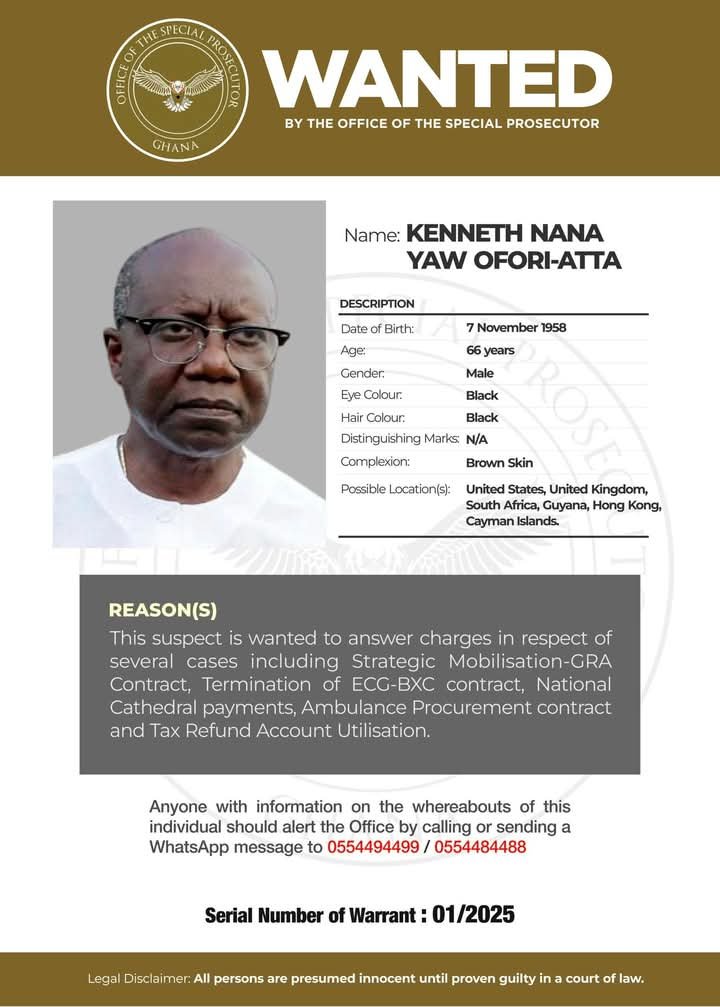
By Edem Mensah-Tsotorme


Women in Sustainability Africa (WiSA) successfully holds the African Women’s Health and Wealth Conference (AWoHW) with a call for research and investment into women’s healthcare.
It also called for robust financial systems and encouraged women to generate wealth as well as prioritise their health.
The conference held at the Shippers House in Accra on Thursday, March 5, 2026, was on the theme, “Championing Inclusive healthcare and finance systems for African women and girls.”
Speaking on behalf of Agnes Naa Momo Lartey, the Minister of Gender, Children and Social Protection, Sabia Kpekata, Programme Officer at the Ministry, said, Financial inclusion remains one of the most critical pathways to women’s empowerment and achieving sustainable development.
According to the minister, it is for this reason that the government continues to support initiatives that expand access to affordable credit, strengthen women-led enterprises and build financial literacy.
“Institutions such as MASLOC, the Women’s Development Bank and other targeted financing mechanisms play a critical role in closing the financial inclusion gap,” she added.
Against this backdrop, she stated that the passage of the Affirmative Action (Gender Equity) Act, 2024 (Act 1121), further strengthens this agenda. By mandating progressive representation of women in decision-making spaces across public and private sectors, the Act ensures that women are not only beneficiaries of financial and healthcare systems, but architects of those systems.
“Women must sit at the policy table where budgets are approved, health priorities are set, and economic policies are designed. This is why the Ministry calls on all stakeholders to push for the effective implementation of the Affirmative Act,” she stated.
Furthermore, she noted that the conference called on everyone to move inclusion from talk to action, incorporating it in budgets, laws, health systems and corporate policies.
She added that the Ministry of Gender, Children and Social Protection is committed to partnering with stakeholders to build inclusive healthcare and financial systems that serve every woman and girl, regardless of location, income, or social status.
“Let us strive to build a Ghana where opportunity is not determined by gender and where systems are designed to uplift, protect and empower,’ she noted.
Addressing the gathering, the Deputy Chief of Staff, Nana Oye Bampoe Addo, said many women suffer from mental health issues as a result of health financing, adding that this is why President Mahama has initiated the Accra Reset to tackle issues relating to women.
Additionally, she commended the Ghana Enterprises Agency for consistently promoting women entrepreneurs.
Nana Oye Bampoe further touched on some government initiatives targeted at women, adding that the government is intentional about women’s empowerment.
On his part, the convener, Nana Yaa Serwaa Sarpong, said, “Today is not just a conference – It is a declaration. It is a declaration that African women and girls will no longer stand at the margins of systems that determine their health, their wealth, and their future.”
According to her, it is a declaration that sustainability is not a slogan for them, rather, it is a strategy, a commitment and a promise.
She said the greatest resource any organisation, community, nation or continent has is its human resources, adding that the continent’s economic prosperity depends on the quality, productivity and capacity of its labour force, including men, women and young people.
The convener noted that where both genders have equal opportunities and operate at near optimal levels, there will be greater economic Expansion and output for the prosperity of all Africans
Additionally, she stated that to drive inclusive economic growth, reduce poverty, amongst others, there is a need for an intentional and clear alignment to economic and social dynamics in specific contexts.
“This will in turn positively impact the involvement and contributions to drive the Sustainable Development Goals (SDGs) and the overall economic prosperity of Africa,” she added.
She further stated that as 2030 approaches, WISA which officially launched on May 1, 2025 in Partnership with the UN Global Compact on behalf of all Women of Africa and of African Descent, will mark a new beginning to accelerate growth towards the closure of the Sustainable Development Goals (SDGs) gaps, by being deliberate to center women at the heart of implementation and compliance.
The Chief Executive Officer of GoldBod Jewellery, Getrude Emefa Donkor, said, Saving alone cannot make one financially sound, adding that investing and having other sources of income is the best way to go.
She also provided some tips for women, calling for discipline in spending, and consistency in saving behaviour, as well as inculcating the habit of budgeting.
WiSA is a Coordinating Pan-African Organization that works with other CSOs, NGOs, Corporate Institutions, local and International Development Organizations and individuals to bring all women, men, young people and women groups together (especially those at the grassroots level) to foster the achievement of the SDGs across Africa.
WiSA stands for the development of new perspectives and catalytic ideas towards accelerating growth for the achievement of the SDGs, including closing the Gender Inequality gap.
By Edem Mensah-Tsotorme
News
Promoting Gender Equity In Governance: Felicia Adjei highlights importance of proportional representation

The Member of Parliament for Kintampo South, Felicia Adjei, has made a statement in Parliament on the importance of proportional representation in promoting gender equity in governance.
Speaking in parliament yesterday, she noted that the Affirmative Action (Gender Equity) Act, 2024 (Act 1121) was a bold step toward encouraging women’s participation, but laws alone cannot guarantee fairness if the electoral system does not support inclusion.
She explained that proportional representation, particularly through Gender-Balance or “zebra” lists where parties alternate between male and female candidates, could help ensure equal opportunities for women in leadership.
The Kintampo MP was of the view that such a system promotes fairness by design rather than leaving representation to chance.
By Edem Mensah-Tsotorme