News
NASA highlights Ghana’s declining forest reserves

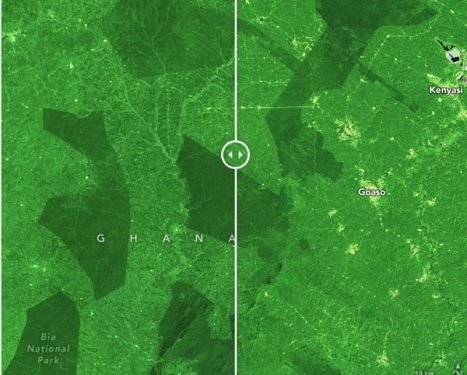
In southwestern Ghana, a patchwork of tropical forest lies among widespread farmland dotted with towns. These forest fragments are remnants of the Upper Guinean forest of West Africa, a biodiversity hotspot that has been diminished by human activity and fires.
Primates, elephants, hippopotamuses, and butterflies are among the thousands of animals that live in the region’s primary forests, which are almost entirely within a network of forest reserves. But satellite images indicate that these protected forest remnants have become even smaller in recent decades.
The false-colour images above, acquired by the Landsat 4 and Landsat 9 satellites, show 12 protected forest reserves and Bia National Park in the Bia-Goaso forest district in 1989 (left) and 2023 (right). The forested canopies of the reserves are dark green, whereas the surrounding landscape is lighter green.
“This area has historically been an important forest habitat for biodiversity, but elephant populations have declined precipitously because of human encroachment and habitat degradation,” said Michael Wimberly, a professor of geography and environmental sustainability at the University of Oklahoma. The photograph below, taken by Wimberly, shows intact forests in a reserve east of the Bia-Goaso region.

Wimberly and a team of researchers in the United States and Ghana used Landsat data to study forest degradation, loss, and recovery in the reserves across Ghana from 2003 to 2019. Although vegetation change was relatively slow from 2003 to 2015, it picked up significantly between 2015 and 2019.
Overall, there was more forest loss and degradation than recovery, resulting in a gradual decline of tree cover.
The drivers of change here are multifaceted, noted Wimberly. In 2016, drought associated with El Niño parched forests and promoted fires across more than 12 percent of Ghana’s moist semi-deciduous and upland evergreen forests. Forest loss was especially prevalent in a reserve known as Bonsam Bepo, south of the city of Goaso.
In a reserve southeast of this image, mining operations contributed to forest loss. In the reserve north of Bia National Forest, widespread logging for timber from 2017 to 2019 led to forest degradation. In other reserves, such as Krokosua (the u-shaped reserve at the bottom of the image), the expansion of cocoa farms has consumed forest. Ghana and neighbouring Côte D’Ivoire produce about two-thirds of the world’s cocoa.
A 2024 United Nations report on the state of the world’s forests highlighted the Forest Data Partnership, an effort to help people in Ghana access remote sensing data to track commodities linked to deforestation and prevent forest loss.
The approach is being field-tested in Ghana and at the joint NASA-USAID SERVIR program’s regional hub for West Africa to help make agricultural production and food systems more sustainable.
Wimberly and colleagues continue to monitor Ghana’s tropical forest landscapes and forest reserves using Landsat data and models to classify the health of forests. Their updated results can be explored in this interactive map.
Source: earthobservatory.nasa.gov









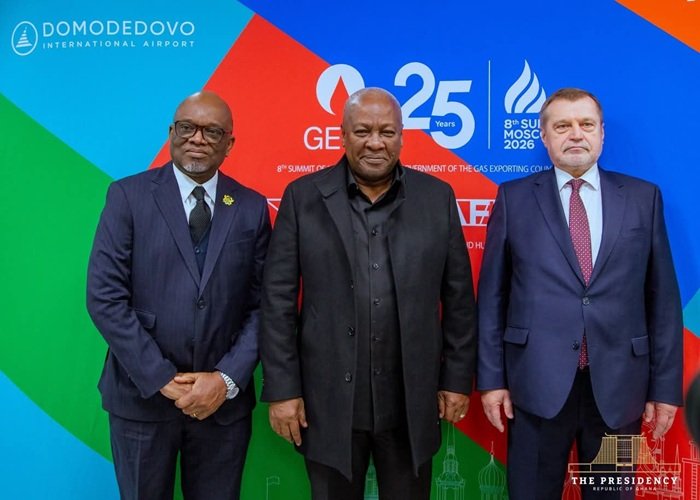
President John Mahama has arrived in Moscow, Russia, from Ethiopia to participate in the 3rd Russia-Africa Summit.
The summit is being hosted by Russian President Vladimir Putin.
During the visit, President Mahama will join fellow African leaders at the Economic and Humanitarian Forum and summit plenary sessions.
He is also scheduled to hold high-level bilateral talks with President Putin and attend a Kente exhibition organised by the Russia-Ghana Parliamentary Forum.
As part of the visit, the President will receive honorary doctorate degrees from the Russian University of Transport and the Peoples’ Friendship University of Russia.
He will also engage Russian businesses and state institutions to advance bilateral cooperation between Ghana and Russia.
By Edem Mensah-Tsotorme
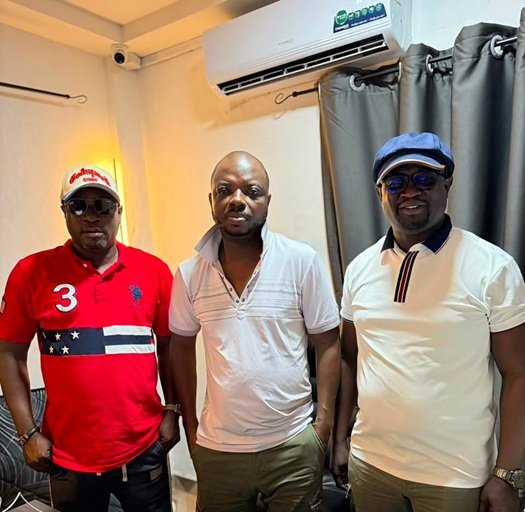
The Greater Accra Regional Organiser of the New Patriotic Party (NPP), Moses Abor, has met with the Bono Regional Chairman of the party, Kwame Baffoe, popularly known as Abronye DC, to address concerns arising from recent social media developments.
In a statement shared , Mr. Abor said he yesterday visited Chairman Baffoe over comments he made on his show, which had raised concern among some party activists.
According to him, he also engaged Charles Opoku Presidoo and ironed out grievances he had earlier held regarding the matter.
Mr. Abor said he was pleased that in the spirit of unity and the party’s shared commitment to return to power in 2028, they had a constructive conversation and addressed the concerns amicably.
“With the matter now resolved, I encourage all Party activists to let the matter rest and redirect our energy toward holding the NDC accountable for its failures and misleading claims,” he said.
He urged party members to continue making the case to Ghanaians on why Dr. Mahamudu Bawumia is the right person to lead the country in 2028.
By Edem Mensah-Tsotorme