News
Nana Yaa Serwaa Sarpong Shines at the 80th UN General Assembly – Speaks and Moderates key Panels on the SDGs, Media Leadership & Impact

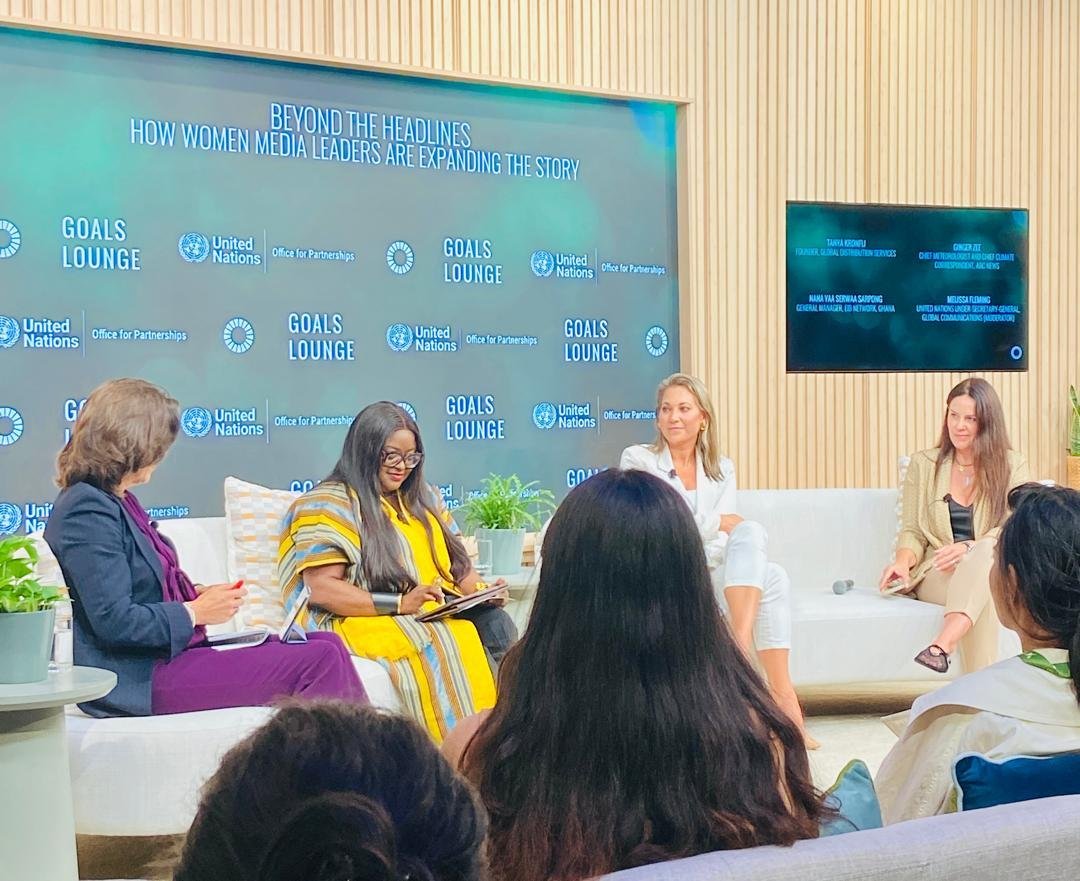
On Thursday September 25, 2025, the 80th United Nations General Assembly (UNGA) witnessed a strong display of African leadership and global collaboration as celebrated Ghanaian media personality Nana Yaa Serwaa Sarpong moderated two high-level panel discussions and delivered remarks on another panel at the Goals Lounge – a special initiative convened by the UN Deputy Secretary-General and hosted by the UN Office for Partnerships.
Nana Yaa, a passionate SDG Advocate who currently celebrates 26 years of impact in media, made Ghana proud at this year’s UNGA in New York.
The Goals Lounge brought together world leaders, UN officials, private sector executives, and media practitioners to address urgent global issues.
Nana Yaa Sarpong shared the stage with distinguished figures including Jessica Alupo, Vice President of Uganda; Annemarie Hou, Executive Director of UN Partnerships; Gerd Müller, Director-General of UNIDO; Edmondo Cirielli, Vice Minister of Foreign Affairs and International Cooperation of Italy; Federica Diamanti, Associate Vice President for External Relations at IFAD; and Melissa Fleming, UN Under-Secretary-General for Global Communication.
The first session she moderated was dubbed “Brewing Sustainability: The Global Coffee Dialogue,” which examined sustainable sourcing and the future of global coffee trade as a means of sustaining livelihood.
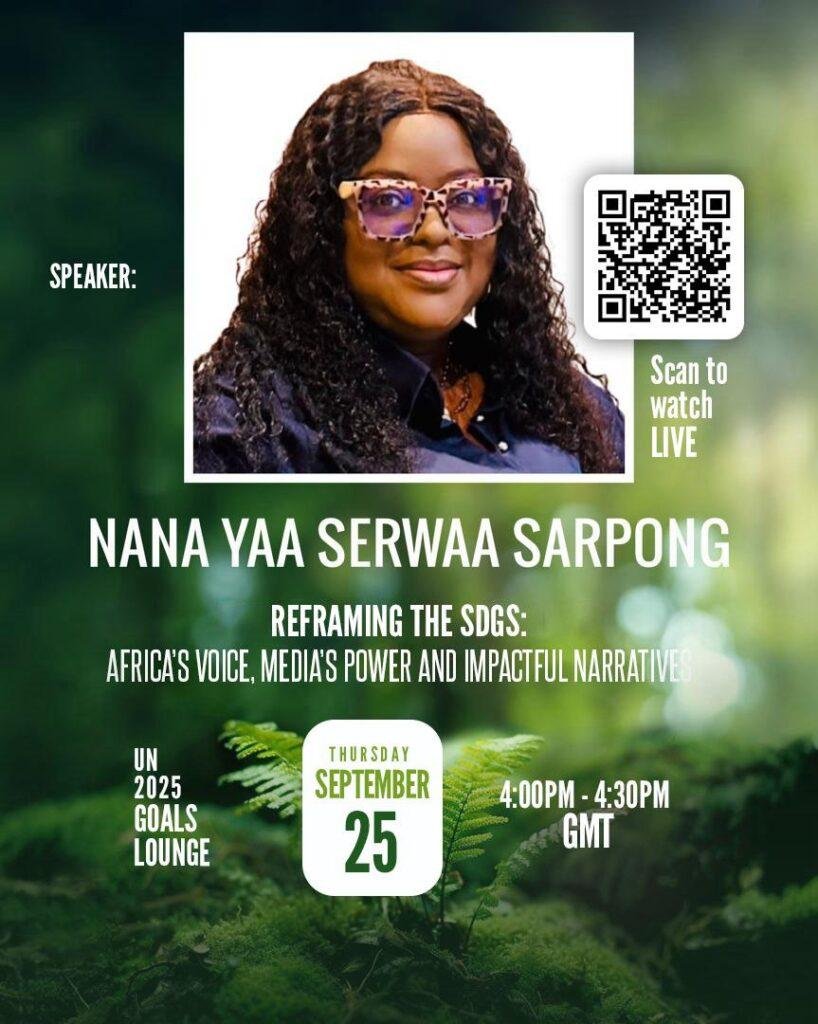
The programme generated insightful sessions where people, ideas, and actions were shared on.
The event spotlighted a multi-stakeholder partnership, strengthening the global coffee value chain as a catalyst for sustainable development. Globally, over 12.5 million farmers depend on coffee production, with 80% grown by smallholder farmers.
The dialogue also brought to the fore coffee’s role linking agriculture, industry, and climate policy, while showcasing the Advancing Climate Resilience and Transformation in African Coffee (ACT) Programme as a platform for investment and collaboration.
Subsequently, she again moderated the insighful panel on ‘Reframing the SDGs: Africa’s Voice, Media’s Power and Impactful Narratives.’
The session explored how Africa can reset the SDG narrative by centering its own voices, experiences, and innovations. Through storytelling for impact, panellists discussed how media can amplify African-led solutions and drive public engagement.
The conversation highlighted the role of journalists, creatives, and communicators in shaping a development narrative that reflects Africa’s complexity, resilience, and promise.
She addressed a session on “Beyond the Headlines: How Women Media Leaders Are Expanding the Story.”
Women media leaders are transforming the industry, breaking barriers, challenging bias, and the evolving role of women in media on reshaping narratives.
This session spotlighted the contribution of women media leaders, with insights from the UN Global Women in Media Report 2025, and the power of inclusive storytelling in shaping public understanding of peace, security, and progress in today’s complex global landscape.
Reflecting on her participation, Nana Yaa Sarpong described the opportunity as both an honour and a responsibility, underscoring the importance of amplifying African voices and centering women in global conversations.
“It is a privilege to use my platform to highlight issues of sustainability, gender equity, and Africa’s leadership in shaping global narratives,” she noted.
The sessions, now available for public viewing, form part of the broader activities of the 80th UNGA in New York, which continues to convene world leaders, policymakers, civil society, and private sector partners in pursuit of accelerated progress on the Sustainable Development Goals.
Also present were Arthur Karuletwa – VP Sustainable Sourcing and Impact, Chobani, Vanusia Nogueira – International Coffee Organization, Executive Director, Solomon Sabiti Rutega – Secretary General, Inter-African Coffee Organisation, Andrea Illy – President of illycaffè, Ambassador John Ulanga – Ambassador and Director of International Trade and Economic Diplomacy at Ministry of Foreign Affairs and East African Cooperation, Kalliopi Mingeirou, Chief of Ending Violence against Women at UN Women; Olusola Momoh, Co-founder and Vice Chairman of Channels Television in Nigeria; Jennifer Zabasajja, Chief Africa Anchor at Bloomberg; and Ginger Zee, Chief Meteorologist and Climate Correspondent for ABC News, among other global voices from international organizations and industry.
Nana Yaa Serwaa Sarpong is also an Entrepreneur, International Trade Consultant, Pastor, Women & Youth and SDG Advocate.
She is the General Manager of Ghana’s media group – EIB Network, and the Founder and President of Women In Sustainability Africa (WiSA), which was recently launched to mark a new beginning to accelerate growth towards the closure of the SDG gaps, including gender inequality.

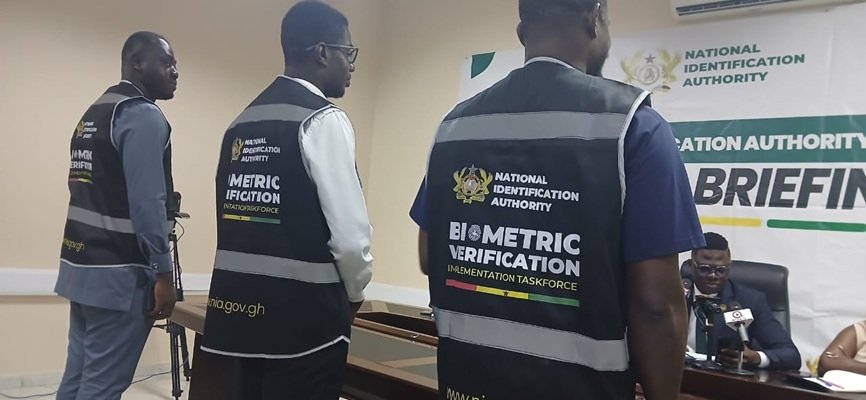
The National Identification Authority (NIA) has announced the commencement of enforcement of the National Identity Register (Amendment) Regulations, 2026 (L.I. 2523), warning institutions that fail to comply with the new requirements of possible fines of up to 2,000 penalty units.
The Authority says it will deploy a Biometric Verification Implementation Task Force to inspect institutions and ensure they comply with the regulations, following the expiration of a three-month grace period granted to businesses and public institutions.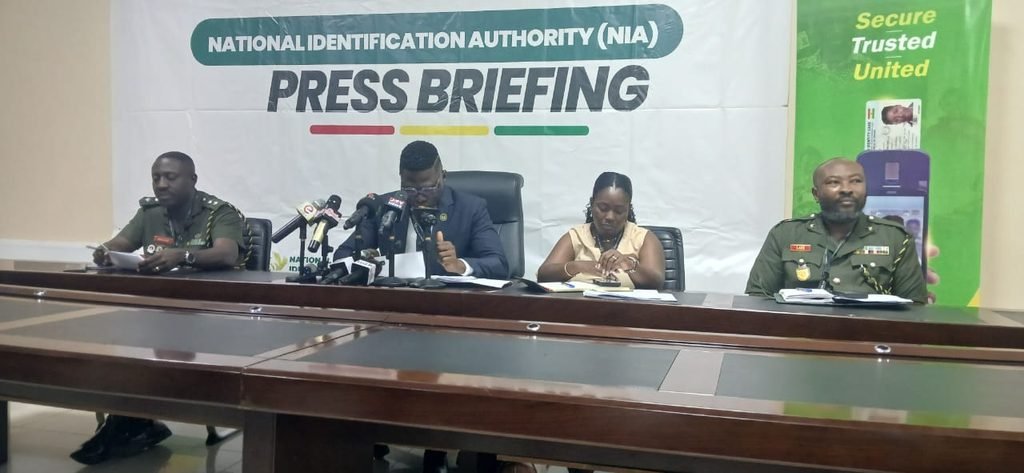
Speaking at a press briefing in Accra on Monday, November 2, 2026, the NIA’s Corporate Affairs representative, William Ampomah Emmanuel Darlas, said the Authority had completed its public education and stakeholder engagement activities and was now moving into the enforcement and compliance monitoring phase.
He explained that the regulations require institutions that verify the identities of customers or applicants as part of their operations to use the NIA’s approved biometric verification platform instead of relying solely on visual inspection of the Ghana Card.
Under the new rules, institutions are prohibited from photocopying, scanning or keeping copies of the Ghana Card for identity verification purposes.
Mr Darlas stressed that simply collecting a customer’s Ghana Card, looking at the photograph and comparing it with the person presenting it would no longer be accepted as a valid method of identity verification.
He, however, clarified that the Ghana Card remains the country’s official national identity document and that citizens are not required to register for a new card or capture their biometrics again under the new regulations.
He said the new system is intended to reduce identity fraud, impersonation and other crimes by ensuring that the person presenting the Ghana Card is the actual owner.
According to him, the biometric verification process will rely on information already captured during Ghana Card registration, including fingerprints, iris details and facial features stored in the card’s chip.
Mr Darlas warned institutions against using third-party companies or individuals to access the NIA’s identity verification platform, insisting that the Authority does not work with intermediaries.
He said institutions seeking access to the National Identity Register must deal directly with the NIA and complete its official onboarding process.
The process requires institutions to prove that they are legally registered companies in Ghana, obtain certification from the Data Protection Commission and work with the NIA’s technical team to establish the necessary connection to its platform.
He further cautioned institutions already connected to the platform against subletting their access to other businesses, particularly small and medium-sized enterprises.
He disclosed that the Authority had received reports of some institutions providing their verification services to other businesses without the NIA’s approval and warned that those involved would face legal action.
Mr Darlas said organisations that fail to comply with L.I. 2523 could face fines ranging from 500 to 2,000 penalty units, depending on the nature of the offence.
He explained that the NIA does not have the authority to impose the fines directly but would take offenders to court for the appropriate punishment.
He indicated that Institutions found guilty could also face additional administrative measures, including being barred from accessing the NIA’s verification platform in the future.
The NIA representative further clarified that the new regulations do not prohibit all institutions from physically using the Ghana Card during transactions.

The Managing Director of the Ghana Publishing Company Limited, Nana Kwesi Boatey, has revealed how he transformed a major overstaffing challenge into a success story through the government’s 24-Hour Economy initiative.
Speaking at the Government Accountability Series on Monday, November 2, Mr. Boatey disclosed that when he assumed office in February 2025, and inherited a bloated workforce of 250 employees doing work that could be efficiently handled by 150 people, a situation that created serious liquidity challenges for the state-owned company.
Instead of resorting to downsizing, he adopted an innovative approach by instituting a 24-hour operational system.
Under the new system, staff were redistributed across three shifts: 7 a.m. – 4:30 p.m., 10 a.m. – 7 p.m., and 10 p.m. – 4:30 a.m.
This not only ensured optimal use of labour but also maximized machine utilization and improved overall output.
According to him, the single move redefined the productivity culture within the company, reinforcing discipline, accountability, and efficiency.
The Ghana Publishing Company’s turnaround is being cited as a practical example of how the 24-Hour Economy policy can drive growth without job losses.
By Edem Mensah-Tsotorme