Features
Monsieur’s daughter – (Part 6)

Gladys opened her eyes, picked up the phone and checked the time. It was just past three. Quite a number of issues were competing for attention in her mind, even though Simon was just by her, snoring gently.
She had already given up on Simon’s laziness and general attitude. But money was becoming a problem. She had done her best to provide for the family, but in some couple of months the WASSCE results would be published, and Sarah would almost certainly be going to university.
How on earth was she going to find money for school fees, hostel accommodation, food and clothing, and pocket money? She was already excited about going to the university, assuming that her mother would find a way to provide her needs. There was almost enough time to start looking for money.
She would go and speak to her bank manager and the folks at the credit union, and she would speak to her friend Catherine with whom she had done joint contracts every now and then. But with the whole house financially dependent on her, it was still going to be quite difficult.
There was, of course, a very simple solution staring her in the face. David Asante. Monsieur. All she needed to do was contact him, and the whole problem, and maybe some of her other problems, would be solved.
But David was the one person she hated with a passion. She hated him for rejecting her, even though she and her family had gone and fallen at his feet to beg for forgiveness. He had stood his ground, dissolved the marriage and flown to Germany.
She admitted that she had made a big mistake. Simon came back to Ghana a few months after she had married David, and she had spent a few evenings in a hotel with him, just to catch some romantic breeze from the past.
He returned a few months later, and they spent another couple of evenings together. That was all. She had no intention of continuing the relationship with Simon. But word had filtered through to David, and he put an emphatic stop to the marriage.
That was quite heartless, and David deserved to be punished for that. She had no regrets, therefore, for telling him that Sarah was not his, but Simon’s baby. That was her emotional retribution for the rejection.
Using her wits, she quickly moved to get Simon to marry her and claim Sarah as his child. If Simon had only made a modest attempt at taking responsibility for the family upkeep, there would be peace. Unfortunately, the house was always in turmoil. She had come to accept the responsibility of taking care of Simon as one of his children.
She got up to get a drink of water from the kitchen. She opened the door and found Sarah seated in the couch, wide awake.
‘Sarah, why, you are unable to sleep? ‘
‘I was waiting to talk to you’.
‘Okay, Sarah. Talk to me. What’s the problem? ‘
‘I want to know who my father is’.
‘How could you say that, Sarah? You know who your….’
‘I want to know who my father is! For a long time I have been hearing the arguments you and Daddy have been making about me. I’m not stupid. Daddy doesn’t like me. I am tired of the confusion in this house. My friends are always asking me what the problem at home is. And I have already heard people saying things. If you won’t tell me, I will take everything into my hands. I won’t continue living like this. I’m tired’.
Simon appeared in the hall and sat down as Gladys stared at the floor.
‘Gladys, if you have anything to set your daughter’s mind at rest, tell her now’. Sarah stared at him.
‘Okay, listen. Your real father is called David Asante. He and I were teachers in the Western Region. He rejected you when you were born, but Daddy stepped in and claimed you, and has been in your life since then. You see, your father is the one who claims you and makes an effort to take care of you. You see, we are not a perfect family, but most families have problems. I’m very sorry for what you call the confusion in this house. Please forgive us.
We will try our very best to keep peace, not only for you but for your siblings too. Daddy and I have already started making plans to find money to take care of your needs when the WASSCE results come in. You are certainly a brilliant student, and we will make sure you go to the university and do something big in future.
I want you to remember, Sarah. Your father rejected you from day one. He hasn’t spent a penny on you since you were born, and he has not tried to find out how you even look like. Is that a father? And another thing. He was always into visiting shrines and the occult, and I don’t think you are safe with him. I would kindly advise you to take it easy for now, and concentrate on your university education. Later on, when you like, you can find him. I don’t know what will happen now if you make the effort’.
‘Sarah’, Simon added, ‘the truth is what your mother has told you. I’m sorry for anything I have said which may have troubled you. Please forgive me, and let’s stick together as a family, okay?’
She nodded and went off to sleep. They sounded a little convincing, she told herself. But she didn’t believe them one bit. She would go and see Ms Odame and present the new information to her. Perhaps she would help her get to the truth.
Later in the morning, she sneaked into her parents’ bedroom, picked her handbag and dashed into the toilet. She removed the phone and scrolled down, but didn’t find what she wanted. Then she took out the little notebook and opened it.
Quite a few phone numbers had been written in it. She scanned carefully, and there it was! David Asante. Her hands shaking, she copied it and replaced the handbag. At long last! Now she was going to confront that irresponsible man who had allowed her to suffer all those years.
Sarah knocked on the door of Ms Odame’s house.
‘Sarah! It’s so good to see you. I was just about to attend a family meeting. Please sit down while I fix you a drink’.
‘Madam, I don’t want a drink. Something happened this morning’.
‘Okay, let me hear it’. She listened as Sarah recounted the discussion she had had with her parents.
‘Sarah, you have suffered for far too long. We will solve the problem today. Give me a minute’, she said. She went to her bedroom and called Mr David Asante’s number.
‘Sarah’, Simon added, ‘the truth is what your mother has told you. I’m sorry for anything I have said which may have troubled you. Please forgive me, and let’s stick together as a family, okay?’
By Ekow de Heer

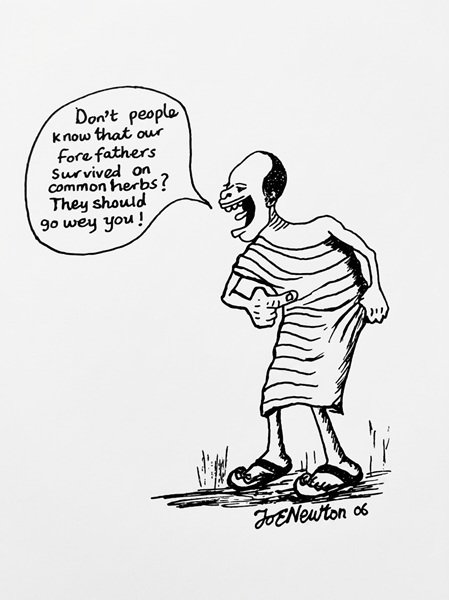
THE typical itinerant salesman in Sikaman is a herbalist. He is normally a slim macho with the capacity to perambulate the expanse of area covering the triangle of Accra-Tema-Ashiaman. In short, he can walk a total of 60 miles a day, marketing a product that cures every disease, including poverty. 
The door-to-door herbal pharmacist advertises his product by word of mouth. He has nothing to do with the Food and Drugs Board (FDB). After all, his concoctions do not feature on FM stations.
Those herbalists who cannot walk to propagate the herbal gospel, liaise with drivers of mass transportation and their mates. They are, therefore, given the chance to sell their products on Benz buses that ply the routes.
Normally, the herbalist starts his sales message with a prayer and Bible study. He asks the passengers to bow down their heads in supplication to God the father, the son, the Holy Spirit.
When a herbalist asks the passengers to close their eyes and bow their heads, Moslems on board naturally feel offended. They feel that the herbalist has no right to assume that every passenger is a Christian. They think such an assumption is an affront to Islam.
So a Moslem on board will raise the hand for a point of order. He’ll remind the herbalist that it would be in his own interest to mind his language.
“Be careful the way you address people in a public place. Not every person here is a Christian,” he’d state assertively.
Of course, the herbalist will promptly ignore him, but would all the same “watch” his tongue. Who knows whether or not the Moslem brother is inspired by Quoranic zeal to defend the tenets of Islam to the hilt?
When he starts saying, “Wallahi!” and “Inshallah!” it could be the beginning of proclaiming Islam as supreme, a point which must be driven home with talibanic precision.
So the herbalist must tread carefully lest he steps on fire.
The herbalist could even add a measure of mirth to it all, by announcing that Christians on board today have very interesting company on the journey, but that should not detract from the business of the day.
The Moslem brother will weigh the words carefully and offer a wry smile.
He must be careful the occasion does not degenerate into the use of semantics and proverbial oration to deride his conviction that public utterances must be mindful of religious sensibilities. He has made his point very clear and expects that it is taken in good faith in the interest of a peaceful journey.
The herbalist will now open the New Testament and preach salvation, stating clearly that salvation can come only through Jesus Christ and NOBODY else.
The Moslem brother will now start twitching his moustache. The visible and almost revolutionary reflexes of his upper lip can be an indication that sentiments have begun superseding reason, and the outcome could well be tragic now shift uneasily in his seat.
The time has come for him to also express his right to the religion of his fore-bears. He’ll put his hand into his pocket and rise to his feet. The time has indeed come!
This article was first published on Saturday, September 9, 2006
When the cause of a particular problem like sickness, disease, sudden illness, a social issue etc. are not known, it stands to reason that resolving it becomes a huge challenge.
Citizens would understand the government when public announcements are made to the effect that government is trying to find a solution to the issue, even though it is taking a while for it to be resolved because citizens are rational beings.
On the other hand, if the solution to a particular issue is known to everybody but the government for whatever reason, is dragging its feet in resolving it, citizens become frustrated and begin to lose trust in their leaders.
One such issue is the heavy traffic along a section of the Kasoa – Odokor road. A short stretch of bad road between the traffic light at the Weija Government Hospital and the entrance to the entrance of the overhead that leads to the N1, is the cause of the problem but nothing is being done about it, day after day, week after week, month after month. Thus is clearly unacceptable.
Another issue that requires urgent attention is the lack of pavements along a lot of streets in parts of the various Municipal Assemblies. Exercise is a prerequisite for long life and healthy living and for those of us who it has become a way of life, this issue of people putting up structures right to the edge of the drains beside the roads, are making life difficult for us.
We are compelled to walk along the roads, putting our lives at serious risk. Pedestrians should never be compelled to compete with vehicles on our streets and roads. Roads and streets are made for vehicles and pavements are made for pedestrians. That is the norm. Any attempt to normalise a situation where pedestrians are mingling with vehicles is insanity.
It is the road regulations that makes it so and therefore district or municipal assemblies are to take responsibility and ensure that spaces for pavements are not encroached upon. Citizens have rights that must be protected by their leaders and making pavements available to pedestrians, is one of them.
When we hear of teachers having sex with students, it appears it is something recent. It is not a new phenomenon. It has been there since Adam. Perhaps this issue is getting much attention due to the proliferation of social media. It was an open secret in times past when Teachers were in relationships with female students and some married them immediately after completion of school.
Some teachers were also known to be having unholy interactions with female pupils but due to the times that these acts occurred, human rights issues and the awareness around it, allowed such unscrupulous teachers to get away with their crimes.
Now we are in a different era and so a Headmaster is now in hot waters. He is alleged to have raped about 19 female students and as usual, some officials tried to cover it up and are also in hot waters and their actions or inactions in the matter are under investigation.
Why the man has been allowed to roam freely without being arrested is simply mind boggling. It appears that the law applies differently, depending on who you are. This issue came to public attention sometime in August this year, yet the police had not arrested or invited this man for question regarding the rape allegation.
It has come out that he is a Constituency Secretary of the ruling party and the question in the public domain is that, is it because he is a political figure that is why he is still walking around without questioning? I believe in the rule of law so let us hold our breadth and let the proper thing be done.
The police must however be seen to be active in this matter. God bless.
SKIP THE QUEUE, TAP THE NEWS
You can now read the Ghanaian Times and The Spectator newspapers from the comfort of your device via TimesNewsPlus.
Join our WhatsApp Channel: https://whatsapp.com/channel/0029VbBElzjInlqHhl1aTU27