News
Minority urges Parliament to pause Chief Justice vetting until court cases end

- /home/u249204778/domains/spectator.com.gh/public_html/wp-content/plugins/mvp-social-buttons/mvp-social-buttons.php on line 27
https://spectator.com.gh/wp-content/uploads/2025/11/IMG-20251112-WA0004.jpg&description=Minority urges Parliament to pause Chief Justice vetting until court cases end', 'pinterestShare', 'width=750,height=350'); return false;" title="Pin This Post">
- Share
- Tweet /home/u249204778/domains/spectator.com.gh/public_html/wp-content/plugins/mvp-social-buttons/mvp-social-buttons.php on line 72
https://spectator.com.gh/wp-content/uploads/2025/11/IMG-20251112-WA0004.jpg&description=Minority urges Parliament to pause Chief Justice vetting until court cases end', 'pinterestShare', 'width=750,height=350'); return false;" title="Pin This Post">
The Minority in Parliament has called on the House to suspend the vetting of Justice Paul Baffoe-Bonnie as Chief Justice until all court cases challenging the removal of Justice Gertrude Torkornoo are concluded.
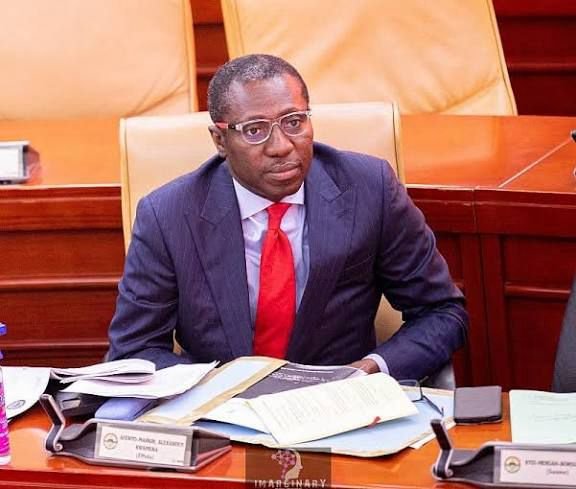
Minority Leader Alexander Afenyo-Markin urged Parliament to use its discretion under Order 5 of the Standing Orders to pause the vetting process, stressing that doing so would protect the integrity of the Constitution and prevent a possible crisis.
He explained that the Supreme Court, High Court, and ECOWAS Court were already handling several cases concerning the legality of Justice Torkornoo’s removal and that the courts could fast-track these cases if the State cooperated instead of delaying proceedings.
According to him, the Judiciary is not without leadership since Justice Baffoe-Bonnie continues to act as Chief Justice under Article 144(6) of the Constitution.
He argued that there would be no crisis if Parliament waited for the courts to finish their work, but a real crisis could occur if a new Chief Justice is confirmed and the courts later overturn the removal, leading to two people claiming the same office.
Mr. Afenyo-Markin said the President’s power to nominate a Chief Justice under Article 144(1) was not in question.
However, he stressed that Parliament’s power to approve nominees must be exercised with respect for the separation of powers, judicial independence, and the sub judice rule, which prevents actions that may influence ongoing court cases.
He warned against misinterpreting the recent Supreme Court ruling in Vincent Assafuah v Attorney-General as permission for Parliament to proceed.
He explained that the Court only refused to issue a temporary injunction on procedural grounds and did not rule that the removal of Justice Torkornoo was lawful.
The Minority Leader said the Assafuah ruling applied the Moffat principle, which discourages courts from stopping government work because of frivolous suits.
However, he noted that the decision was not meant to encourage constitutional bodies to act without caution while serious cases were still pending.
He stated that the Supreme Court’s reasoning balanced the need to maintain judicial integrity with ensuring that constitutional duties continue smoothly.
The ruling, he added, was never meant as a go-ahead for Parliament to act hastily.
Mr. Afenyo-Markin explained that the Court’s decision not to compel Parliament to stop its work was out of respect for the separation of powers, not because it believed Parliament should disregard the courts.
He clarified that the Minority’s appeal was not for the Judiciary to control Parliament but for Parliament to exercise its own constitutional conscience by choosing to wait until the courts deliver their judgments.
He added that the Supreme Court assumed that constitutional bodies like Parliament would act wisely and in good faith, not mechanically, when performing their duties.
Mr. Afenyo-Markin also referred to Article 64(2) of the Constitution, which allows certain presidential acts to stand even after a court invalidates an election to prevent chaos.
He cautioned, however, that this provision was never meant to encourage recklessness or to create irreversible constitutional problems.
He warned that if Parliament confirms Justice Baffoe-Bonnie while the courts are still handling challenges to Justice Torkornoo’s removal, Ghana could face a constitutional crisis involving two claimants to the office of Chief Justice.
He argued that such a development would damage the reputation of Parliament and undermine public confidence in the country’s democratic institutions.
The Minority Leader maintained that waiting for the courts to conclude the cases would demonstrate Parliament’s maturity, fairness, and commitment to constitutional principles.
He said taking a short pause would protect the rule of law and show that Parliament values legality over haste and principle over politics.
“The prudent path, the constitutional path, is to wait,” he emphasized.
By: Jacob Aggrey




Over 20 structures built within the 50-metre buffer zone of the Kpeshie Lagoon at the Laboma Beach Resort in the La Dade-Kotopon Municipality were on Sunday demolished by the Greater Accra Regional Coordinating Council (GARCC).
Buildings such as single-unit semi-detached under construction and completed chalets at the resort were pulled down while portions of a newly constructed perimeter wall were also demolished. Read More
SKIP THE QUEUE, TAP THE NEWS
You can now read the Ghanaian Times and The Spectator newspapers from the comfort of your device via TimesNewsPlus.
Join our WhatsApp Channel: https://whatsapp.com/channel/0029VbBElzjInlqHhl1aTU27

About 120 golfers from clubs across Ghana participated in an 18-hole competition, dubbed ‘MTN 30th Anniversary CEO Invitational Golf Tournament’ held at the Achimota Golf Club on Saturday.
At the end of the hectic day, Frederick Semenu Duvor won the Men’s Group A event with 39 points, while Julienne Afi claimed the Ladies’ Group A title with the same score.
Yaw Mireku Jnr. won the Men’s Group B with an impressive 45 points, while Kous Louanges Mang took the Ladies’ Group B title with 38 points.
Kofi Mangesi won Men’s Group C with 40 points while Elorm R. Akuash Bonney claimed the Ladies’ version with 42 points.
In the Seniors Division, Jan Vogel emerged winner of the men’s category with 39 gross, while Helen Appah topped the ladies’ category with 44 gross.
Addressing participants, the company’s Board Chairman, Mr Ishmael Yamson, urged the company to approach its next phase with the same resilience, discipline and determination that have defined its success over the past three decades.
He drew a striking parallel between the game of golf and MTN Ghana’s three-decade journey, describing both as long games in which success depends less on one spectacular moment than on consistency, patience, judgment and the ability to recover from setbacks.
He said, golf had taught him a lesson that extended far beyond the fairways, thus, a round cannot be won on the first hole.

In golfing terms, he said, MTN Ghana had encountered its share of regulatory bunkers, competitive hazards and unexpected storms that had forced the company to pause, reassess and change its approach.
But those challenges, he suggested, were part of the journey rather than reasons to abandon it.
By Andrew Nortey
SKIP THE QUEUE, TAP THE NEWS
You can now read the Ghanaian Times and The Spectator newspapers from the comfort of your device via TimesNewsPlus.
Join our WhatsApp Channel: https://whatsapp.com/channel/0029VbBElzjInlqHhl1aTU27

 Entertainment1 week ago
Fiifi Coleman Productions adapt ‘I Told You So’ stage play into feature film
- Entertainment5 days ago
Rhythms On Da Runway returns November 28 with 16th edition themed ‘Unbound’
- News6 days ago
48 Engineer Regiment to be major sub-contractor on Accra-Kumasi Expressway, $2bn ready- Prez Mahama