Features
Marriage palaver – Part 2


Sikaman is always a hot ground for the bachelor who has to sweep his own room, fetch his own water, clean the bathroom, clean the dishes, and of course cook his own banku.
But cooking for instance, does not present much of a problem since the bachelor can forever procure food in the form of Hausa koko, koose, waakye, kenkey and shito, as well as roasted groundnuts from sellers who are constantly playing hide-and-seek with AMA authorities.
The typical bachelor who becomes an incorrigible patron of wayside food peddlers is normally malnourished due to obvious reasons.
Apart from the fact that most food sellers do not give a damn about quality, it may also happen that in the locality of the bachelor, there are only kenkey sellers.
For eight years running, the bachelor devours kenkey in all its forms and ramifications: kenkey and shito, mashed kenkey with sugar, fermented kenkey (a favourite of alcoholics), and kenkey with pear. The dessert is usually iced water.
If the bachelor’s mother does not take pains to visit him once a fortnight to prepare him ‘home food,’ then of course he will sooner or later die of ‘kenkeymatics,’ which is a disease that attacks bachelors in the Accra Metropolitan Area.
Some bachelors, however, run their home like a pseudo-marriage enterprise. The bachelor has a girl-friend who comes and goes as and when her services are needed. She often spends the night if there is no risk of an earthquake resulting from the clash of rivals.
BACHELOR
However, it become rather expensive running a bachelor home with a commuter girl-friend who must be paid fat allowances for cooking, washing, dancing, sleeping and of course, romance. And if you refuse to provide her with a full-shoe, full-dress, full-chicken and full-jelly curls during X’mas, you’ll never see her tail again except in your dreams.
As it were, it is better to get married because a wife does not disappear just because you cannot afford the ‘fullness’ of everything. Marriage is, therefore, the ideal thing, but how many bachelors can afford to marry without going bankrupt?
In some parts of Northern Ghana for instance, if you don’t have four cows it means you can always be assured of dying a bachelor-boy. This is rather unfair to those who do not rear cows and therefore have to purchase four cows with hard cash before getting a wife who will start misbehaving the next day.
In spite of the problematic nature of Sikaman marriages, research has always indicated that married people live longer than their unmarried counterparts.
The reason is quite simple. Married life is the most ideal for an adult. In marriage, contrary to most opinions, one is more relaxed, has time to pursue ambitions, and eats balanced diet and much more. Married people are always disciplined and responsible and are rewarded accordingly.
It is, therefore, rather unfortunate that certain marriages are more disastrous than ‘bachelorships’ or ‘spinsterships.’
The process of getting married itself is a time-consuming venture, and is not achieved in a single day. It starts with courtship which is the beginning and, therefore, the sweetest part of it.
Boy and girl are usually encased in a dreamland savouring love for each other. Some girls so admire their tall handsome boy- friends that they keep worshipping them and forget about God.
Some boys also bow to girls who wear spectacles. And both parties want to put up the best of impressions. Hot-tempers are regulated with safety valves; the best clothes are worn during dates, and the daintiest of manners are exhibited.
During this period, the males miraculously have an inexhaustible supply of cash and the females are also poised to receive gifts before they reciprocate one way or the other, Love letters are written with chosen words that evoke love and overpowering sentiments.
Then comes time for a proposal that is if that had not preceded courtship, because some men propose marriage long before they begin courting.
Proposing marriage can, however, be an awkward part of the whole show, especially when the man is not too sure about what the girl’s response will be.
The faint-hearted aspiring husband, therefore, takes a good measure of mahogany-bitters to sharpen the edge of his tongue with which he is going to deliver the message in phonetical tone.
That way, the girl can never refuse, because with some Oxford accent backed by alcoholic power, the proposal becomes the sweetest music in the ear of a maiden.
Alas, the engagement is no joke. A mediocre engagement ring is around GH¢15,000, and that is only a fraction of the estimated expenditure. Apart from the presentation of several items that run into many thousands of cedis, the groom must hold a reception for people whose stomachs are specially designed for engagement parties. Such well-wishers accommodate every drinkable from palm wine to champagne and will digest anything especially left-overs.
It is, however, often tragic for the groom when invited guests and well-wishers do not donate the money value far and above the equivalent of what they eat and drink. And of course, some quick- witted guests will donate according to the quantity of beer, chips and jollof rice served them.
An engagement party, therefore, becomes a refined chop bar where you pay according to what you are served.
When the engagement ring is put on the girl’s finger, a certain magical change occurs within her which would be shown in fine colours im mediately she gets under the same roof with the man.
And true like hell, problems begin from the financial angle.
The man feels that although he has not yet wedded the girl, she is now a wife who will understand matters when he cannot afford a full-shoe in the face of rising cost of living and the inability of many corporations and companies to pay the minimum wage.
DOMESTIC
Grudges and grievances are stored in the heart. The woman begins to nag and the man may feel misunderstood. When tension rises to breaking point, he must start boxing training for the eventual showdown.
That way he’d not be found lacking when it comes to vying for the domestic kenkey weight championship title. If the husband is a southpaw, the situation becomes very dangerous.
Happy marriages are rare in Sikaman. Two out of every five marriages do not travel the entire distance. It sooner or later runs out of steam because of fighting, nagging, infidelity, womanising, arrogance, interference of in-laws, and chop- money palaver.
My pal Robert Kempes Paani Ofosu- ware observes that happy marriages are those that are run with plenty of cash and everything flowing around.
According to him, “Nagging, fighting, arrogance and infidelity on the part of the woman will cease or become minimised when the house is adequately provided for and the wife is enjoying material wealth.
Contrary to this school of thought, Nii Odai TT, alias Goukouni Weddeye says that money per se is not an important factor. An arrogant and disrespectful girl, he notes, will persist in her obstinacy whether or not she is offered a million cedis, in other words, some girls ate congenitally stubborn and, therefore, incorrigible.
Dear reader, which of these schools do you sympathise with?
This article was first written on Saturday June, 2, 1990

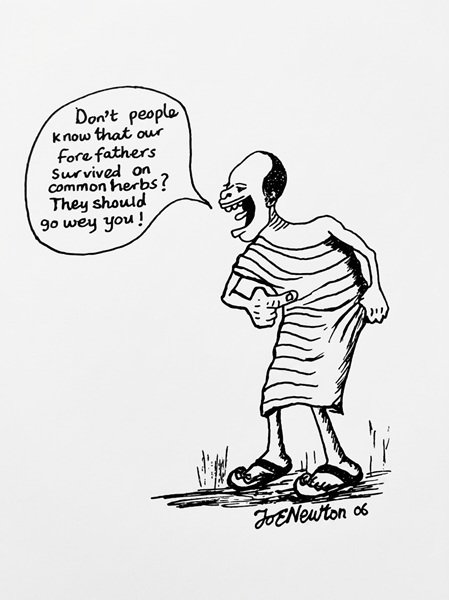
THE typical itinerant salesman in Sikaman is a herbalist. He is normally a slim macho with the capacity to perambulate the expanse of area covering the triangle of Accra-Tema-Ashiaman. In short, he can walk a total of 60 miles a day, marketing a product that cures every disease, including poverty.
The door-to-door herbal pharmacist advertises his product by word of mouth. He has nothing to do with the Food and Drugs Board (FDB). After all, his concoctions do not feature on FM stations.
Those herbalists who cannot walk to propagate the herbal gospel, liaise with drivers of mass transportation and their mates. They are, therefore, given the chance to sell their products on Benz buses that ply the routes.
Normally, the herbalist starts his sales message with a prayer and Bible study. He asks the passengers to bow down their heads in supplication to God the father, the son, the Holy Spirit.
When a herbalist asks the passengers to close their eyes and bow their heads, Moslems on board naturally feel offended. They feel that the herbalist has no right to assume that every passenger is a Christian. They think such an assumption is an affront to Islam.
So a Moslem on board will raise the hand for a point of order. He’ll remind the herbalist that it would be in his own interest to mind his language.
“Be careful the way you address people in a public place. Not every person here is a Christian,” he’d state assertively.
Of course, the herbalist will promptly ignore him, but would all the same “watch” his tongue. Who knows whether or not the Moslem brother is inspired by Quoranic zeal to defend the tenets of Islam to the hilt?
When he starts saying, “Wallahi!” and “Inshallah!” it could be the beginning of proclaiming Islam as supreme, a point which must be driven home with talibanic precision.
So the herbalist must tread carefully lest he steps on fire.
The herbalist could even add a measure of mirth to it all, by announcing that Christians on board today have very interesting company on the journey, but that should not detract from the business of the day.
The Moslem brother will weigh the words carefully and offer a wry smile.
He must be careful the occasion does not degenerate into the use of semantics and proverbial oration to deride his conviction that public utterances must be mindful of religious sensibilities. He has made his point very clear and expects that it is taken in good faith in the interest of a peaceful journey.
The herbalist will now open the New Testament and preach salvation, stating clearly that salvation can come only through Jesus Christ and NOBODY else.
The Moslem brother will now start twitching his moustache. The visible and almost revolutionary reflexes of his upper lip can be an indication that sentiments have begun superseding reason, and the outcome could well be tragic now shift uneasily in his seat.
The time has come for him to also express his right to the religion of his fore-bears. He’ll put his hand into his pocket and rise to his feet. The time has indeed come!
This article was first published on Saturday, September 9, 2006
When the cause of a particular problem like sickness, disease, sudden illness, a social issue etc. are not known, it stands to reason that resolving it becomes a huge challenge.
Citizens would understand the government when public announcements are made to the effect that government is trying to find a solution to the issue, even though it is taking a while for it to be resolved because citizens are rational beings.
On the other hand, if the solution to a particular issue is known to everybody but the government for whatever reason, is dragging its feet in resolving it, citizens become frustrated and begin to lose trust in their leaders.
One such issue is the heavy traffic along a section of the Kasoa – Odokor road. A short stretch of bad road between the traffic light at the Weija Government Hospital and the entrance to the entrance of the overhead that leads to the N1, is the cause of the problem but nothing is being done about it, day after day, week after week, month after month. Thus is clearly unacceptable.
Another issue that requires urgent attention is the lack of pavements along a lot of streets in parts of the various Municipal Assemblies. Exercise is a prerequisite for long life and healthy living and for those of us who it has become a way of life, this issue of people putting up structures right to the edge of the drains beside the roads, are making life difficult for us.
We are compelled to walk along the roads, putting our lives at serious risk. Pedestrians should never be compelled to compete with vehicles on our streets and roads. Roads and streets are made for vehicles and pavements are made for pedestrians. That is the norm. Any attempt to normalise a situation where pedestrians are mingling with vehicles is insanity.
It is the road regulations that makes it so and therefore district or municipal assemblies are to take responsibility and ensure that spaces for pavements are not encroached upon. Citizens have rights that must be protected by their leaders and making pavements available to pedestrians, is one of them.
When we hear of teachers having sex with students, it appears it is something recent. It is not a new phenomenon. It has been there since Adam. Perhaps this issue is getting much attention due to the proliferation of social media. It was an open secret in times past when Teachers were in relationships with female students and some married them immediately after completion of school.
Some teachers were also known to be having unholy interactions with female pupils but due to the times that these acts occurred, human rights issues and the awareness around it, allowed such unscrupulous teachers to get away with their crimes.
Now we are in a different era and so a Headmaster is now in hot waters. He is alleged to have raped about 19 female students and as usual, some officials tried to cover it up and are also in hot waters and their actions or inactions in the matter are under investigation.
Why the man has been allowed to roam freely without being arrested is simply mind boggling. It appears that the law applies differently, depending on who you are. This issue came to public attention sometime in August this year, yet the police had not arrested or invited this man for question regarding the rape allegation.
It has come out that he is a Constituency Secretary of the ruling party and the question in the public domain is that, is it because he is a political figure that is why he is still walking around without questioning? I believe in the rule of law so let us hold our breadth and let the proper thing be done.
The police must however be seen to be active in this matter. God bless.
SKIP THE QUEUE, TAP THE NEWS
You can now read the Ghanaian Times and The Spectator newspapers from the comfort of your device via TimesNewsPlus.
Join our WhatsApp Channel: https://whatsapp.com/channel/0029VbBElzjInlqHhl1aTU27