News
Marriage based on lies will not last – Catholic Priest

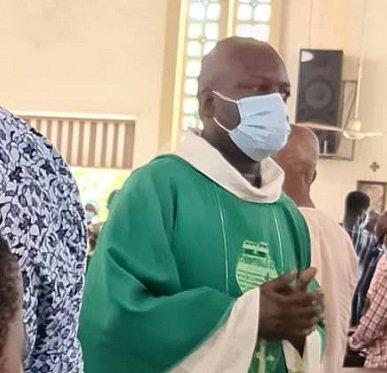
A Catholic Priest at the St. Augustine Catholic Church in Ashaiman, Reverend Father Tapera Muserere (SVD), has advised persons intending to marry not to do so with an ulterior motive or under compulsion.
He explained that it was important for a person to come freely with his or her choice of partner to the church but should remember that “the church does not force people to marry”.
“If your marriage is based on lies, you will cry tomorrow ” he said delivering a sermon at the St. Augustine Catholic Church in Ashaiman on the 27th Sunday in Ordinary Time under the theme “Marriage and Family Life”.
Rev Fr. Muserere said marriage was a covenant and a contract, therefore, if a person was brought to the Church for the wrong reasons or based on lies for marriage, it had serious implications.
“You fooled the person, you didn’t tell him or her the truth. That means that marriage was not a covenant in the first place” he stressed.
The Catholic Priest said there had been instances where people who had been previously married traditionally failed to disclose this to their partners who only found out after their marriage had been solemnised.
He said others who had children also failed to disclose that information to their potential spouses for fear that they would be rejected.
These reasons according to him were not justifiable in any sense and were enough grounds for nullification of the marriage.
Rev Fr. Muserere said truth was key for a successful marriage and a marriage which was based on lies could never survive.
He advised singles to pray over their potential spouses and ask God to give them spouses who would love them and they could do same to be able to stick together in thick and thin.
He said for those who were already married but living unnaceptable lives and hiding behind the excuse “that it was the work of the devil” should have a change of life, be disciplined and rather ask God for strength instead if being comfortable hiding behind the so-called devil.
He charged all married couples to pray to God to intervene in whatever challenges they might be going through and ask Him to strengthen them for the rest of the journey ahead because every marriage had its own challenges, and needed the help of God. END
From Dzifa Tetteh Tay, Ashaiman.



Management and staff of Owass FM have announced the passing of media personality, comedian and politician Seth Kwame Dzokoto following a medical emergency during a live morning show discussion at the station earlier today.
According to the station, Dzokoto was participating in a panel discussion on its morning show “Oman Nkoso” when he suddenly took ill and collapsed.
A statement from the station said its team immediately rushed him to the hospital for medical attention, but he was pronounced dead by the attending medical doctor upon arrival.
“We are deeply saddened by this unfortunate incident, which occurred in the course of our regular programming. Our thoughts and prayers are with his family, loved ones, colleagues, and all those who have been affected by his passing,” the statement said.
Management acknowledged that information about the incident is already circulating in the public domain, but appealed to the public and colleague media houses to respect the privacy of the bereaved family and refrain from circulating unverified information or speculation regarding the circumstances of his death.
Owass FM extended its heartfelt condolences to the family of Seth Kwame Dzokoto.
By Edem Mensah-Tsotorme

The State through the Attorney General (AG) has filed an appeal at the Supreme Court challenging the suspension of the trial in the case of The Republic v Hanan Aludiba and Faiza Seidu.
On Monday, the Court of Appeal suspended the trial in the case. But the prosecution says it has filed an appeal against the suspension order.
According to the update, the law does not allow a criminal trial to be suspended simply because an accused person has complained about some of the charges on the charge sheet, particularly when those complaints were dismissed as meritless.
It argues that if the Court of Appeal’s decision is allowed to stand, no prosecution will ever be possible, since all it would take for a trial to be suspended is an accused person complaining about anything on the charge sheet.
By Edem Mensah-Tsotorme