News
Lawmakers carried out during Hong Kong parliament mayhem

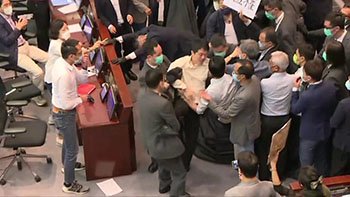
A number of pro-democracy lawmakers in Hong Kong were dragged out of the chamber during a row about a Chinese national anthem bill.
The bill would criminalise disrespect of the anthem.
Legislators were arguing over the leadership of a key committee, which would affect the bill’s progress.
One of the lawmakers carried out, Eddie Chu, told the BBC: “If Hong Kong was a democracy, we would not need to start scuffles like this.”
He added: “Unfortunately we are forced into this situation. I can foresee more fights within the chamber and outside the chamber.”
The chaotic scenes highlight the deep divisions in Hong Kong, which is a special administrative region of China.
Although last year’s street protests died down during the pandemic, some demonstrations are expected to resume.
It’s the second time in recent days there have been scuffles in the Legislative Council.
The Legislative Council was in dispute over who should run the house committee, which scrutinises bills and decides when they are voted on.
Last week, the council president appointed Chan Kin-por, a pro-Beijing lawmaker, to oversee the election of a new leader.
On Monday – before the Legislative Council began – Mr Chan was in the chairman’s seat, surrounded by more than 20 security guards.
As pro-democracy lawmakers entered the room, they tried to reach the seat, but were stopped by the guards.
As the guards used blankets to corral the protesters, others pointed and yelled from their seats.
One lawmaker held a sign that said: “CCP [Chinese Communist Party] tramples HK legislature.”
During the melee – which went on for several minutes – at least one person fell to the ground, apparently injured.
At one point, a lawmaker took a running jump to try to reach the chairman’s bench, but was stopped in mid-air by guards.
After most of the pro-democracy lawmakers left – or were removed – the pro-Beijing Starry Lee was elected chairwoman of the house committee.
This, her opponents fear, will make it easier for the national anthem bill to be passed.
China wants a controversial bill that would criminalise abuse of China’s national anthem to get passed as soon as possible.
But the house committee – responsible for scrutinising controversial bills, including the national anthem one – has failed to select a chairperson for months. -BBC


THE Gospel Advocates (TGA), a non-denominational evangelistic Christian organisation last Saturday donated a number of educational logistics to the Dodi Asantekrom Basic School in the Eastern region of Ghana.
The gesture was to mark the seventh anniversary of the organisation made up of professionals committed to preaching the gospel of Jesus Christ to students in senior high schools, particularly in rural communities.
TGA also seeks to inspire students towards attaining academic excellence and guiding them towards optimising the various learning opportunities and academic programmes available at the tertiary level.
Among the items donated were 100 desks, 10 cupboards, 10 desktop computers, two laptops, 10 teachers’ tables and chairs and others.
The group also held its annual outreach programme that had a significant impact in the community through initiatives such as feeding 500 children with hot meals and assorted drinks, providing free medical screening and drugs for 500 adults and youth and conducting health education and sensitisation for both children and adults.
TGA also took upon itself to restock the community clinic with essential medicines and distributed food items, plastic bowls, cups and clothing to members of the community.
The initiative, according to officials of the group, was supported by ORSAM Limited, Doctors Save Lives Foundation, Johnson Tord Foundation, El-Shaddai Mothercare, Exceed Alliance Limited, GB Foods Ghana Limited, Qualiplast Limited, Phyto-Riker (Gihoc) Pharmaceuticals Limited, Cosa Bright Ghana, Kabs Pharmacy, Tobinco Pharmaceuticals, Pill Bay Pharmacy and Bamah 3.7.7.
“We are deeply grateful for their immense support and partnership in bringing hope, relief, and practical assistance to the people of Dodi Asantekrom,” the officials said.
In a statement, the President and Chairman of The Gospel Advocates, Mr. Selom Kpikpitse, said the donation to Dodi Asantekrom forms part of TGA’s broader mission to propagate the gospel of Jesus Christ among students and youth in rural communities through teachings, music and arts.
He explained that the meals provided to over 500 pupils were in line with the organization’s annual “Feed the Kidz Project,” which demonstrates Christ’s love.
Receiving the items on behalf of the school, the Headmaster, Mr. Otumfour Newton, expressed gratitude to TGA and its sponsors, saying that “the items would significantly enhance teaching and learning while improving the overall welfare and development of the pupils.”
Mr. Newton also commended the team for the free medical screenings for adults and youth in the community, and other community engagements.
Medical supplies were also donated to the Dodi Asantekrom CHPS compound and received on behalf of the facility by Mr. Amefu, a Physician Assistant.
By Spectator Reporter
Join our WhatsApp Channel now!
https://whatsapp.com/channel/0029VbBElzjInlqHhl1aTU27


AS Ghana celebrates its 69th Independence Day, the country reflects on the vision of its first President, Kwame Nkrumah. Beyond political freedom, Nkrumah dreamed of building a modern, self-reliant nation.
He launched ambitious projects aimed at industrialisation, job creation, and to position Ghana as a leader in Africa.
Many of these projects were interrupted or abandoned after the 1966 coup that removed him from power. Today, these projects remain reminders of bold ambitions and opportunities for revival.
1. The Black Star Line
One of Nkrumah’s earliest initiatives was the Black Star Line, Ghana’s first national shipping company. Established in 1957, it aimed to boost trade and reduce dependence on foreign vessels. Nkrumah envisioned a fleet of Ghanaian ships transporting goods across Africa and beyond.
The project, however, suffered from poor management, financial challenges, and political instability. After the 1966 coup, the Black Star Line collapsed, leaving a gap in Ghana’s maritime sector. Today, the country still relies heavily on foreign shipping, showing how Nkrumah’s foresight was ahead of its time.
2. Railway expansion
Perhaps Nkrumah’s most enduring domestic dream was a nationwide railway network. He wanted lines connecting northern and southern Ghana, linking agricultural zones to factories, and connecting mines to ports. Railways were to be the backbone of industrialisation, enabling efficient transport of goods and people.
Much of this vision remains unrealised. Expansion stalled after 1966, and the network has suffered decades of neglect.
- Juapong textile factory
- Tomato and fruit processing plants: Designed to add value to agricultural produce, but operations collapsed due to inconsistent supply and lack of technical expertise.
Modernisation efforts by successive governments, including the construction of the Tema–Mpakadan line and rehabilitation of parts of the Western Line, have only partially restored his vision. A fully integrated railway system, particularly linking northern regions, remains a work in progress.
3. Accra–Tema Industrial corridor
The Accra–Tema Motorway, constructed in the early 1960s, was intended to anchor an industrial corridor connecting factories, ports, and residential areas.
The motorway itself was completed and remains a key route, but many industrial zones along the corridor were never built, limiting the economic impact of the project.
4. Defunct factories and industrial ambitions
Through the Ghana Industrial Holding Corporation (GIHOC), Nkrumah established numerous state-owned factories to reduce imports, create jobs, and industrialise the country. Many of these factories, however, became defunct due to poor management, political changes, and economic challenges.
Some notable examples include:
- Textile factories: Aimed at making Ghana self-reliant in clothing production, but most shut down after Nkrumah’s overthrow.
- Brick, tile, and cement factories: Intended to supply building materials for rapid urbanisation; many closed or underperformed.
- Sugar and meat processing plants: Built to supply local demand and reduce imports, yet most never reached full capacity.
These defunct factories are a testament to the challenges of maintaining large-scale industrial projects in a changing political and economic environment. They also illustrate the potential that existed to make Ghana self-sufficient in manufacturing.
Meridian Hotel
The Meridian Hotel in Tema. Built in 1960 by Ghana’s first President, Osagyefo Dr. Kwame Nkrumah. One of the most sought-after hotels at the time, it was a popular location for dignitaries and tourists. The iconic hotel was so popular it inspired the famous Wulomei song Meridian.
Sadly, it has been abandoned for over two decades after it was closed down in the late 1990s. Meanwhile, residents in the area have called on the government to demolish the building if there are no plans to revamp it.
Lessons and way forward
These abandoned projects and defunct factories are not just stories of failure. They highlight Nkrumah’s bold vision and the importance of continuity in national development. Independence brought freedom, but building a self-reliant, industrialised Ghana requires sustained planning, political stability, and investment in infrastructure and human capital.
As Ghana marks its 69th Independence Day, revisiting these projects is both a reflection on history and a call to action. Reviving or modernising parts of these initiatives could strengthen infrastructure, create jobs, and make the country more competitive in the regional and global economy.
Nkrumah’s projects were not merely monuments of ambitions but blueprints for economic sovereignty. As Ghanaians, it is not just enough to remember past events leading to independence but completing and reviving works that began in 1957.
It reminds us that true nation-building—connecting the country, industrialising the economy, and asserting Ghana’s role in Africa—is an ongoing journey.
By Esinam Jemima Kuatsinu
Join our WhatsApp Channel now!
https://whatsapp.com/channel/0029VbBElzjInlqHhl1aTU27