Features
Jobless thousands in Sikaman-Part One

It is normally the desire of every human being, of sound mind, to work for the sake of his stomach and that of his dependants. It is also true that some indolent fatheads always want to be bellyful without desiring to work.
In any case, the good old Lord has since the beginning of time declared: “Не that does not want to work, let him not eat.”
Obviously, when the Lord made this declaration there was nothing like unemployment or retrenchment of workers, known in Sikaman jargon as redeployment.
In Sikaman today, like elsewhere, many people really want to work but it appears the work can be found only in heaven, not Sikaman.
Thousands of both the educated and uneducated grieve in their hearts for the lack of something small doing to earn them their daily bread and to buy clothes to cover their nakedness.
Indeed, many able-bodied persons aged over forty, highly educated and willing to work roam the streets, living on petty charities and the magnanimous hands of sympathisers.
The declaration of the Lord will have to be amended: “Blame not he who wants to work but has no work to do. The state must feed him.”
This is already being applied in some advanced countries, where the jobless enjoy unemployment benefits that cater for food, clothing, accommodation and incidental expenses. And the equivalent of money paid to a jobless man in the US for instance is about four times the salary of a Managing Director in Sikaman.
PROGRAMME
Understandably, however, the resources of Third World countries cannot accommodate such programmes for the unfortunate thousands who are jobless and destitute. And so be it in Sikaman.
Let’s come to the investments parents make to educate their wards. When parents are paying school fees, they don’t do so just for the sake of it. They pay school fees in the hope that the child would become educated, responsible and independent. And perhaps in a reciprocal gesture, the child would look after them in their old age.
But today, many parents do not reap the fruits of what they have sown. Their wards complete school and stay at home jobless, still depending on their ageing parents to feed them three solid times a day. The parents become tired feeding their well-educated but jobless children.
When they can’t continue feeding them any longer, they either resign or leave the children to their fate or they die to end it all. They can’t continue like that, feeding able- bodied wards who are old enough to have children. There is no one to feed at the cemetery, anyway, so why not rest there in peace?
Every school-going child also entertains a dream – a dream of becoming a responsible fellow in gainful employment after completing “college”. This dream lingers all through secondary school days.
When a child completes and his grades are terribly bad then he is in trouble. Because messengers are now Level holders, an ‘O’ Level dropout must start to discard the idea of becoming a lawyer or space engineer and start thinking about how to become a cobbler i.e. shoemaker or an apprentice to a tailor.
If he is brilliant enough to get to Sixth form, he is going to experience hell, unless he squeezes through academic net and enters university.
Otherwise, and because there is no job befitting his status, he’d have to do as a messenger, a post that is politely referred to as junior clerk. If that is also hard to come and he doesn’t want to be a ‘housewife,’ then he start making a living the hard way.
Indeed, many certificate holders are today seriously engaged selling dog chains, air refreshners, ice-kenkey, meat-pie and chamber pots. No kidding, dear reader, it is what is actually happening in the Kenkey Kingdom.
When the child, however, gets admission into university, he believes he is in paradise. Soon, he’d graduate with a Bachelor of Science (Honours) and become a man.” Some even entertain the illusion of chauffeur- cars. And sure he passes his exams with excellence, earning him a Second Class Upper (Hons).
The graduation ceremony is superbly organised. The Head of State or his representative is ever-present to offer a very inspiring speech. Cameras flash around and coloured pictures are taken.
Meanwhile the graduates appear in their gowns known as acapompo in allusion to academic pomposity. Then they retire home and start trotting in readiness for national service. Of course one must serve his nation.
In fact, national service becomes a real breather for graduates who, otherwise, would have been unemployed straight from school. Doing the service at Karni JSS (Upper West) or with the Community Improvement Unit (CIU) at Kordiabe Junction, the serviceman can at least earn something to buy ‘supporter’ and ‘charlie-wote’ and drink beer once in a month.
Adjustment
It is when the national service period is grinding to a halt that the graduates begin having nightmares. They have terrifying dreams about IMF, structural adjustment, freeze on employment, increase in the price of kenkey, Saddam Hussein and others.
Some expect to be retained in their departments after national service but, more often than not, they are told: “You’ve been a hard worker, intelligent and respectful. We would have wanted to retain you. Unfortunately, however, we are allergic to retaining servicemen just like how some people are allergic to Chloroquine. So please pack your things and go away peacefully. Peace be with you and with us.”
The graduate comes to realise that academic qualification is not all there is to life. But he must not lose hope at this crucial stage in his life. He must start writing applications. He approaches his mummy: “I want to buy seven official envelops, seven official papers and stamps. I must apply to all the companies in Sikaman. At least three of them will click, and I can choose the best of the three. “Yes, he must start begging for a job, irrespective of his qualifications.
In colonial times, writing application for a job was altogether a laborious venture bordering on the use of highfalutin language and linguistic gymnastics. And the jobs were available for qualified personnel.
Today, we write in simple language and as simply as that, there are no jobs. Perhaps applicants of today will have to write something similar to what a Pitman shorthand college graduate wrote some three decades ago.
“I wish to apply for employment in your highly- esteemed company. … My achievements in the realm of Pitmanization have been noised hither and yon, and I am accordingly indelibly impressed with your restrained solicitation in the publications for a stenographical secretarial amanuensis.
“Fortunately, I am at the present a member of the regimentation of unemployed and am therefore at liberty to consolidate my interests with your own at a moment’s notification.
“Both by educational attainment and experiential service, I am pre-eminently qualified to render you superlative performances in the acknowledged artistry of abbreviated communication. I remain, your humble servant… signed”
Dear reader, the discussion continues next week.
*This article was first published on May 4, 1991*


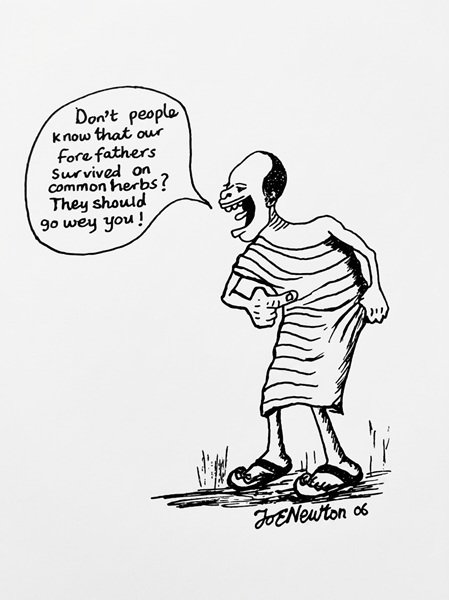
THE typical itinerant salesman in Sikaman is a herbalist. He is normally a slim macho with the capacity to perambulate the expanse of area covering the triangle of Accra-Tema-Ashiaman. In short, he can walk a total of 60 miles a day, marketing a product that cures every disease, including poverty. 
The door-to-door herbal pharmacist advertises his product by word of mouth. He has nothing to do with the Food and Drugs Board (FDB). After all, his concoctions do not feature on FM stations.
Those herbalists who cannot walk to propagate the herbal gospel, liaise with drivers of mass transportation and their mates. They are, therefore, given the chance to sell their products on Benz buses that ply the routes.
Normally, the herbalist starts his sales message with a prayer and Bible study. He asks the passengers to bow down their heads in supplication to God the father, the son, the Holy Spirit.
When a herbalist asks the passengers to close their eyes and bow their heads, Moslems on board naturally feel offended. They feel that the herbalist has no right to assume that every passenger is a Christian. They think such an assumption is an affront to Islam.
So a Moslem on board will raise the hand for a point of order. He’ll remind the herbalist that it would be in his own interest to mind his language.
“Be careful the way you address people in a public place. Not every person here is a Christian,” he’d state assertively.
Of course, the herbalist will promptly ignore him, but would all the same “watch” his tongue. Who knows whether or not the Moslem brother is inspired by Quoranic zeal to defend the tenets of Islam to the hilt?
When he starts saying, “Wallahi!” and “Inshallah!” it could be the beginning of proclaiming Islam as supreme, a point which must be driven home with talibanic precision.
So the herbalist must tread carefully lest he steps on fire.
The herbalist could even add a measure of mirth to it all, by announcing that Christians on board today have very interesting company on the journey, but that should not detract from the business of the day.
The Moslem brother will weigh the words carefully and offer a wry smile.
He must be careful the occasion does not degenerate into the use of semantics and proverbial oration to deride his conviction that public utterances must be mindful of religious sensibilities. He has made his point very clear and expects that it is taken in good faith in the interest of a peaceful journey.
The herbalist will now open the New Testament and preach salvation, stating clearly that salvation can come only through Jesus Christ and NOBODY else.
The Moslem brother will now start twitching his moustache. The visible and almost revolutionary reflexes of his upper lip can be an indication that sentiments have begun superseding reason, and the outcome could well be tragic now shift uneasily in his seat.
The time has come for him to also express his right to the religion of his fore-bears. He’ll put his hand into his pocket and rise to his feet. The time has indeed come!
This article was first published on Saturday, September 9, 2006
When the cause of a particular problem like sickness, disease, sudden illness, a social issue etc. are not known, it stands to reason that resolving it becomes a huge challenge.
Citizens would understand the government when public announcements are made to the effect that government is trying to find a solution to the issue, even though it is taking a while for it to be resolved because citizens are rational beings.
On the other hand, if the solution to a particular issue is known to everybody but the government for whatever reason, is dragging its feet in resolving it, citizens become frustrated and begin to lose trust in their leaders.
One such issue is the heavy traffic along a section of the Kasoa – Odokor road. A short stretch of bad road between the traffic light at the Weija Government Hospital and the entrance to the entrance of the overhead that leads to the N1, is the cause of the problem but nothing is being done about it, day after day, week after week, month after month. Thus is clearly unacceptable.
Another issue that requires urgent attention is the lack of pavements along a lot of streets in parts of the various Municipal Assemblies. Exercise is a prerequisite for long life and healthy living and for those of us who it has become a way of life, this issue of people putting up structures right to the edge of the drains beside the roads, are making life difficult for us.
We are compelled to walk along the roads, putting our lives at serious risk. Pedestrians should never be compelled to compete with vehicles on our streets and roads. Roads and streets are made for vehicles and pavements are made for pedestrians. That is the norm. Any attempt to normalise a situation where pedestrians are mingling with vehicles is insanity.
It is the road regulations that makes it so and therefore district or municipal assemblies are to take responsibility and ensure that spaces for pavements are not encroached upon. Citizens have rights that must be protected by their leaders and making pavements available to pedestrians, is one of them.
When we hear of teachers having sex with students, it appears it is something recent. It is not a new phenomenon. It has been there since Adam. Perhaps this issue is getting much attention due to the proliferation of social media. It was an open secret in times past when Teachers were in relationships with female students and some married them immediately after completion of school.
Some teachers were also known to be having unholy interactions with female pupils but due to the times that these acts occurred, human rights issues and the awareness around it, allowed such unscrupulous teachers to get away with their crimes.
Now we are in a different era and so a Headmaster is now in hot waters. He is alleged to have raped about 19 female students and as usual, some officials tried to cover it up and are also in hot waters and their actions or inactions in the matter are under investigation.
Why the man has been allowed to roam freely without being arrested is simply mind boggling. It appears that the law applies differently, depending on who you are. This issue came to public attention sometime in August this year, yet the police had not arrested or invited this man for question regarding the rape allegation.
It has come out that he is a Constituency Secretary of the ruling party and the question in the public domain is that, is it because he is a political figure that is why he is still walking around without questioning? I believe in the rule of law so let us hold our breadth and let the proper thing be done.
The police must however be seen to be active in this matter. God bless.
SKIP THE QUEUE, TAP THE NEWS
You can now read the Ghanaian Times and The Spectator newspapers from the comfort of your device via TimesNewsPlus.
Join our WhatsApp Channel: https://whatsapp.com/channel/0029VbBElzjInlqHhl1aTU27