Features
Is the freeze on employment not worsening the precarious graduate unemployment situation in Ghana?

The Finance Minister, Ken Ofori- Atta, on Thursday, November 24, 2022, presented the 2023 Budget and Economic Policy of the Government to Parliament, indicating far-reaching measures towards expenditure rationalisation to salvage the current economic downturn in the country that has resulted in severe hardships among the populace. Among these measures, is the announcement of a freeze on employment for civil and public servants, effective January, 2023.
FREEZE ON EMPLOYMENT
The Minister announced also that the purchase of new vehicles shall be restricted to locally assembled vehicles while the allocation of fuel coupons to political appointees and Heads of Ministries, Department and Agencies (MDAs), Metropolitan, Municipal and District Assemblies (MMDAs) and State-Owned Enterprises
(SOES), HAD BEEN REDUCED BY 50 PER CENT.
These were the words from the Minister; “Mr. Speaker, as a first step towards expenditure rationalisation, the Government has approved the following directives which take effect from January 2023. All MDAs MMDAs and SOEs, are directed to reduce fuel allocations to Political Appointees and Heads of MDAs, MMDAs and SOEs by 50 per cent. This directive applies to all methods of fuel allocation, including coupons, electronic cards, chit system and fuel depots. Accordingly, 50 per cent of the previous year’s (2022) budget allocation for fuel, shall be earmarked for official business pertaining to MDAs, MMDAs and SOEs;
EXPENDITURE RATIONALISATION
“A ban on the use of V8s/V6s or its equivalent, except for cross-country travel. All government vehicles would be registered with GV green plates from January 2023; Limited budgetary allocation for the purchase of vehicles. For the avoidance of doubt, the purchase of new vehicles shall be restricted to locally assembled vehicles; Only essential foreign travel across government, including SOEs shall be allowed for board members. Accordingly, all government institutions should submit a travel plan for the year 2023 by mid-December of all expected travels to the Chief of Staff.
“As far as possible, meetings and workshops should be done within the official environment or government facilities; Government sponsored external training and Staff Development activities at the Office of the President, Ministries and SOEs, must be put on hold for 2023 financial year. Reduction of expenditure on appointments including salary freezes together with suspension of certain allowances like housing, utilities and clothing, etc. A freeze on new tax waivers for foreign companies and review of tax exemptions for free zone, mining, oil and gas companies. A hiring freeze for civil and public servants. No new government agencies shall be established in 2023. There shall be no hampers for 2022”.
IMF CONDITIONS
FOR BAILOUT
Indeed, some of these measures, are already in place, however, for the government to muster the necessary courage to ensure that they are enforced to the letter, has been the major problem. It is the hope of many Ghanaians that this time round, the government will put the necessary mechanism in place to ensure an effective monitoring of the process and the implementation of the additional policies and programmes. Already, many are of the firm belief that these are some of the conditions attached to the International Monetary Fund (IMF) offer, to bail the country out of the current economic mess.
AGENDA 111 HOSPITAL PROJECT TO SUFFER
While the majority of Ghanaians do sympathise with the government for the situation it finds itself in now and, therefore, has to succumb to some of these pressures from the IMF for the needed financial bailout, many are also of the view that the freeze on employment within the civil and public services, is a serious development which the government has to take a second look at the policy, since it will not serve the best interest of this nation whatsoever. When this policy is allowed to be implemented as it stands next year, certain critical and vital areas such as the health and education sectors of the economy, will suffer unduly. Already our health facilities across the country are challenged with shortage of professionals such as doctors, dentists, nurses, cardiologists, laboratory technicians, radiographers and X’ray technicians among others, while our universities, colleges, polytechnics, Junior and Senior High Schools lacked the required manpower to manage that sectors. The government flagship Agenda 111 Hospital project is likely to face a major setback as a result of the freeze on employment. The new district hospitals, currently under construction will face manpower problem. Placing a total ban on employment for the next two years, will deal a major blow to our dear country.
PRECARIOUS GRADUATE UNEMPLOYMENT
We are in a country where graduate unemployment has been a major headache to the extent that today, Ghana has in existence, Unemployed University Graduate Association (UUGA). The National Labour Commission estimates a staggering unemployment figure of 700,000. Roughly, 53 per cent of recent graduates are either unemployed or underemployed. The average university graduate, needs up to half a year to find their initial employment if any. According to the 2021 Population and Housing Census by the Ghana Statistical Service, more than 13 per cent of Ghana’s economically active population are out of work.
When graduates find themselves unemployed, poor, psychological, physical and emotional health and well-being may follow. This impacts on the motivation and drive to actively seek employment, which in turn lessens the probability of unemployed graduates securing employment in the labour market. The underlying causes of youth employment in Ghana, include inadequate job creation despite relative good economic growth, poor access to, and quality of education and a mismatch in skills appropriate to the labour demands. In order to promote youth employment in Ghana, it is important to align formal education programmes and skills development initiatives in the context of fast changing labour market that requires new and different skill sets and to adapt to new technology.
TUC STANCE ON EMPLOYMENT FREEZE
As we speak now, the Trades Union Congress (TUC), the umbrella body of workers in Ghana, is vehemently, opposing the government’s decision to place a moratorium on employment in the civil and public services in 2023. Its Deputy General Secretary, Joshua Ansah, said the group was not in favour of a freeze on employment in the services and took steps to prevent it by engaging the IMF team which came into the country. According to him, the TUC was disappointed in the government for the move, describing it as “a stab in the back because government promised not to do so”. He assured that the TUC would discuss the issue with its social partners and respond appropriately.
Many have suggested that in order to cut down government expenditure and save cost, the government should take immediate steps to downsize its ministers and other political appointees, re-align some of the ministries to take other responsibilities since there are a lot of duplications in the functions of some of the ministries. Expenditures on some of these ministries can be channelled into productive areas of the economy. There are a lot of wastes in public expenditure which need to be curtailed in order to conserve the needed revenue to prosecute our development agenda.
DOWNSIZING GOVERNMENT AND CUTTING WASTES
Placing a moratorium on employment by freezing employment in civil and public services cannot in itself be the panacea for our present economic challenges. The ghost names in the public sector payrolls must be completely eradicated to introduce sanity into the system. The extravagance and opulent lifestyles of some of our ministers and other office holders need to be checked as we find solutions to our hydra-headed challenges.Yes, government has introduced far-reaching measures to cut down public expenditure as requested by the IMF, but the leadership must lead by example by reducing the present size of government and refrain from unnecessary expenditures at the presidency. For instance, the tendency of conveying a special Presidential Chair to and fro by V8 vehicle to state function across the country by the Office of the President must cease forthwith. Besides, the large convoy of state vehicles that always follows the President to public functions both internally and externally must be stopped to save the needed revenue.
LACK OF INTEREST IN GRADUATES’ WELFARE
It is quite obvious that our policymakers and for that matter the government and its political appointees, are only interested in churning out a large chunk of graduates yearly from our various universities and other tertiary institutions, just for cheap political propaganda. How these graduates will manage to secure the needed jobs or employment is not their priority or business at all. If really, they care for these graduates, they would not have accepted this bitter pill from the IMF of putting a freeze on employment.
Contact email/WhatsApp of author:
ataani2000@yahoo.com 0277753946/0248933366
By Charles Neequaye


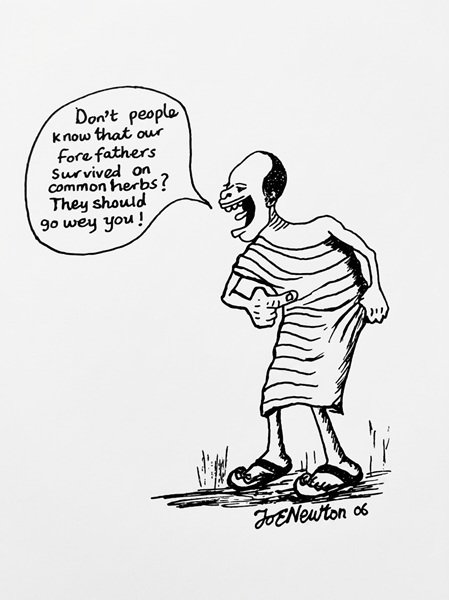
THE typical itinerant salesman in Sikaman is a herbalist. He is normally a slim macho with the capacity to perambulate the expanse of area covering the triangle of Accra-Tema-Ashiaman. In short, he can walk a total of 60 miles a day, marketing a product that cures every disease, including poverty. 
The door-to-door herbal pharmacist advertises his product by word of mouth. He has nothing to do with the Food and Drugs Board (FDB). After all, his concoctions do not feature on FM stations.
Those herbalists who cannot walk to propagate the herbal gospel, liaise with drivers of mass transportation and their mates. They are, therefore, given the chance to sell their products on Benz buses that ply the routes.
Normally, the herbalist starts his sales message with a prayer and Bible study. He asks the passengers to bow down their heads in supplication to God the father, the son, the Holy Spirit.
When a herbalist asks the passengers to close their eyes and bow their heads, Moslems on board naturally feel offended. They feel that the herbalist has no right to assume that every passenger is a Christian. They think such an assumption is an affront to Islam.
So a Moslem on board will raise the hand for a point of order. He’ll remind the herbalist that it would be in his own interest to mind his language.
“Be careful the way you address people in a public place. Not every person here is a Christian,” he’d state assertively.
Of course, the herbalist will promptly ignore him, but would all the same “watch” his tongue. Who knows whether or not the Moslem brother is inspired by Quoranic zeal to defend the tenets of Islam to the hilt?
When he starts saying, “Wallahi!” and “Inshallah!” it could be the beginning of proclaiming Islam as supreme, a point which must be driven home with talibanic precision.
So the herbalist must tread carefully lest he steps on fire.
The herbalist could even add a measure of mirth to it all, by announcing that Christians on board today have very interesting company on the journey, but that should not detract from the business of the day.
The Moslem brother will weigh the words carefully and offer a wry smile.
He must be careful the occasion does not degenerate into the use of semantics and proverbial oration to deride his conviction that public utterances must be mindful of religious sensibilities. He has made his point very clear and expects that it is taken in good faith in the interest of a peaceful journey.
The herbalist will now open the New Testament and preach salvation, stating clearly that salvation can come only through Jesus Christ and NOBODY else.
The Moslem brother will now start twitching his moustache. The visible and almost revolutionary reflexes of his upper lip can be an indication that sentiments have begun superseding reason, and the outcome could well be tragic now shift uneasily in his seat.
The time has come for him to also express his right to the religion of his fore-bears. He’ll put his hand into his pocket and rise to his feet. The time has indeed come!
This article was first published on Saturday, September 9, 2006
When the cause of a particular problem like sickness, disease, sudden illness, a social issue etc. are not known, it stands to reason that resolving it becomes a huge challenge.
Citizens would understand the government when public announcements are made to the effect that government is trying to find a solution to the issue, even though it is taking a while for it to be resolved because citizens are rational beings.
On the other hand, if the solution to a particular issue is known to everybody but the government for whatever reason, is dragging its feet in resolving it, citizens become frustrated and begin to lose trust in their leaders.
One such issue is the heavy traffic along a section of the Kasoa – Odokor road. A short stretch of bad road between the traffic light at the Weija Government Hospital and the entrance to the entrance of the overhead that leads to the N1, is the cause of the problem but nothing is being done about it, day after day, week after week, month after month. Thus is clearly unacceptable.
Another issue that requires urgent attention is the lack of pavements along a lot of streets in parts of the various Municipal Assemblies. Exercise is a prerequisite for long life and healthy living and for those of us who it has become a way of life, this issue of people putting up structures right to the edge of the drains beside the roads, are making life difficult for us.
We are compelled to walk along the roads, putting our lives at serious risk. Pedestrians should never be compelled to compete with vehicles on our streets and roads. Roads and streets are made for vehicles and pavements are made for pedestrians. That is the norm. Any attempt to normalise a situation where pedestrians are mingling with vehicles is insanity.
It is the road regulations that makes it so and therefore district or municipal assemblies are to take responsibility and ensure that spaces for pavements are not encroached upon. Citizens have rights that must be protected by their leaders and making pavements available to pedestrians, is one of them.
When we hear of teachers having sex with students, it appears it is something recent. It is not a new phenomenon. It has been there since Adam. Perhaps this issue is getting much attention due to the proliferation of social media. It was an open secret in times past when Teachers were in relationships with female students and some married them immediately after completion of school.
Some teachers were also known to be having unholy interactions with female pupils but due to the times that these acts occurred, human rights issues and the awareness around it, allowed such unscrupulous teachers to get away with their crimes.
Now we are in a different era and so a Headmaster is now in hot waters. He is alleged to have raped about 19 female students and as usual, some officials tried to cover it up and are also in hot waters and their actions or inactions in the matter are under investigation.
Why the man has been allowed to roam freely without being arrested is simply mind boggling. It appears that the law applies differently, depending on who you are. This issue came to public attention sometime in August this year, yet the police had not arrested or invited this man for question regarding the rape allegation.
It has come out that he is a Constituency Secretary of the ruling party and the question in the public domain is that, is it because he is a political figure that is why he is still walking around without questioning? I believe in the rule of law so let us hold our breadth and let the proper thing be done.
The police must however be seen to be active in this matter. God bless.
SKIP THE QUEUE, TAP THE NEWS
You can now read the Ghanaian Times and The Spectator newspapers from the comfort of your device via TimesNewsPlus.
Join our WhatsApp Channel: https://whatsapp.com/channel/0029VbBElzjInlqHhl1aTU27