Features
The fight against illegal mining… ‘Untouchables’ are the problem

His name is Bernard Antwi Boasiako, aka Chairman Wontumi, he is the current Ashanti Regional Chairman of the ruling New Patriotic Party (NPP), a farmer, owner of Wontumi Radio and Television stations and Akonta Mining Limited, a small-scale mining company in the Ashanti Region. As the meaning of his akan nickname connotes in the English Language, “You can’t Fit me”, Chairman Wontumi, is a strong and powerful personality within the NPP circles who does not fear any persons, including people in the corridors of power whatsoever. He claims to be one of the millionaires in Ghana in recent times, and at one time, expressed interest to buy the famous Chelsea Football Club in London, United Kingdom.
When you talk about prominent personalities involved in small-scale mining popularly known as galamsey in this country, Ghana, you cannot leave out this ‘powerful’ man who is into serious small-scale mining business in parts of the Ashanti and Western regions.
AKONTA MINING LIMITED
Records show that, his company on 20th August 2022 applied for a Mining Lease to undertake mining in some parts of Samreboi in the Western Region, outside the Forest Reserve, but the company has extended its operations to the Tano Nimiri Forest Reserve in the Western Region. By a Ministerial Directive, all reconnaissance, prospecting and/or exploratory activities in Forest Reserves in the country are suspended, except in exceptional circumstances. Although this directive does not affect mining in Forest Reserves, further records indicate that Akonta Mining Limited’s application has not been determined, hence any alleged activity being undertaken by the company in the Forest Reserve is considered illegal.
GUN SHOTS AT FOREST RESERVE
In recent times, there were reports circulating on social media and other traditional news outlet about exchange of gunshots between personnel of Akonta Mining Limited and some youth of Samreboi, leading to two persons sustaining gunshot wounds. Per the cause of that incident, a section of the youth reportedly prevented personnel of the company from taking more mining equipment into the Tano Nimiri Forest Reserve.
The company, it was reported, was said to have been mining in the reserve despite a declaration by government (Minerals Commission) that it had not granted any entry permit into the forest reserve. According to reports, two of the vehicles transporting mining equipment were also burnt by the youth while some vehicles belonging to a timber firm, Samartex, had their windscreens smashed.
WONTUMI’S EXPLANATION
The owner and regional chairman of the NPP, Antwi Boasiako, has denied using the site for illegal mining. According to him his outfit has a genuine documents and licence from the Minerals Commission which would expire in the year 2030, claiming that his company was rather reclaiming the site which was overtaken by some illegal miners after digging pits on the site.
When you weigh the Land and Natural Resources Minister’s (Samuel Abdulai Jinapor) statement in which he made it clear that the company was operating illegally in the Tano Nimiri Forest Reserve against Chairman Wontumi’s defence, then you can simply ask yourself, who is telling the truth? And what is the Forestry Commission saying? That, the Akonta Mining Limited, indeed, has a pending application dated August 25, 2022, for a Mining Lease over an area within the Tano Nimiri Reserve? Does that grant the company permission to enter into the reserve to mine?
FREEING GALAMSEY FIGHT OF POLITICS
This fight against this illegal small-scale mining in this country, can only make the necessary progress and meaningful impact, if we shed party colours and dealt ruthlessly with people involved in the activity no matter their status in the ruling party and the party in power. If we try to impute politics into steps being taken to stop this menace, we will get nowhere in our determination to stop the practice. It is because we, ourselves, are not ready to deal with the problem, that is the more reason foreigners, especially Chinese, have taken an advantage of the system to engage massively in this illegal galamsey business and subsequently, destroying our environment and the ecosystem.
Some of our traditional leaders as well as Metropolitan, Municipal and District Chief Executives in areas where these illegal operations are taking place in their forest reserves, have sold their conscience for peanuts to the people including foreigners in the trade, forgetting that they are rather helping them to destroy their water bodies and the ecosystem.
LEVEL OF POLLUTION OF WATER BODIES
It is sickening when you look at the massive destructions that had taken place in most of these areas where these small scale illegal mining are taking place. Party officials and other irresponsible personalities in the corridors of power who are deeply involved in these shameful business must bow their heads in shame.
Are we really happy with the level of contamination and pollution of our water bodies and rivers as well as the forest cover by these galamseyers, spearheaded mostly by Chinese nationals and other high profile Ghanaians? Can we imagine the colour of water from our various water bodies? Are we happy to see our cocoa farms under siege? We need to be ashamed of ourselves for encouraging pollution and contamination of our water sources as well as the massive destruction of our forests.
ASANTEHENE SPEAKS OUT
No wonder, the Asantehene Otumfuo Osei Tutu II, recently, questioned the relevance of our District and Municipal Security Councils over their failure to fight the illegal mining menace in the country. He was surprised that after years that the government launched the fight against this galamsey business, little had been achieved describing the situation as very poor. Hear him, “At the district level, we have the political administration, District Chief Executives and District Security Councils. Are they all saying that they are unaware of the activities of these galamsayers? If they are unable to detect and stop the operation of these galamsayers, then they are unworthy to be there; it is as simple as that”.
“We should have brought finality to this issue by now. The President, had even put his presidency on the line, yet this is going on. To me, something is wrong somewhere,” he told the US Ambassador, Stephanie Sullivan, when she called on him recently at the Manhyia Palace in Kumasi.
FIGHT AGAINST GALAMSEY
It is sad that we should continue to talk about some of these negative issues again when we have flogged them over and over. While we continue to preserve the little human and material resources at our disposal due to our present economic difficulties and challenges, we have in recent past invested heavily in the formation of various ministerial taskforces to combat this small scale illegal mining in parts of the country. It is, indeed, sad and regretful that despite all these huge financial investments, the problem continues unabated and even in its worse form.
I have had the privilege to visit China for at least four times, during which I toured most of the provinces including the famous and popular Shanghai, and I can confidently say that they are taking good and proper care of their country and obeying their laws as well as the rules and regulations well. China started from the scratch like us and that country has gone far and can be referred to as a developed nation. Why are we doing disservice to ourselves by allowing Chinese nationals to enter into our country, plunder and destroy our natural resources, while they protect and conserve theirs? We have given them all the courtesies to live in our country yet they don’t respect our laws but rather treat us with contempt and disdain.
OUR LEADERS LACK THE WILL POWER
It is, indeed, surprising that our leaders often travel to some of these developed countries and are fully aware of the socio-economic development in those countries and upon returning home, they close their eyes to these developments they saw, and allow our country to go down the drain. Yes, we depend on some of these countries for loans and grants to revamp and reshape our economy, but we cannot continue to be stooges to them by allowing their nationals to misbehave when they enter into our territory.
As the Asantehene rightly put it: If those leaders appointed at the local level; Metropolitan, Municipal and District Assemblies, are unable to stand up against these illegal mining in their jurisdictions, then they have no business to be there at all. Let us keep politics out of this fight against galamsey and deal resolutely with offenders of the law irrespective of party affiliations. We want to see more action from our President, the number one gentleman of the land in this fight against the galamsey menace.
Contact email/WhatsApp of author:
ataani2000@yahoo.com 0277753946/0248933366
By Charles Neequaye


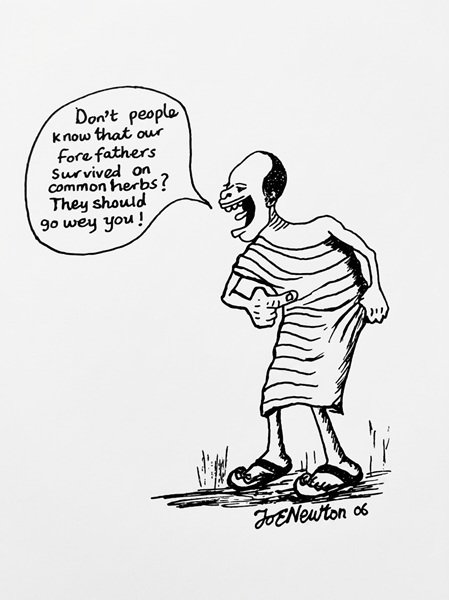
THE typical itinerant salesman in Sikaman is a herbalist. He is normally a slim macho with the capacity to perambulate the expanse of area covering the triangle of Accra-Tema-Ashiaman. In short, he can walk a total of 60 miles a day, marketing a product that cures every disease, including poverty. 
The door-to-door herbal pharmacist advertises his product by word of mouth. He has nothing to do with the Food and Drugs Board (FDB). After all, his concoctions do not feature on FM stations.
Those herbalists who cannot walk to propagate the herbal gospel, liaise with drivers of mass transportation and their mates. They are, therefore, given the chance to sell their products on Benz buses that ply the routes.
Normally, the herbalist starts his sales message with a prayer and Bible study. He asks the passengers to bow down their heads in supplication to God the father, the son, the Holy Spirit.
When a herbalist asks the passengers to close their eyes and bow their heads, Moslems on board naturally feel offended. They feel that the herbalist has no right to assume that every passenger is a Christian. They think such an assumption is an affront to Islam.
So a Moslem on board will raise the hand for a point of order. He’ll remind the herbalist that it would be in his own interest to mind his language.
“Be careful the way you address people in a public place. Not every person here is a Christian,” he’d state assertively.
Of course, the herbalist will promptly ignore him, but would all the same “watch” his tongue. Who knows whether or not the Moslem brother is inspired by Quoranic zeal to defend the tenets of Islam to the hilt?
When he starts saying, “Wallahi!” and “Inshallah!” it could be the beginning of proclaiming Islam as supreme, a point which must be driven home with talibanic precision.
So the herbalist must tread carefully lest he steps on fire.
The herbalist could even add a measure of mirth to it all, by announcing that Christians on board today have very interesting company on the journey, but that should not detract from the business of the day.
The Moslem brother will weigh the words carefully and offer a wry smile.
He must be careful the occasion does not degenerate into the use of semantics and proverbial oration to deride his conviction that public utterances must be mindful of religious sensibilities. He has made his point very clear and expects that it is taken in good faith in the interest of a peaceful journey.
The herbalist will now open the New Testament and preach salvation, stating clearly that salvation can come only through Jesus Christ and NOBODY else.
The Moslem brother will now start twitching his moustache. The visible and almost revolutionary reflexes of his upper lip can be an indication that sentiments have begun superseding reason, and the outcome could well be tragic now shift uneasily in his seat.
The time has come for him to also express his right to the religion of his fore-bears. He’ll put his hand into his pocket and rise to his feet. The time has indeed come!
This article was first published on Saturday, September 9, 2006
When the cause of a particular problem like sickness, disease, sudden illness, a social issue etc. are not known, it stands to reason that resolving it becomes a huge challenge.
Citizens would understand the government when public announcements are made to the effect that government is trying to find a solution to the issue, even though it is taking a while for it to be resolved because citizens are rational beings.
On the other hand, if the solution to a particular issue is known to everybody but the government for whatever reason, is dragging its feet in resolving it, citizens become frustrated and begin to lose trust in their leaders.
One such issue is the heavy traffic along a section of the Kasoa – Odokor road. A short stretch of bad road between the traffic light at the Weija Government Hospital and the entrance to the entrance of the overhead that leads to the N1, is the cause of the problem but nothing is being done about it, day after day, week after week, month after month. Thus is clearly unacceptable.
Another issue that requires urgent attention is the lack of pavements along a lot of streets in parts of the various Municipal Assemblies. Exercise is a prerequisite for long life and healthy living and for those of us who it has become a way of life, this issue of people putting up structures right to the edge of the drains beside the roads, are making life difficult for us.
We are compelled to walk along the roads, putting our lives at serious risk. Pedestrians should never be compelled to compete with vehicles on our streets and roads. Roads and streets are made for vehicles and pavements are made for pedestrians. That is the norm. Any attempt to normalise a situation where pedestrians are mingling with vehicles is insanity.
It is the road regulations that makes it so and therefore district or municipal assemblies are to take responsibility and ensure that spaces for pavements are not encroached upon. Citizens have rights that must be protected by their leaders and making pavements available to pedestrians, is one of them.
When we hear of teachers having sex with students, it appears it is something recent. It is not a new phenomenon. It has been there since Adam. Perhaps this issue is getting much attention due to the proliferation of social media. It was an open secret in times past when Teachers were in relationships with female students and some married them immediately after completion of school.
Some teachers were also known to be having unholy interactions with female pupils but due to the times that these acts occurred, human rights issues and the awareness around it, allowed such unscrupulous teachers to get away with their crimes.
Now we are in a different era and so a Headmaster is now in hot waters. He is alleged to have raped about 19 female students and as usual, some officials tried to cover it up and are also in hot waters and their actions or inactions in the matter are under investigation.
Why the man has been allowed to roam freely without being arrested is simply mind boggling. It appears that the law applies differently, depending on who you are. This issue came to public attention sometime in August this year, yet the police had not arrested or invited this man for question regarding the rape allegation.
It has come out that he is a Constituency Secretary of the ruling party and the question in the public domain is that, is it because he is a political figure that is why he is still walking around without questioning? I believe in the rule of law so let us hold our breadth and let the proper thing be done.
The police must however be seen to be active in this matter. God bless.
SKIP THE QUEUE, TAP THE NEWS
You can now read the Ghanaian Times and The Spectator newspapers from the comfort of your device via TimesNewsPlus.
Join our WhatsApp Channel: https://whatsapp.com/channel/0029VbBElzjInlqHhl1aTU27