News
GREL HANDS OVER TWO WATER PROJECTS TO CHAVENE AND ELLOBANKATA.


- /home/u249204778/domains/spectator.com.gh/public_html/wp-content/plugins/mvp-social-buttons/mvp-social-buttons.php on line 27
https://spectator.com.gh/wp-content/uploads/2022/04/DSC_2164-1-1.jpg&description=GREL HANDS OVER TWO WATER PROJECTS TO CHAVENE AND ELLOBANKATA.', 'pinterestShare', 'width=750,height=350'); return false;" title="Pin This Post">
- Share
- Tweet /home/u249204778/domains/spectator.com.gh/public_html/wp-content/plugins/mvp-social-buttons/mvp-social-buttons.php on line 72
https://spectator.com.gh/wp-content/uploads/2022/04/DSC_2164-1-1.jpg&description=GREL HANDS OVER TWO WATER PROJECTS TO CHAVENE AND ELLOBANKATA.', 'pinterestShare', 'width=750,height=350'); return false;" title="Pin This Post">
The Managing Director of the Ghana Rubber Estates Limited (GREL), Mr. Lionel Barre has advised the people of Chavene and Ellobankata both in the Ahanta Municipality of the Western Region to consider the two Water Projects the company has provided their own and maintain them.

He said the time government built infrastructure and maintained them for the communities had outlived its usefulness so beneficiary communities of government, Non-Governmental Organisations or philanthropists projects should take good care of them.
The Corporate Affairs Manager of GREL, Mr. Perry Acheampong was reading the Managing Director’s speech at the inauguration and handing over of two separate Water Projects undertaken by GREL at the cost of GH¢286, 100.00 at Chavene and Ellobankata, two farming communities. The Chavene Water Project cost GH¢93,500.00 while that of Ellobankata cost GH¢192,500.00.
He said GREL had been renowned through its many social intervention projects that it was championing in the 90 operational area communities in the Western, Central and Eastern regions of Ghana.
He said GREL believed it was essential to create and maintain a strong relationship with the stakeholders for improved livelihoods of residents in the operational areas by firmly holding on to their Sustainable Policy of Respect for Human Rights, Responsible Development of their Operations and Best Management Practices in line with National and International Laws Regulations and Conventions.
He said the water projects were in line with their SIFCA (GREL’s mother company) and GREL’s commitment to give meaning to the United Nation’s Sustainable Development Goal Six (6) which talks of “Clean Water & Sanitation”.
The Municipal Chief Executive (MCE) of the Ahanta West Municipality, Mr. John K. Agyare observed that what the two communities had got was an expression of true love from GREL because anybody or organisation that brought water to a particular group of people actually gave such people life.
He said government alone could not meet all the social needs of the communities so companies, NGOs and individuals should try to complement government’s efforts by offering projects for some communities.
The Chairman of (ACLANGO) Association of Chiefs on Whose Lands GREL Operates, Nana Kwesi Agyeman IX, told the beneficiary communities to form workable committees to take control of the water projects and see to it that the projects worked very well.
The Vice Chairman of ACLANGO, Awulae Attibrukusu II noted that GREL had brought life to the people of these two communities who before then had no access to potable water.
He said the Water Project would allow people to lay pipe lines into their homes in order to have better access to the water making the walking of women and children to the river side to fetch water a thing of the past.
FROM PETER GBAMBILA, CHAVENA AND ELLOBANKATA.


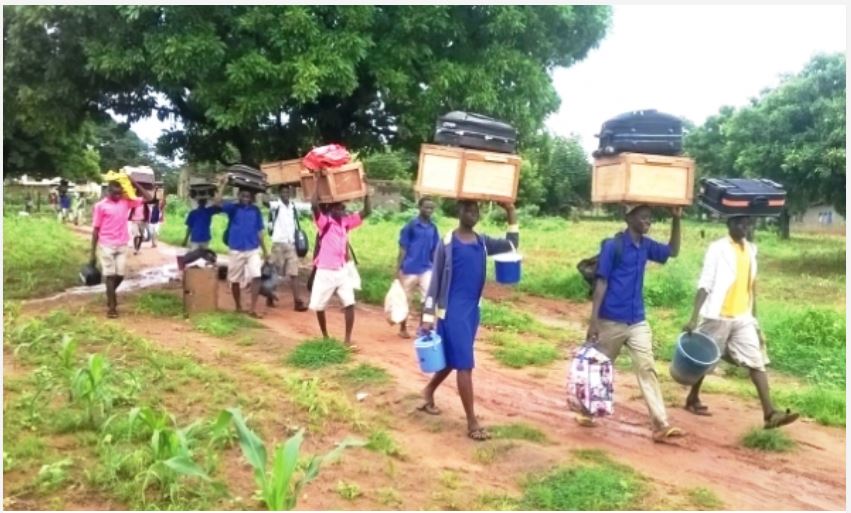
The Ghana Education Service (GES) has asked heads of schools not to turn away newly admitted students or refuse to accommodate them over metal trunks or wooden chop boxes.
“These practices may impose unnecessary financial burdens on parents and guardians who may be unable to afford alternative storage containers prescribed by individual schools,” the GES said in a statement.
“All students admitted to boarding accommodation should be treated fairly and accommodated without discrimination based on their economic circumstances or ability of their parents or guardians to purchase a particular brand or type of personal effects.”
The statement, signed by Professor Mrs Smile Dzisi, the Deputy GES Director-General, comes after Management of the Service received reports that some senior high schools and senior high technical schools (SHS/SHTS) were turning newly admitted students or refusing to accommodate them because they brought metal trunks, wooden chop boxes or other personal storage containers to school.
Consequently, the GES has asked regional directors to inform all heads to desist from turning away or refusing admissions to duly admitted students solely on the basis of the type of trunk, chop box, or personal storage container they bought to school.
Provided the item was reasonably sized, safe and did not pose risk to the health, safety or welfare of other students, those students must not be refused accommodation, it added.
The statement said: “Any reported case of a duly admitted student being denied accommodation or turned away solely because of the type of trunk, chop box or personal storage container brought to school should be investigated and same reported to management.”
“Any head of SHS/SHSTS who flouts this directive shall be dealt with in accordance with the applicable standards, regulation and laws of the service.” –GNA
SKIP THE QUEUE, TAP THE NEWS
You can now read the Ghanaian Times and The Spectator newspapers from the comfort of your device via TimesNewsPlus.
Join our WhatsApp Channel: https://whatsapp.com/channel/0029VbBElzjInlqHhl1aTU27

The Denu Circuit Court has sentenced Amos Kojo Andrews, also known as “Adebayo”, a 40-year-old Ghanaian driver, to five years’ imprisonment for his involvement in human trafficking-related offences.
The court imposed five years’ imprisonment on each of the six counts against Andrews, with the sentences ordered to run concurrently, resulting in an effective prison term of five years.
Court records indicate that Andrews was to be transferred to the Ho Central Prison to serve his sentence.
The six counts comprised three counts of conspiracy to commit human trafficking, contrary to Section 23(1) of the Criminal Offences Act, 1960 (Act 29), and three counts of human trafficking, contrary to Sections 2(1) and 2(2) of the Human Trafficking Act, 2005 (Act 694), as amended by Section 1(1) of the Human Trafficking (Amendment) Act, 2009 (Act 784).
The case followed investigations into the recruitment and movement of Nigerian females through Ghana under deceptive promises of employment.
According to the case brief, one of the victims was transported from Nigeria to Ghana after arrangements were made for her journey and was later moved towards the Ghana-Côte d’Ivoire border.
During the journey, she was informed that the intended work involved prostitution. She resisted the arrangement and was subsequently returned to Elubo.
Investigators said Andrews later arranged temporary work for the victim while seeking to recover transportation expenses from her earnings.
The case came to the attention of the authorities after a passenger overheard a suspicious telephone conversation concerning arrangements to move the victim back to Aflao and alerted security officials.
Andrews was subsequently arrested when he went to receive the victim at the Aflao station.
During follow-up investigations, a joint team from the Anti-Human Smuggling and Trafficking in Persons Unit of the Ghana Immigration Service, Aflao Sector Command, and the National Intelligence Bureau searched Andrews’ residence and rescued another Nigerian female.
Investigators said the second victim had also been recruited on the promise of work abroad but was later informed that she would be sent for prostitution in Abidjan.
The court, in delivering its judgment, held that the prosecution had presented overwhelming evidence and successfully established the elements required to prove both human trafficking and conspiracy to commit human trafficking.
It further found that the defence had failed to displace the prosecution’s evidence, which was marked by admissions and inconsistencies.
Speaking to the Ghana News Agency (GNA), Deputy Commissioner of Immigration (DCOI) Mark Asamoah-Boakye urged the public to remain vigilant and report suspicious activities that could lead to the identification, arrest and prosecution of persons involved in bringing unsuspecting victims into the country.
He said the Ghana Immigration Service remained committed to securing the country’s borders and protecting individuals who were lured with promises of employment but subsequently found themselves in situations that undermined their dignity.
DCOI Asamoah-Boakye said public cooperation was important in helping security agencies identify suspected trafficking activities and protect potential victims. -GNA
The root causes: It is never just one reason
My years of counselling at CPAC show me abandonment is rarely an act of malice. It is the tragic endpoint of seven overwhelming distresses:
Psychology
1. Severe maternal mental illness —The hidden emergency
a) Clinical Postpartum Depression (PPD): This is far beyond “baby blues.” It is a severe mood disorder that can appear weeks to months after birth. Due to a massive drop in hormones, extreme sleep deprivation, and emotional exhaustion, the mother feels deep sadness, worthlessness, and complete emotional numbness towards her baby. Picture: A new mother sits by her bed all day, staring blankly. Her baby cries for hours, but she cannot lift her hands to carry the baby. She whispers, “This baby would be better off without me.” She does not hate the baby; she feels she has completely failed as a mother.
Advertisement
b) Peripartum Psychosis (Postpartum Psychosis): This is a psychiatric emergency. Rare but extremely dangerous, appearing suddenly within the first 2-3 weeks after delivery. The mother completely loses touch with reality. She hears commanding voices telling her to abandon the baby, or believes the baby is possessed by an evil spirit or is a “spirit child” who will bring a curse. Picture: A mother genuinely believes she heard a voice saying, “Leave this child at the crossroads at midnight or your family will die.” She abandons the baby not out of hatred, but because her broken mind believes she is obeying a higher spiritual order to save her family.
c) Pre-existing untreated Schizophrenia: This is a chronic, severe mental disorder that existed before the pregnancy. The stress of pregnancy and labour shatters her fragile coping. She suffers from paranoid delusions — believing people want to poison her and the baby — flat affect (zero facial expression), and grossly disorganised thinking, making it impossible to plan how to feed or clean a baby. Picture: A young woman whose family called her illness “spiritual attack” instead of taking her for medication wanders away after delivery, completely forgetting she even gave birth, leaving the infant behind.
2. Extreme socio-economic deprivation: For many girls in some parts of Ghana such as Kasoa, Madina, or Bekwai, poverty is not a statistic; it is a daily panic. No money for antenatal care, no money for hospital delivery, no money for baby diapers or formula. When a mother cannot feed herself, the thought of feeding another mouth feels impossible. Some mothers say, “I left her where someone richer would find her, because I could not watch her starve to death in my hands.” It is a distorted act of survival.
Geographic Reference
3. Intense societal stigma and shame: In Ghana, pregnancy outside marriage, teenage pregnancy, or pregnancy from rape can bring extreme family rejection. The girl is called “spoilt,” beaten, banned from church, or sacked from school. The fear of bringing shame to the family name is heavier than the fear of police. So she hides the pregnancy for 9 months, delivers alone, and abandons in secret to protect her family’s “honour.”
Advertisement
4. Paternal abandonment — The Man Who Ran Away: Behind almost every abandoned baby is a man who vanished. He says, “It is not mine,” or “Abort it,” and switches off his phone. The mother is left utterly isolated — no emotional, financial, or social support. She is criminalised alone, but the abandonment started with him. Psychological research shows paternal denial is one of the strongest predictors of maternal panic and newborn abandonment.
5. Substance abuse disorders: Alcohol, tramadol, and other drug addiction impair the brain’s executive functioning — the ability to plan, judge consequences, and process emotions. A mother struggling with addiction may give birth in a highly intoxicated or withdrawal state, unable to comprehend the needs of the newborn, leading to neglect and eventual abandonment.
6. The spirit child cultural phenomenon and superstition: In some remote pockets of Northern Ghana and even in few parts of Central and Ashanti regions, public health research shows babies born with congenital deformities, severe disabilities, or whose mothers die in childbirth are branded as “spirit children” or cursed. In extreme instances, families, under cultural pressure, mandate that such babies be exposed or abandoned at shrines or bushes. This is not mental illness, but a harmful cultural belief system that still kills.
The invisible wounds
Advertisement
On the baby: Risk of death from hypothermia, sepsis, and infection. Survivors suffer Anaclitic Depression and Failure to Thrive due to lack of touch. As adults, they battle Reactive Attachment Disorder, chronic mistrust, and identity crisis — “Why did my mother leave me in a dustbin?”
Babies & Toddlers
On the mother: Lifelong hidden grief, intense guilt, chronic PTSD, depression, and elevated suicide risk. A prison cell does not heal this.
On the nation: Overburdened orphanages like Osu Children’s Home, draining health budgets, and overworked Social Welfare officers.
SKIP THE QUEUE, TAP THE NEWS
Advertisement
Discover more
Africans & Diaspora
pregnancy
Trash Cans
You can now read the Ghanaian Times and The Spectator newspapers from the comfort of your device via TimesNewsPlus.
Join our WhatsApp Channel: https://whatsapp.com/channel/0029VbBElzjInlqHhl1aTU27