News
Govt commended for reducing maternal mortality

![• Dr. Wilfred Ochan (fitth from right) with Mr. Martin Adu-Owusu [fourth from right] and Staff UNFPA and NTC after the meeting Photo: Okai Elizabeth](https://spectator.com.gh/wp-content/uploads/2025/05/Dr.-Wilfred-Ochan-fitth-from-right-with-Mr.-Martin-Adu-Owusu-fourth-from-right-and-Staff-UNFPA-and-NTC-after-the-meeting-Photo-Okai-Elizabeth-scaled.jpg)
- /home/u249204778/domains/spectator.com.gh/public_html/wp-content/plugins/mvp-social-buttons/mvp-social-buttons.php on line 27
https://spectator.com.gh/wp-content/uploads/2025/05/Dr.-Wilfred-Ochan-fitth-from-right-with-Mr.-Martin-Adu-Owusu-fourth-from-right-and-Staff-UNFPA-and-NTC-after-the-meeting-Photo-Okai-Elizabeth-1000x600.jpg&description= Govt commended for reducing maternal mortality', 'pinterestShare', 'width=750,height=350'); return false;" title="Pin This Post">
- Share
- Tweet /home/u249204778/domains/spectator.com.gh/public_html/wp-content/plugins/mvp-social-buttons/mvp-social-buttons.php on line 72
https://spectator.com.gh/wp-content/uploads/2025/05/Dr.-Wilfred-Ochan-fitth-from-right-with-Mr.-Martin-Adu-Owusu-fourth-from-right-and-Staff-UNFPA-and-NTC-after-the-meeting-Photo-Okai-Elizabeth-1000x600.jpg&description= Govt commended for reducing maternal mortality', 'pinterestShare', 'width=750,height=350'); return false;" title="Pin This Post">
The decision to keep or terminate a pregnancy should solely be the choice of women, the United Nations Population Fund (UNFPA) Ghana representative has said.
“The sense is that people should plan when they wish to start having babies, the spacing between the children, number of children and when you wish to stop having children,” the UNFPA said.
The Country Representative of UNFPA, Dr Wilfred Ochan said this on Thursday when he paid a courtesy call on the Management of New Times Corporation (NTC) in Accra.
The visit formed part of UNFPA’s effort to strengthen partnership between the two entities and also to amplify reproductive health advocacy.
He further reiterated his outfit’s commitment to achieving a world where every pregnancy is wanted, every childbirth is safe, and every young person’s potential is fulfilled.
He explained that enabling individuals to make informed decisions about when and how to have children is central to their mandate.
“In Ghana, about 23 per cent of people who need contraceptives are unable to access them. We at UNFPA support the procurement of 40 per cent of the country’s contraceptive commodities to help meet this need. Our aim is to achieve zero unmet need for family planning,” he noted.
Dr Ochan said to have a satisfactory outcome of every pregnancy, it was important to have both mother and child alive but that is not so with every pregnancy, stating that “ we still get 310 women per 100,000 live births die in the process of child birth.
According to the Country’s Director of UNPFA, Ghana was far from achieving the global target of 70 per 100,000 live births by 2030 but commended Ghana for taking some bold steps in reducing maternal mortality.
In an attempt to reduce maternal mortality, Dr Ochan called for training of midwives, equipping them with right skills and competence and also mentoring them on the job while developing policies and guidelines.
Highlighting the devastating impact of obstetric fistula; a condition often caused by obstructed labour, Dr Ochan called attention to the upcoming International Day to end Obstetric Fistula, observed annually on May 23.
As part of the 2025 commemoration, UNFPA will visit fistula survivors and support repair surgeries at hospitals in Ho, Cape Coast, and other facilities.
Responding, the Managing Director of NTC, Mr Martin Adu Owusu pledged the corporation’s readiness to collaborate with UNFPA to ensure maternal deaths was reduced.
The Editor of The Spectator, Mrs Georgina N. M Quaittoo called on the UNFPA to open its doors and be ready to share information to the paper as it focused on maternal issues.
By Esinam Jemima Kuatsinu

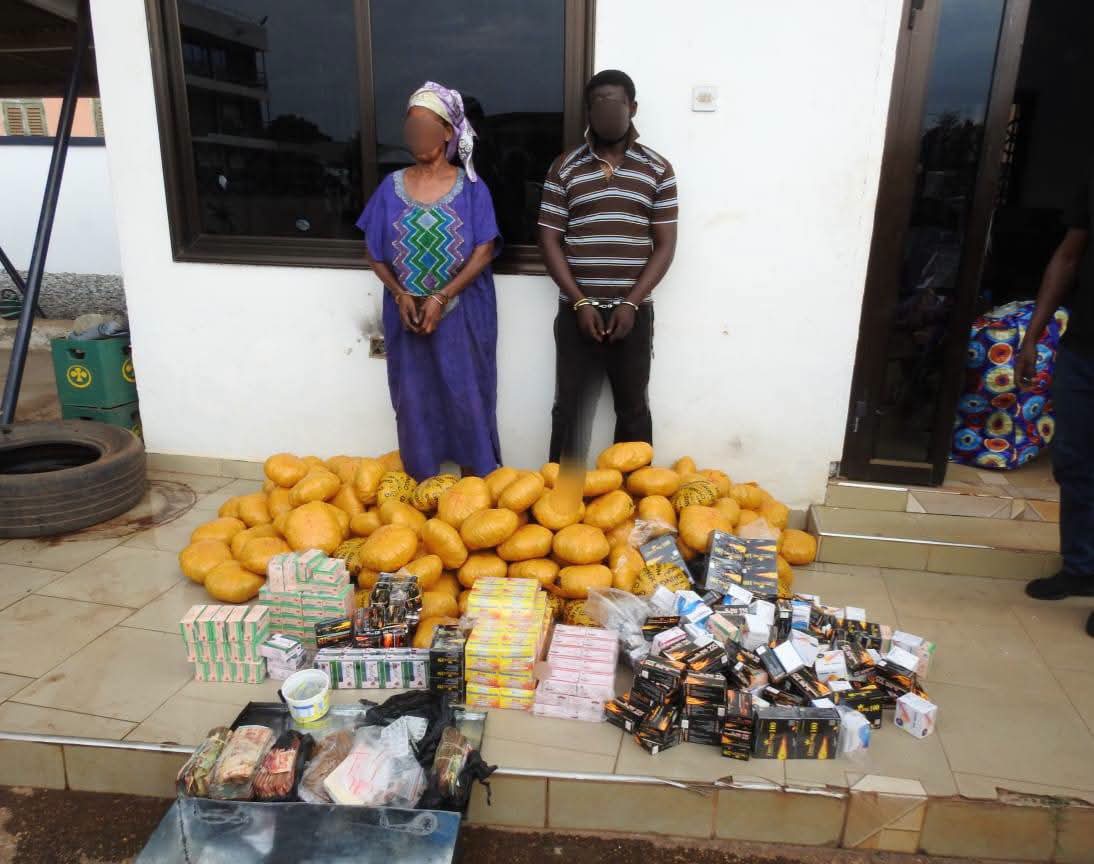
The Bono Regional Drug Law Enforcement Unit has arrested a 66-year-old woman and her 29-year-old son after police allegedly found suspected Indian hemp, Tramadol and other restricted drugs in their rooms at Dormaa Ahenkro.
The suspects, Mary Awuni and Maxwell Akukah, were arrested during an intelligence-led operation at Kumi Daa Street, a suburb of the Dormaa Central Municipality.
According to the Bono Regional Police Command, a search conducted in their rooms led to the recovery of 147 yellow compressed slabs wrapped in sellotape and suspected to be Indian hemp.
Police also retrieved 270 boxes and 329 blisters of assorted Tramadol, 14 blisters of Rohypnol, GH¢87,751 and CFA 2,000.
The police explained that Mary Awuni was found with a metal trunk containing the 14 blisters of Rohypnol, GH¢72,612 and CFA 2,000.
She allegedly told investigators that the items and money had been given to her by a man in Accra to be delivered to another person in Côte d’Ivoire. However, she admitted ownership of the items found in her room.
Her son, Maxwell Akukah, was arrested in a separate room where the suspected Indian hemp, Tramadol and GH¢15,139 were found.
He allegedly claimed that the items belonged to his brother, Anthony, who was said to be outside Dormaa Ahenkro.
In a press release issued on September 4, the Bono Regional Police Command stated that the two suspects remain in custody and are assisting with investigations.
The police added that investigations were ongoing to identify and prosecute all persons found to be involved.
The Command assured the public of its commitment to combating narcotics-related offences and urged residents to provide credible information to help police protect communities and maintain public safety.
By: Jacob Aggrey

Ashanti Region have been crowned champions of the 2026 MTN Elite U-19 Championship after edging defending champions Eastern Region 4-3 in a pulsating final at the Ghanaman Soccer Centre of Excellence, Prampram.
The final provided a fitting climax to 11 days of exciting football, delivering a seven-goal thriller at the GFA Technical Centre on Friday.
In a contest full of attacking intent and drama, Eastern Region fought back three times but Ashanti held their nerve to dethrone the holders and send the trophy to Kumasi.
Ashanti made a blistering start and took the lead in the 7th minute through Mohammed Dayvon. Eastern responded quickly, with Umar Archraf levelling matters in the 12th minute.
Issah Seidu restored Ashanti’s advantage six minutes later, but Tetteh Narh again drew Eastern level at 2-2 before the break in what was a fiercely contested first half.
The second half followed a similar pattern. Elvis Kwarteng put Ashanti ahead for the third time in the 78th minute with a performance that would later earn him the Final’s Most Valuable Player award.
Eastern refused to give up and equalised again three minutes later to make it 3-3, setting up a tense finish.
But their joy was short-lived. Substitute Emmanuel Boateng struck the winner in the 82nd minute to seal a dramatic 4-3 victory for Ashanti.
Eastern piled on pressure in the closing stages, but Raphael Amankwah’s side stayed resolute to see out the win.
The triumph capped an impressive campaign for Ashanti, who showed consistency and resilience throughout the tournament.
Individual Honours
Elvis Kwarteng was named Most Valuable Player of the final, while Central Region’s Desmond Korlettey was adjudged Overall Most Valuable Player after winning four MVP awards during the tournament.
Central Region also picked up the Fair Play award, while Ashanti’s Raphael Amankwah was named Best Coach.
Kelvin Osei Owusu of Ashanti won Best Goalkeeper, with Greater Accra’s Dennis Adjei finishing as Top Scorer with six goals.
The closing ceremony was led by Chairman of the Championship Committee, Hon. Eric Edem Agbana, and MTN representative Andy Cofie, joined by Executive Council members Samuel Aboabire and Eugene Noel Nobel, Juvenile Committee Vice-Chairman Samuel Anim Addo and Black Satellites head coach Maxwell Konadu.
Reserved exclusively for Second Division players, the championship once again proved a vital platform for discovering and showcasing Ghana’s next generation of talent.
By Edem Mensah-Tsotorme