News
GASIP honours 59 farmers in UER

- /home/u249204778/domains/spectator.com.gh/public_html/wp-content/plugins/mvp-social-buttons/mvp-social-buttons.php on line 27
https://spectator.com.gh/wp-content/uploads/2020/05/Untitled.png&description=GASIP honours 59 farmers in UER', 'pinterestShare', 'width=750,height=350'); return false;" title="Pin This Post">
- Share
- Tweet /home/u249204778/domains/spectator.com.gh/public_html/wp-content/plugins/mvp-social-buttons/mvp-social-buttons.php on line 72
https://spectator.com.gh/wp-content/uploads/2020/05/Untitled.png&description=GASIP honours 59 farmers in UER', 'pinterestShare', 'width=750,height=350'); return false;" title="Pin This Post">
The Upper East Regional Director of Agriculture, Mr Francis Ennor, has assured farmers in the region that the Ministry of Food and Agriculture will not withdraw its interventions to them in this farming season as a result of the coronavirus (COVID-19).
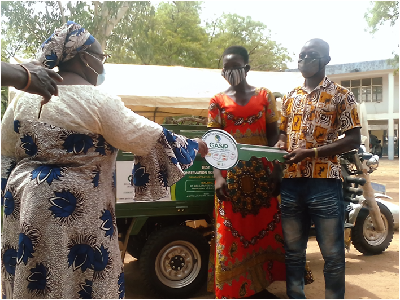
The Regional Director allayed the fears of the farmers at an award ceremony organised by the Ghana Agricultural Sector Investment Programme (GASIP) and his outfit in Bolgatanga on Monday to honour some farmers in the region for adopting Agriculture Conservation Practices.
In all, GASIP rewarded 329 farmers in the seven programme beneficiary regions with tricycle motors and personal protection gears for farm activities, including Wellington boots, nose masks, long sleeves and trousers, eye goggles and knapsack sprayers.
For the Upper East Region, 59 farmers drawn from the Kalbeo, Yebongo, Sumbrungu, Katanga, Yikine, and Yorogo communities were part of the awardees.
Mr Ennor told the farmers the region had started receiving its package of the farming subsidy under the Planting for Food and Jobs (PFJ).
He told the farmers that arrangements were being made by the Regional and District Directorates of Agriculture to ensure that the farmers got their share of the government’s fertiliser and seeds subsidies on time.
Mr Ennor said any lapses to support farmers to undertake farming activities this farming season would have the tendency of affecting food security in this period of COVID-19.
He indicated that plans were far advanced to deploy information technologies in the form of mobile applications and radio programmes on good farming practices to complement the work of agriculture extension agents to educate the farmers on good agriculture practices to ensure food security.
Mr Ennor impressed upon the farmers to adopt climate smart agriculture technologies such as the use of climate-resilient seeds, applying the right quantity of fertilizer at the right time, appropriate land preparation devoid of slash and burn, to enable them harvest good yields.
The Climate Change Adaptation Manager of GASIP, Dr.Edmund Akoto-Danso, who addressed the ceremony on behalf of the GASIP National Programme Coordinator, Mr Klutse Kudomor, said the ceremony, being organised separately in seven regions, marked the beginning of the 2020 farming season.
He said the five-year GASIP, which is being implemented by the Ministry of Food and Agriculture with support from the International Fund for Agricultural Development (IFAD), would this farming season provide support in the form of climate-resilient seeds and other inputs to 1,500 smallholder farmers in 12 districts to cultivate a maximum of two acres each, using various climate-smart agriculture technologies and techniques.
The Municipal Chief Executive (MCE) of Bolgatanga, Mr Joseph Amiyure, said formerly farmers in the region used to plant early April, but now it often travels to June and entreated the farmers to take the issues of climate change very seriously.
FROM SAMUEL AKAPULE, BOLGATANGA



The Ghana Gold Board (GoldBod) has announced changes to how the purity of gold will be tested for local purchases, with the new rules taking effect from October 1, 2026.
The notice was issued today by the Compliance Directorate of the Ghana Gold Board.
Under the new arrangement, the Water Density method will only be used to give an indication of the purity of gold and will no longer serve as the final basis for determining its purity, price or payment.
In a compliance notice issued on September 28, GoldBod said X-Ray Fluorescence (XRF) testing would become the definitive method for determining the purity of gold doré purchased by the Board and its licensed buyers.
It explained that the applicable payment for gold would therefore be based on the purity determined through the XRF method.
However, GoldBod said where a licensed buyer is unable to use XRF due to genuine operational or logistical challenges, or where both the buyer and seller voluntarily agree to use the Water Density method, the gold would be purchased at a 0.7 percent purity discount.
The Board introduced a tolerance level for differences between successive XRF test results for the same gold or transaction.
According to the notice, the permissible difference between one XRF report and another must remain within plus or minus 0.1 percent.
GoldBod said any difference beyond that range would have to be verified before the transaction is completed or reported to the Board.
The new requirements apply to all aggregators and licensed gold buyers, who have been directed to ensure that they are fully prepared to comply with the changes by October 1.
GoldBod said the notice forms part of the terms and conditions of licences issued to aggregators and licensed gold buyers.
It warned that failure to comply with the new requirements would constitute a breach of the applicable licence conditions and could result in regulatory or enforcement action under the Ghana Gold Board Act, 2025 (Act 1140).
By: Jacob Aggrey

Investigative journalist Manasseh Azure Awuni has waded into the debate over government support for Ghanaian evacuees, describing complaints over the amount given as “nauseating entitlement.”
In a strongly worded post shared on Facebook, Manasseh argued that Ghanaians who were airlifted from South Africa after xenophobic threats should show gratitude rather than discontent.
“Some countries abandoned their people because they either did not care enough or they did not think it was economically wise to spend huge sums of money chartering planes and evacuating their people. Your country did not abandon you. It chartered aircraft and lifted you,” he wrote.
According to him, government spent huge sums to bring citizens home at a time when the country has pressing needs that could have been addressed with that money, but no one complained because “your life as a citizen is just as pressing.”
Manasseh said it was therefore worrying that after the evacuation and subsequent financial support from the state, some beneficiaries are complaining that the amount is not enough.
“Sir, some people need only 2000 cedis to start a business, but the state has not given them anything. Others worked and paid taxes while you were away, but have not received a pesewa from the state. Think about that,” he stated.
He added that while the frustration of losing opportunities abroad is understandable, the evacuation was not forced but was done to save lives.
He added that “We can sympathise with whatever opportunities you may have lost by returning home, but note that the government did not forcibly evacuate you. Your safety was paramount. You could have lost your life if the government had abandoned you.”
Manasseh warned that such complaints only fuel negativity in the political space.
“Your complaints will please a section of our society that lives in perpetual search of negativity with which to score cheap political points. But to the discerning people, it is a nauseating sense of entitlement,” he stressed.
He concluded with a call for appreciation “And whatever you have been given to ease your return is an added bonus. Appreciate it and pray for more. There’s a vast difference between a favour and an entitlement.”
By Edem Mensah-Tsotorme