News
Experts call for greater economic freedom and sustainable fiscal policies to boost Ghana’s growth

- /home/u249204778/domains/spectator.com.gh/public_html/wp-content/plugins/mvp-social-buttons/mvp-social-buttons.php on line 27
https://spectator.com.gh/wp-content/uploads/2025/11/WhatsApp-Image-2025-11-12-at-11.02.09.jpeg&description=Experts call for greater economic freedom and sustainable fiscal policies to boost Ghana’s growth', 'pinterestShare', 'width=750,height=350'); return false;" title="Pin This Post">
- Share
- Tweet /home/u249204778/domains/spectator.com.gh/public_html/wp-content/plugins/mvp-social-buttons/mvp-social-buttons.php on line 72
https://spectator.com.gh/wp-content/uploads/2025/11/WhatsApp-Image-2025-11-12-at-11.02.09.jpeg&description=Experts call for greater economic freedom and sustainable fiscal policies to boost Ghana’s growth', 'pinterestShare', 'width=750,height=350'); return false;" title="Pin This Post">
Economists and policy experts have underscored the need for Ghana to promote economic freedom, reduce bureaucratic barriers, and sustain ongoing fiscal stability efforts to strengthen private sector growth.
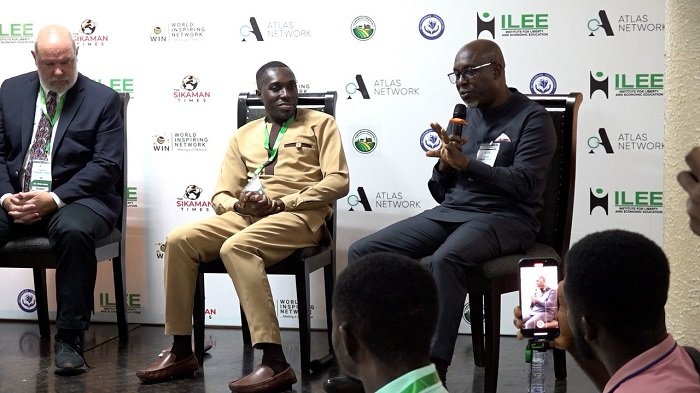
The call was made during a public discussion on economic freedom organised by the Institute for Liberty and Communication (ILC) in Accra, which brought together economists from the United States and Ghana to explore policies that can help small and medium enterprises (SMEs) grow and reduce poverty.
Director of Education and Senior Research Fellow at the American Institute for Economic Research (AIER), Ryan Young, urged governments to focus on creating an environment that allows individuals and businesses to take responsibility for improving their lives rather than relying on centralized plans.
“At the core, people have the potential to do great things when given the opportunity. The focus should be on removing rules and regulations that make it difficult for individuals to improve their own lives. Public policy should start from freedom, economic and personal, where individuals are empowered to make their own progress,” he explained.
Mr. Young emphasized that credit markets should be allowed to operate freely to support small businesses.
He noted that whenever governments set up new public funds or centrally managed loan schemes, they often compete with and weaken private lending systems.
“People should make lending decisions based on risk and reward, not administrators in an agency,” he said.
Director of Economics and Economic Freedom at AIER, Dr. Peter C. Earl, explained that economic development depends heavily on maintaining sound monetary policies, such as controlling inflation.
He commended Ghana’s recent decline in inflation to around 8–9%, calling it a positive sign that could lead to growth in employment and business activity if sustained.

“There’s no development without sound money. Ghana’s progress in reducing inflation is impressive. Stability in currency encourages investment and confidence. It’s important that the country doesn’t relax its efforts now,” Dr. Earl stressed.
He, however, warned that global trends, including the weakening of the U.S. dollar due to political and economic policies, could affect emerging economies like Ghana’s.
“A weaker dollar might make African exports to the U.S. more expensive, while U.S. goods become cheaper here. The long-term effects depend on how countries manage their local economies,” he added.
Vice President of IMANI Africa, Kofi Bentil, speaking on Ghana’s monetary outlook, said the Bank of Ghana’s interventions have helped stabilise the cedi but raised concerns about sustainability.
“The central bank’s responsibility is to stabilise the cedi, and they’ve done that well so far. The question is whether what they’re doing is sustainable. If the stability is artificial driven only by pumping dollars into the market then we will pay a heavy price when that stops,” he cautioned.

Mr. Bentil called for transparency in how the central bank manages its gold reserves and interventions, saying it would help build public confidence.
He also urged consistency in economic management, noting that stability over time is more important than short-term gains.
“Prices don’t immediately respond to changes in the exchange rate. What matters is a stable, predictable economic environment that allows businesses to plan ahead,” he explained.
He added that the programme was designed to promote ideas that encourage private sector participation and investment.
“Our aim is to promote economic freedom. People should be able to set up businesses, register them easily, and grow them without unnecessary barriers. The government’s role is to regulate fairly and create an environment where businesses can thrive,” he said.
He lamented that Ghana’s business registration and taxation processes remain cumbersome, describing the country’s bureaucracy as a major obstacle to entrepreneurship.
“Even though we’re not as bad as some socialist countries, starting a business in Ghana is still too difficult. The government must simplify the process to make it easier for small businesses to enter the market,” he urged.
By: Jacob Aggrey
🔗 Follow Ghanaian Times WhatsApp Channel today. https://whatsapp.com/channel/0029VbAjG7g3gvWajUAEX12Q
🌍 Trusted News. Real Stories. Anytime, Anywhere.
✅ Join our WhatsApp Channel now! https://whatsapp.com/channel/0029VbAjG7g3gvWajUAEX12Q






The Office of the Special Prosecutor (OSP) has taken note of public allegations of extortion and related conduct made against the Minority Leader of Parliament, Alexander Afenyo-Markin.
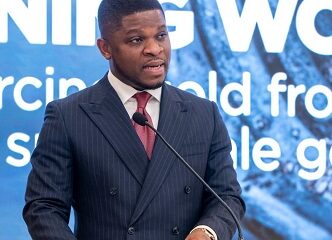
The allegations were made by the Chief Executive of the Ghana Gold Board (GoldBod), Sammy Gyamfi.
In a brief statement, the OSP said it has also received a joint petition submitted by two persons, as well as two separate petitions from other persons, in relation to the same allegations.
“Given the nature of the allegations, the OSP will assess the case and determine whether it falls within its statutory mandate and whether further investigative action is warranted,” the statement said.
The development comes amid a heated public feud between the Minority in Parliament and the leadership of GoldBod over the operations of the Domestic Gold Purchase Programme.
The Minority, led by Afenyo-Markin, has accused GoldBod and the Bank of Ghana of causing a loss of over $1.7 billion, citing the International Monetary Fund’s August 2026 report. The Minority has vowed to pursue the matter as Parliament has reconvened for an emergency sitting.
GoldBod, on the other hand, has rejected claims by some NPP MPs, including Tano South MP Dr Gideon Boako, that it owes the Bank of Ghana GH¢1 billion in overdrafts, describing the claim as “false and malicious.”
In the latest twist, GoldBod CEO Sammy Gyamfi has accused the Minority Leader of extortion and related conduct, an allegation that has triggered petitions to the OSP.
The OSP is mandated under Act 959 to investigate and prosecute specific cases of alleged or suspected corruption and corruption-related offences involving public officers and politically exposed persons.
By Edem Mensah-Tsotorme

General Secretary of the New Patriotic Party (NPP), Justin Kodua Frimpong, has filed his nomination to contest the position of General Secretary again as the party begins its rebuilding efforts ahead of the 2028 general elections.
He was accompanied by party stalwarts and supporters who were in high spirits, expressing confidence that he is the right person to hold the position.
Speaking after filing his nomination, Mr Kodua Frimpong assured the rank and file of the party that he would not disappoint them.
“I can assure you that the faith the rank and file of the party have had in me, I will never disappoint them,” he said.
He also pledged to run a clean campaign devoid of personal attacks.
“I can assure you that our internal campaign will be devoid of personal attacks,” he told his fellow contestants and the rank and file of the party as he seeks to retain his position.
His tenure has seen the party through the 2024 general elections, where the NPP lost power to the National Democratic Congress (NDC) after eight years in government.
The party is currently in a rebuilding phase, with internal elections scheduled to elect new national executives to lead its reorganization towards the 2028 polls.
The General Secretary position is considered one of the most influential in the party’s administrative structure, responsible for the day-to-day running of the party secretariat and implementation of party decisions.
By Edem Mensah-Tsotorme