Hot!
Ernest Twum Barima makes coconut husk, plastic waste valuable

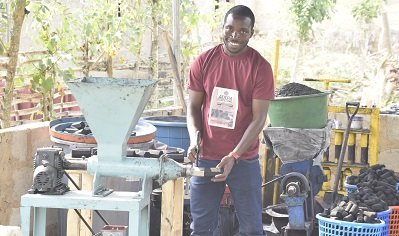
Realising the extent of waste pollution in his vicinity and the country at large, he thought of alternative ways to make good use the situation. He ended up creating a job for himself and a few others.
Here is Mr Ernest Twum Barima, the young university graduate, whose company produces smokeless and long-lasting charcoal briquettes from coconut husk.
The product, targeted at households and institutions, continues to earn positive review and commendation as the manufacturer intends to scale up production to meet local and international demand.
Business
Ernest is a graduate of Koforidua Technical University (KTU) and Valley View University. He studied Purchasing and Supply at KTU before proceeding to Valley View where he obtained Bachelor of Education (B.Ed.) and Information Technology in Education Management.
He conceived the business idea while studying at Valley View University and decided to roll it out after many attempts to secure a job.
Throughout his educational journey, he had dreamt of establishing his own company and it is, therefore, not surprising that he has surmounted the hurdle.
Currently based at Kyebi-Afiesa in the Eastern Region, the venture known as Adepafie Market Company Limited, began when he procured and distributed 100 pieces of waste bins to encourage responsible waste disposal.
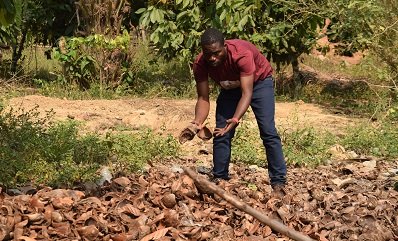
As time went by, he noticed the volume of waste generated daily by coconut vendors in his area and decided to conduct studies into unconventional uses of the discarded coconut husk.
“After I discovered other uses of the coconut husk, I gave empty sacks to the coconut sellers and asked them to offload the husks at my house at the end of every business day.
“My family initially could not come to terms with why I was turning our house into a dumpsite for coconut husk and even thought I had lost my mind,” he told The Spectator.
Unperturbed by these unsavoury comments, however, Ernest kept fine-tuning his idea until 2019, when he produced the first batch of charcoal briquettes to be used at home.
Community members, impressed with the outcome, subsequently encouraged him to start producing for commercial use.
Challenges
According to the initiator, steps towards commercialisation was challenging as he sought financial and technical assistance from some private entities but they failed to deliver on their promise after series of engagement with them.
Undauntedly, he relied on personal savings and the support of family and friends to get his idea off the ground. And with barely a year into his business, he has employed six people who are supporting him presently.
Apart from making charcoal briquettes, Ernest again recycles plastic waste into pavement bricks which, he said, could be a substitute for concrete blocks used in road construction.
Production process
Explaining the making of the charcoal briquettes, he said “the coconut husk is allowed to dry and later burnt and crushed into powder. The powder is then compacted with an organic binder, extruded and moulded into desired shapes and finally left to harden.”
He said he used to go through these processes manually but had now been able to build a makeshift machine which enables him to produce faster.
“I could produce only two bags of charcoal briquette in three days when there was no machine, but I am now able to produce about 10 bags in a day. The quality has improved and it is currently in high demand,” he said.
The charcoal briquette is packed in paper bags, made from plantain stem, and sold at GH 3.00 per Kilo.
The Chief Executive Officer says he has intended to reduce the price in future and has encouraged traditional charcoal producers to adopt his approach and stop cutting trees for charcoal production.
Future
In spite of the progress made, Ernest continues to fall on the support of family and friends to fund his operations.
“I could not meet the requests of my clients previously but I can now meet their need within a month with the little machine I use at the moment.
“I receive a lot of orders from across the country and if I get the needed support to expand production I know things would get better,” he noted.
The mini factory for the charcoal briquette, he said, was situated on a piece of family land, and he would require modern machines and vehicles to convey raw materials to help speed up production.
Although the company makes some profit, Ernest says the income generated goes into repayment of loans he has secured from family and friends.
With the required support, he intends to set up a bigger factory in Accra and Kumasi and employ more youth, should he get the needed support.
By Ernest Nutsugah

The professor who spends his days exploring the intricacies of African languages found himself at the centre of a different kind of lesson on Friday, October 2, 2026. 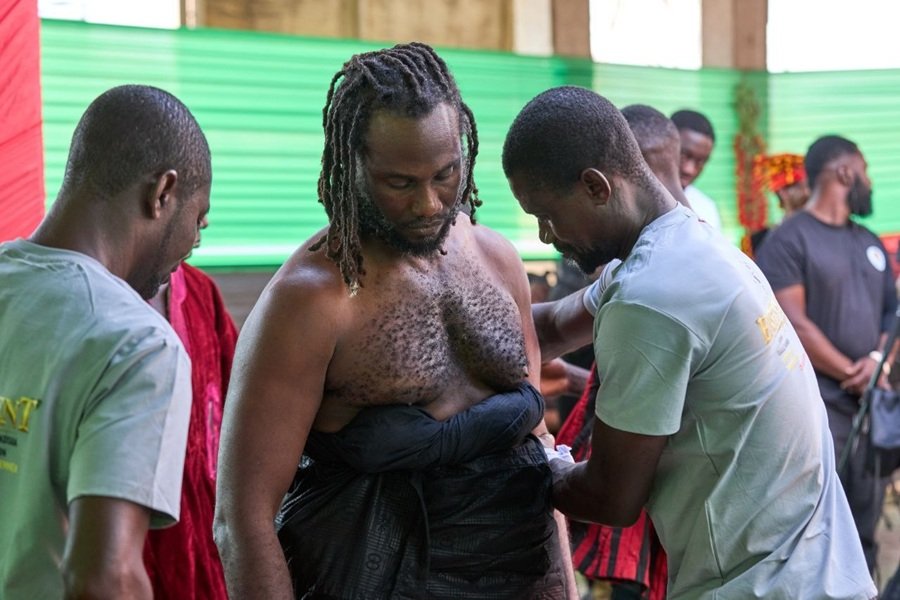
This time, there were no lecture notes, academic arguments or university classrooms. Instead, there was the weight of tradition, the rhythm of a community celebration and the solemnity of an oath at a royal palace.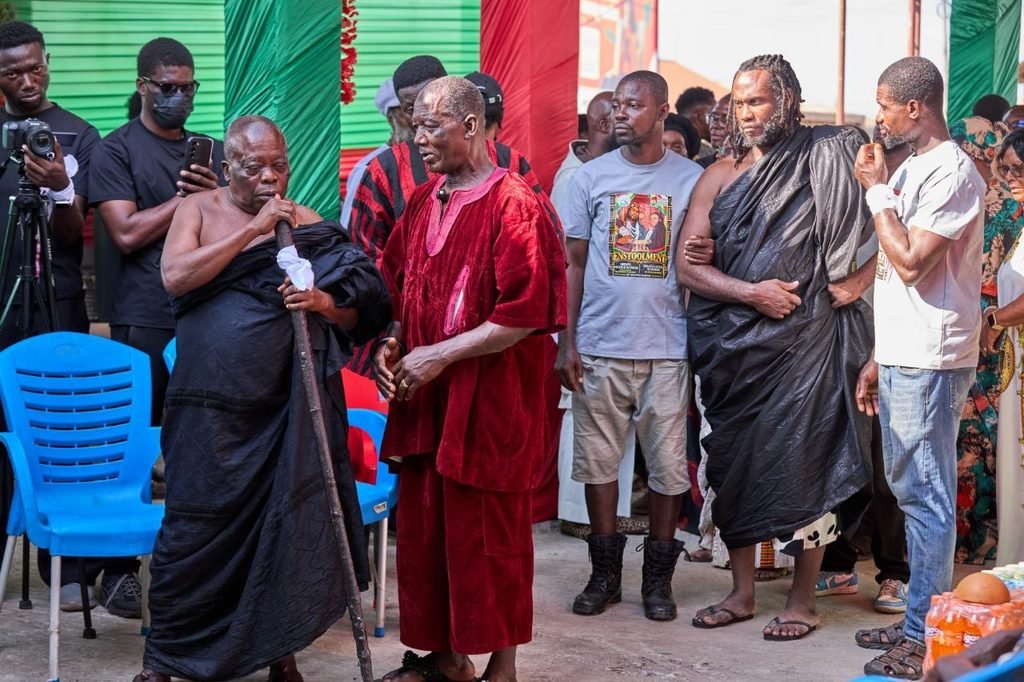
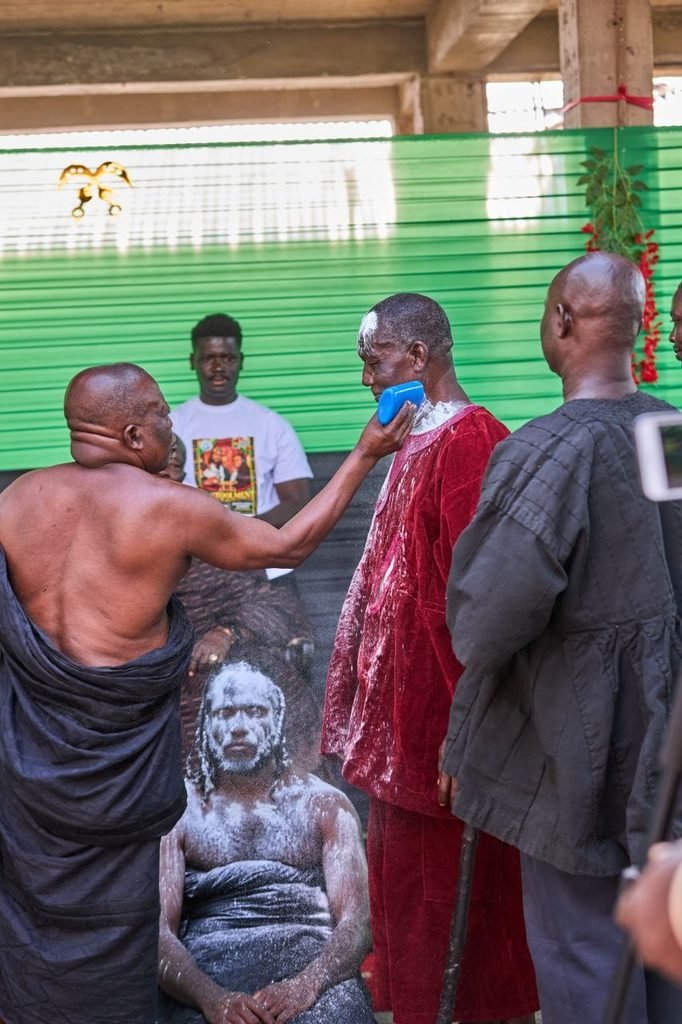
Professor Ọbádélé Kambon, a full Professor of African Linguistics at the University of Ghana, was enstooled as Apagyahene and Sunsum Ɔsahene of Akuapem Mampong in the Eastern Region in a ceremony that brought academia and traditional authority together.
For the professor, the occasion was more than a new title. It was a moment that connected his academic interests in African languages and indigenous knowledge with the living traditions of an Akan community.
The day’s events unfolded through a series of customary observances. Kambon was first taken to the compounds of the Ɔkyeamehene and Gyasehene, where the preparations for his installation continued.
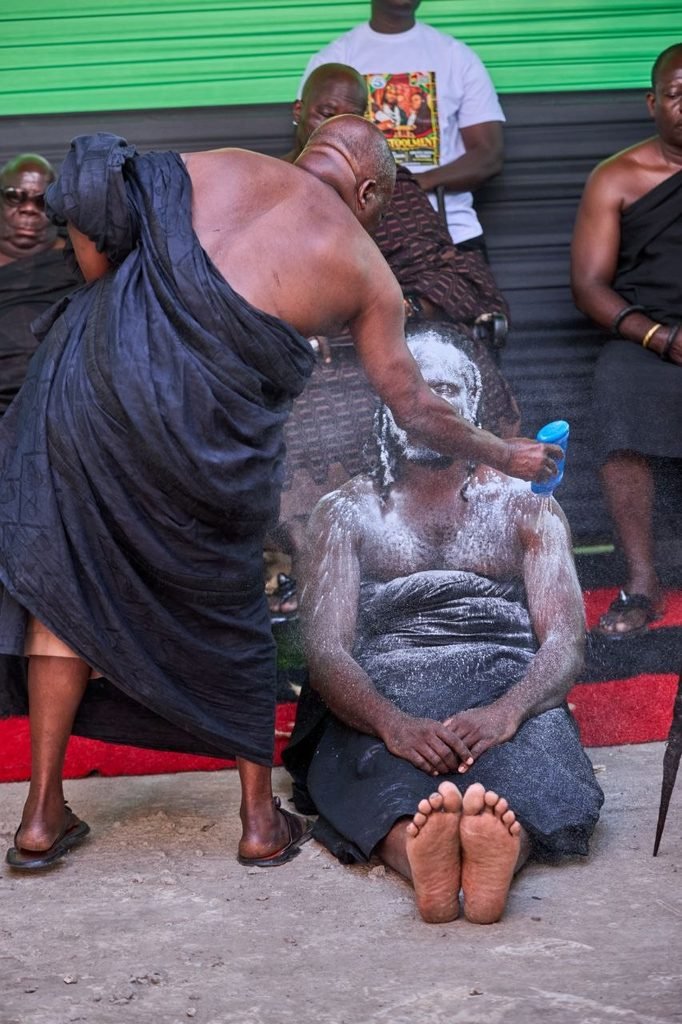
Then came the application of hyire, the white kaolin powder associated with traditional rites.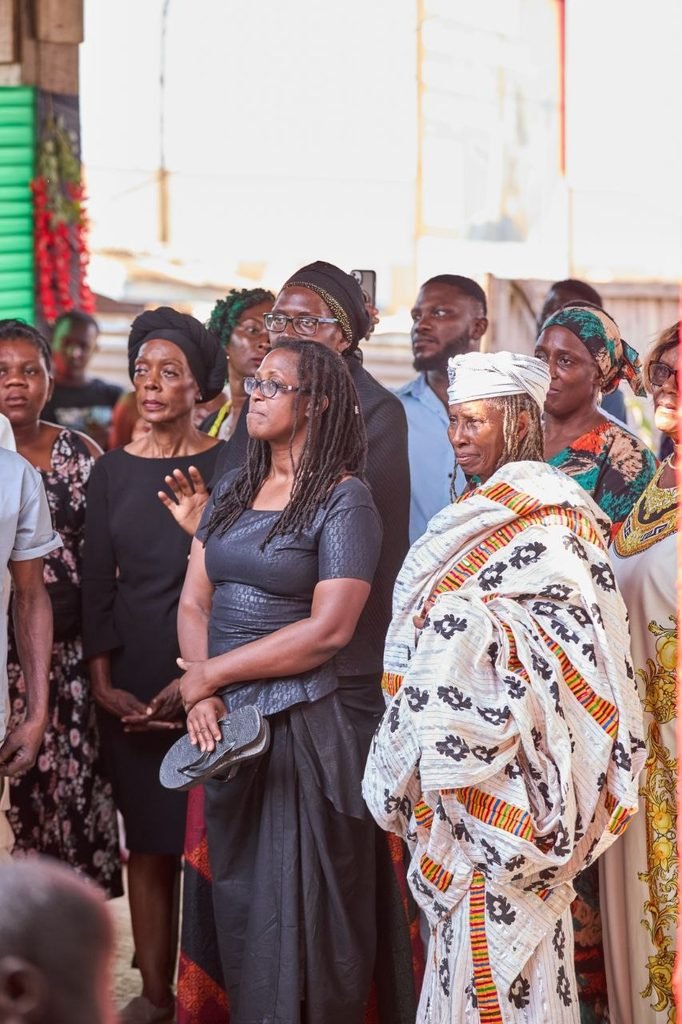
With the customary proceedings underway, the new chief was lifted onto the shoulders of celebrants and carried along the main thoroughfare of Akuapem Mampong.
The procession transformed the streets into a public stage for a ceremony rooted in the community’s traditional institutions.
There was something striking about the image, a university professor, accustomed to the measured language of academic discourse, being carried through the town in a display of traditional recognition.
Yet the celebration was not complete with the procession.
A ram was sacrificed at the Mamponghene’s compound before Kambon was taken to the palace, to swear the oath associated with his new offices.

The ceremony brought him formally into his roles as Apagyahene and Sunsum Ɔsahene.
Beyond the colourful proceedings, the titles themselves carry layers of historical meaning.
Kambon in his research explores the historical connections between Apagya and Akan political and military organisation.
Accounts cited in his work linked Apagya to an asafo, or military company, while historical writing traces an Apagya stool in Asante to the reign of Opoku Ware I in the eighteenth century.
These historical associations offer a glimpse into the institutions that have shaped Akan society over generations, although they do not automatically define the precise responsibilities of the office in Akuapem Mampong.
Kambon’s own professional life reflects a similar interest in preserving and examining African knowledge.
His work encompasses Akan language structure, naming practices across the Black world, proverbs and indigenous intellectual traditions.
Through Abibitumi, the platform he founded, he also promotes language learning, scholarship and cultural engagement.
But tradition was only one part of the story that day.
When the formal ceremony gave way to a reception, the occasion expanded into a celebration of three milestones: Kambon’s enstoolment, his promotion to full professor and his daughter Ama’s admission to the University of Ghana.
The gathering therefore carried a personal significance that went beyond the honours bestowed on one man. 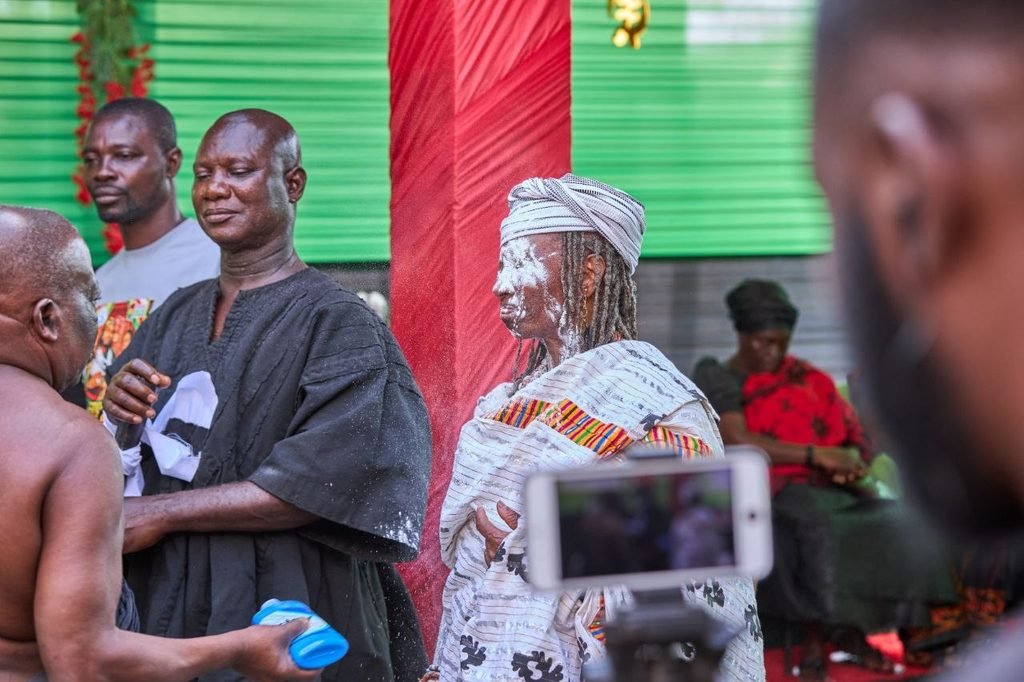
It celebrated professional advancement, the continuation of family aspirations and a connection to cultural heritage.
For a father, seeing a daughter gain admission to the same university where he holds a distinguished academic position offered another reason to celebrate.
For the professor, the moment placed family achievement alongside his own professional and traditional milestones.
Kambon had already established a place in the traditional life of Akuapem Mampɔn through an earlier installation as Banmuhene Kyidɔmhene, recorded in 2017.
His latest enstoolment adds another chapter to that relationship.
In Akuapem Mampɔn, the day brought together the university, the palace and the family table in one celebration. And for Kambon, the journey from the lecture room to the traditional procession showed how scholarship, cultural responsibility and family achievement could converge in a single memorable occasion.
By Enoch Ntiamoah Siaw
SKIP THE QUEUE, TAP THE NEWS
You can now read the Ghanaian Times and The Spectator newspapers from the comfort of your device via TimesNewsPlus.
Join our WhatsApp Channel: https://whatsapp.com/channel/0029VbBElzjInlqHhl1aTU27

Intercity STC Coaches Limited has interdicted a driver captured in a viral video allegedly hitting a Sprinter bus during an overtaking manoeuvre at Pokuase before driving away from the scene.
In a public notice, the company described the driver’s conduct as unacceptable, stressing that it did not reflect the safety standards and professionalism it upholds.
Management said it had commenced an immediate investigation into the incident and identified the driver, who has been interdicted pending the outcome of the disciplinary process.
The company added that it was awaiting an official report from the Pokuase Police Command to help establish the facts surrounding the incident.
STC reaffirmed its commitment to passenger safety and responsible road use, while thanking members of the public for bringing the incident to its attention.
Management assured the public that appropriate action would be taken following the investigation.
By: Jacob Aggrey