News
COVID-19 disrupts ‘normal life’ in Parliament


The disruption to social life, forced by the novel corona virus, was brought to bear yesterday when Parliament operated at half capacity; not by will, but by compulsion to stop the further spread of the respiratory disease.
Out of the 275 lawmakers, only 140, representing 50.90 per cent, were allowed onto the floor of the House when the Finance Minister, Ken Ofori-Atta, came to present the mid-year budget review and economic policy of the government for the 2020 fiscal year pursuant to section 28 of the Public Financial Management Act, 2016 (Act 921).
“The Minister [for Finance] shall, not later than the July 31 of each financial year, prepare and submit to Parliament a mid-year fiscal policy review” the section reads adding that the presentation should contain a brief overview of recent macroeconomic developments of government, an update of macroeconomic forecasts undertaken by government and an analysis of the total revenue and expenditure amongst others.
The legislators, in various shapes and colour of nose masks, sat a chair apart to comply with the physical distancing etiquette in compliance with the COVID-19 preventive protocol.
With admission to the House on ‘first come, first served’ basis, as outlined by Speaker Aaron Mike Oquaye on Thursday, MPs who arrived after the House was ‘full to capacity,’ had to observe proceedings on televisions in their respective offices or alternatively in the public gallery.
With the public barred from participating in this year’s exercise, the gallery, which used to house diplomats, traditional rulers, other dignitaries and the local and international media at such events was virtually empty.
Before the two-hour presentation by Mr Ofori-Atta started at about 1pm, the MPs chit-chatted at considerable distances all in compliance with the COVID-19 preventive protocol.
Dressed in all white, Mr Ofori-Atta’s presentation was interspersed with periodic cheers, jeers and boos from either side of the House depending on what they heard.
Unlike in the past where the cheers and jeers virtually made hearing finance ministers on such occasions difficult, there was calm and order in the House making Mr Ofori-Atta audible.
While at it, the MPs could be seen taking notes; probably in preparation for the debate on Monday. It could be said that the House was generally decorous parting away from previous presentations where placards were displayed to convey messages.
The House, however, bounced back to life after the finance minister finished his presentation at about 3: 00 p.m. to a standing ovation from the majority side of the House.
Calling for a continuation in leadership as he concluded his presentation, Mr Ofori-Atta said the President, Nana Addo Dankwa Akufo-Addo government was the best to steer the country out of the economic quagmire forced by the coronavirus pandemic. Minority Leader, Haruna Iddrisu, seconding the motion for adjournment described the presentation as a “sermon of manifesto promises and pledges rather than mid-year budget review,” to loud laughter by his caucus.
BY JULIUS YAO PETETSI


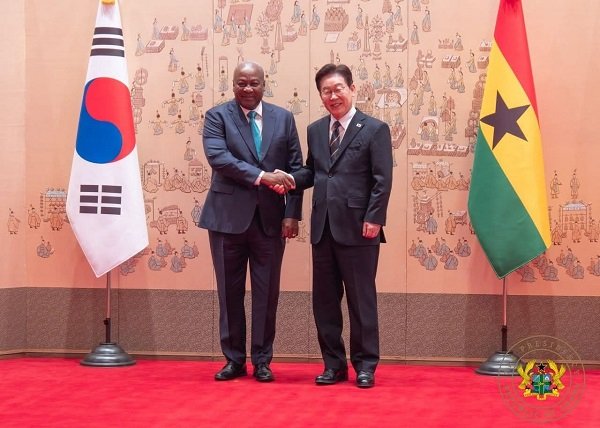
President John Dramani Mahama has held bilateral talks with the President of South Korea, Lee Jae Myung, reaffirming the strong ties and shared values that continue to define relations between Ghana and South Korea.
During the discussions, President Mahama highlighted the historic connection between the two nations, noting their common commitment to democracy, human rights, and a shared historical experience.
He emphasised the opportunities for deeper cooperation, stating that Ghana’s rich natural and human resources, combined with Korea’s technological expertise and innovation, present a strong foundation for a mutually beneficial partnership.
The President also underscored Ghana’s strategic role within the African market through the African Continental Free Trade Area, whose secretariat is headquartered in Accra, positioning the country as a gateway for production and exports into a market of over 1.4 billion people.
President Lee Jae Myung, in his remarks, described Ghana as a country that holds a special place in the hearts of many Koreans, highlighting decades of cooperation in areas such as maritime security, trade, and agriculture.
He also reflected on the longstanding cultural and economic connection symbolised by the popular “Ghana” chocolate brand made from Ghanaian cocoa, which has been enjoyed in Korea for over five decades.
Both leaders expressed optimism about expanding people-to-people exchanges, cultural engagement, and economic collaboration, with President Lee noting that President Mahama’s visit provides a timely opportunity to deepen practical cooperation that will directly benefit the citizens of both nations.

The Ministry of Foreign Affairs has been informed by the relevant authorities in the United Arab Emirates that two Ghanaian nationals sustained injuries following a drone incident in the vicinity of Dubai International Airport earlier today, March 11, 2026.
Against this backdrop, the Government of Ghana has strongly condemned any act that endangers civilian lives and critical infrastructure.
In a statement issued by the Ministry of Foreign Affairs today, March 11, such incidents pose serious risks to public safety and underscore the importance of ensuring the protection of civilians and vital international transport hubs.
Ghana’s Ambassador in the United Arab Emirates has led a delegation of the Embassy in Abu Dhabi and Consulate in Dubai to visit the two injured Ghanaians in hospital.
Their injuries are not critical and are expected to fully recover soon.
“We therefore urge calm as we continue to extend consular assistance and collaborate closely with host authorities,” the statement added.
The Ministry has revealed that they are closely monitoring the situation and will continue to engage with the appropriate authorities as required.
The Government of Ghana expresses its concern over the incident and conveys its thoughts to the injured individuals and their families.
The Ministry of Foreign Affairs reiterates the Government of Ghana’s commitment to the protection and welfare of Ghanaian citizens wherever they may be.
The Government of Ghana is actively supporting ongoing consultations within the UN to pass a resolution seeking a cessation of hostilities.
According to the Ministry they are offering the necessary leadership and coordination with Ghana’s diplomatic Missions and will provide updates on the matter as and when the need arises.
Government has reiterated its call for Nationals in the Gulf region to always exercise heightened vigilance and comply with directives from Ghanaian Embassies and local authorities.