News
Council 27 celebrates Golden Jubilee in Tamale

- /home/u249204778/domains/spectator.com.gh/public_html/wp-content/plugins/mvp-social-buttons/mvp-social-buttons.php on line 27
https://spectator.com.gh/wp-content/uploads/2022/11/Inset-Most-Rev.-Philip-Naameh-delivering-his-speech-while-the-Marshallans-listen-attentively.jpg&description=Council 27 celebrates Golden Jubilee in Tamale', 'pinterestShare', 'width=750,height=350'); return false;" title="Pin This Post">
- Share
- Tweet /home/u249204778/domains/spectator.com.gh/public_html/wp-content/plugins/mvp-social-buttons/mvp-social-buttons.php on line 72
https://spectator.com.gh/wp-content/uploads/2022/11/Inset-Most-Rev.-Philip-Naameh-delivering-his-speech-while-the-Marshallans-listen-attentively.jpg&description=Council 27 celebrates Golden Jubilee in Tamale', 'pinterestShare', 'width=750,height=350'); return false;" title="Pin This Post">
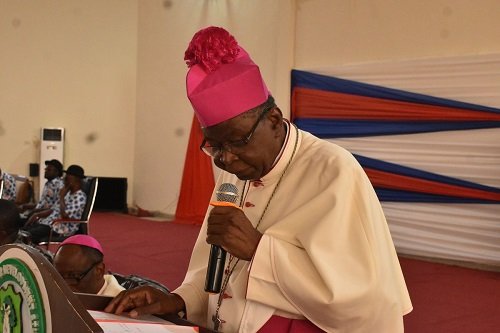
• Inset: Most Rev. Philip Naameh delivering his
speech while the Marshallans listen attentively
The Noble Order of the Knights and Ladies of Marshall (a Catholic Friendly Society), Council 27 has celebrated the Golden Jubilee of the Consecration of the Council at Dungu near Tamale in the Northern Region.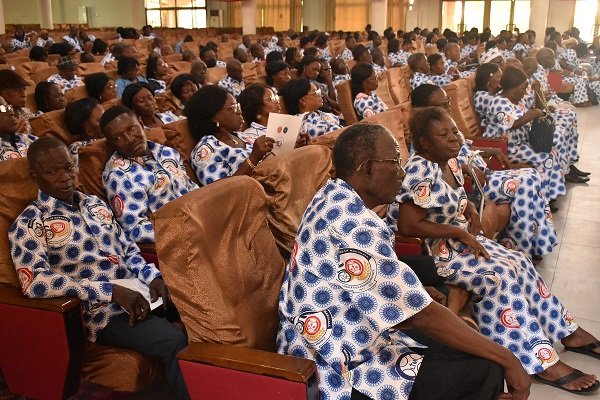
Council 27 of Tamale since its consecration in 1972 has been able to see to the consecration of 33 other component councils throughout the Upper East, Upper West, Northern, Savannah and the North East regions.
The theme for the celebration was “The Knights and Ladies of Marshall; Discipleship and Evangelisation in the Tamale Ecclesiastical Province”.
Delivering the keynote address on the theme, the Metropolitan Archbishop of Tamale, Most Rev. Philip Naameh said by Baptism and Confirmation, Jesus called each one of us to discipleship for the purpose of the evangelisation and salvation of the world.
He said as Baptised Catholics we were all evangelisers who were called to evangelise ourselves, families, parishioners, neighbours and others as St. Paul emphasised the urgency of proclaiming the Gospel when he said “an obligation has been imposed on me, and woe to me if I do not preach it” (1 Cor.9:16).
He said the recent Synodal Process in the Province reminded many of the need to look again at the mission of the Church and that the place to begin with discernment was how to form committed disciples for the purpose of evangelisation adding “a renewed commitment is required of all of us because evangelisation needs evangelisers”.
Most Rev. Naameh said the coming together of all Marshallans in the North to discern new ways to evangelise the people was apt because looking at it, discipleship would be key and central so Marshallans needed to focus on how they could form themselves as disciples of Christ.
He said from the Synodal Process it was seen that the Church within this Province was faced with challenges for which Catholics were not able to bring the good news of Christ to those who needed it and, therefore, obliged by these revelations to evangelise.
He defined disciple as “a student who depicted an intimate form of mentorship whereby the student did not only sit in the classroom to listen and learn but lived with the master and learnt from him how he lived and managed his family affairs.”
The Metropolitan Archbishop said from the Christian perspective discipleship was modelled on the calling of the disciples by Jesus with the command to follow Him so the first disciples Peter and Andrew were called to come and be fishers of men.
He said the disciple was to be holy and sought acts of holiness and the Second Vatican Council described the call to discipleship as the universal call to holiness.
He said the command to the Twelve to go out and proclaim the Good News was also valid for all Christians though in different ways, the Good News of the kingdom which was coming and which had begun was meant for all people of all times, those who received the Good News and who had been gathered by it into the community of salvation could and must communicate and spread the news.
He indicated that no believer in Christ, no institution of the Church could avoid this supreme duty to proclaim Christ to all people.
Most Rev. Philip Naameh who is the immediate past President of the Ghana Catholic Bishops Conference said it had been observed that some Catholics went to Mass regularly on Sundays out of habit and then lived the rest of the days as accomplices in thoughts and deeds that contributed to the ills of our society.
He told the Marshallans that they were expected to live together in Unity, Charity and Service with all people as their motto said.
He said when the society was formed in 1925 the enthusiastic young Catholics planned to spread the Good News and to prevent Catholic men who might be attracted to secret societies making those who joined the Marshallan Order authentic disciples or witnesses to the Catholic faith.
He said Sir James Marshall, a Scottish Anglican clergyman and a Justice of Gold Coast who converted to Roman Catholicism gave every support and championed the re-establishment of the Catholic Church in Ghana by adding his voice to appeals and pressures that made Propaganda Fide to assign the Society of African Missions (SMA, also known as White Fathers) to Ghana.
He said Sir James Marshall demonstrated clearly a good spirit of discipleship and commitment to the evangelisation of Ghana which showed that the laity could contribute immensely to the evangelisation of the people.
He told the Marshallans to emulate Sir James Marshall who, convinced that there was Good News in the Catholic faith, saw to it that the Good News must be preached in a sustainable way to the people of the Gold Coast.
The Archbishop said during the earthly ministry of Jesus He loved and served strangers, the sick, the poor, the hungry, the weak and vulnerable motivated by pure love so all Marshallans as a lay organisation must emulate the deeds of Jesus Christ and this would mean being good and active Catholics.
The Supreme Knight, Sir Kt. Bro. Patrick Kobina Anumel said a disciple was one who “has taken the name of Christ and lived to see the spiritual needs of others.”
He said a disciple made people to live like Christ by imitating the life and deeds of Christ and the mustard seed sown 50 years ago in Tamale had grown to have shades all over the Catholic Dioceses in the North.
Rev. Prof. Samuel Donkoh of the University for Development Studies (UDS), said the Catholic Church had many schools with dedicated staff impacting knowledge to the students.
He said the most well behaved students on campus were mostly from Catholic institutions because of the proper training they had in those schools.
He said the main objective of Christians was to spread the good news of Christ and this evangelisation was done through the mouth or your deeds and living lives worthy of emulation by loving your neighbour as yourselves with your whole heart and soul because our Lord lived a very perfect life.
The Regional Chief Director of Northern Regional Coordinating Council, Alhaji Issahaku Alhassan said the Catholic Church through so many interventions brought many development projects to Ghana especially the deprived areas in the Northern sector.
He said the church did not only deal with the spiritual aspects of the people but had brought education, health, potable water and other social amenities to many communities.
He said the Knights and Ladies of Marshall as a segment of the Catholic Church had also contributed a lot to many needy people, orphanages and the prisons.
Alhaji Issahaku said the schools managed by the Catholic Church were the best in terms of academic performances and discipline and must be sustained to advance the development of Ghana.
The Chairman of the Anniversary Planning Committee, Worthy Bro. Malex Alebikiya said the celebration was a reflection of where the Order came from and how far they had lived as a Catholic Friendly Society for these 50 years.
The host Regional Grand Knight-Tamale Region-Worthy Bro. Peter Badimak Yaro said the year-long activities of the Order launched on Saturday 5th March 2022 saw the organisation of a series of charity works and spiritual renewals among Marshallans and other societies in the church and beyond.
From Peter Gbambila, Dungu.

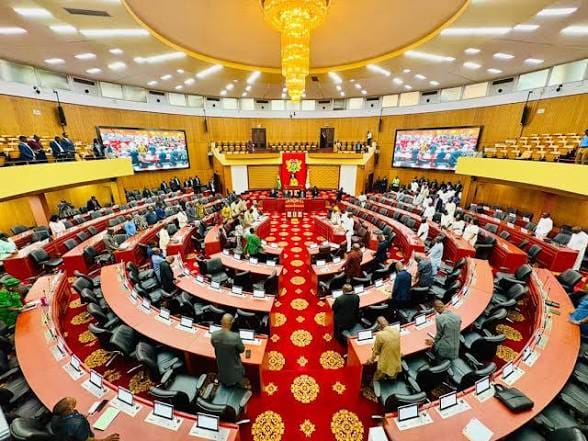
Parliament has clarified public commentary on social media regarding a notice on its notice board that read “No Vacancy for National Service Personnel 2026/2027. Kindly go for reposting.”
In a statement, signed by the Director of Media Relations, David Sebastian Damoah, Parliament said the notice has been misconstrued and was not a policy statement, a freeze on national service placements, or a change in its support for the National Service Scheme.
According to Parliament, the notice was a routine administrative message to prospective personnel who reported to the House, informing them that it has received more personnel than it can accommodate for the 2026/2027 service year and that they should seek reposting to other institutions.
It said it remains committed to the National Service Scheme and values the contribution of service personnel to its work, and regrets any confusion or inconvenience the wording may have caused.
By Edem Mensah-Tsotorme

Ghanaian public advocate Hopeson Yaovi Adorye has been elected to the Board of Directors of the World Taxpayers Association (WTA).
The election took place on Sunday, October 5, 2026, during the Association’s conference in Kraków, Poland.
His election marks a significant addition to his international leadership portfolio and provides a platform for Ghanaian and African perspectives to contribute to global discussions on taxpayer rights, responsible taxation, transparency and prudent management of public resources.
Reacting to his election, Mr. Adorye expressed appreciation to the leadership and members of the WTA for the confidence reposed in him.
“I am deeply honoured by this confidence and conscious of the responsibility that comes with it. Taxpayers are at the heart of every economy, and they deserve fairness, transparency, accountability and value for the taxes they pay. I look forward to working with colleagues from across the world to strengthen the voice of taxpayers and promote responsible fiscal governance,” he said.
According to him, taxation should not be viewed solely as a mechanism for raising government revenue, but also as an important component of the social contract between citizens and the state.
Mr. Adorye said governments have a responsibility to ensure taxes are collected fairly and public resources are utilised efficiently to deliver quality infrastructure, healthcare, education, security and other essential services.
His election also creates an opportunity to bring African experiences into international conversations on taxation and public expenditure.
Mr. Adorye, who is Executive Director of Taxpayers League Ghana, has previously served as Global Board Chairman of the International Youth Network for UN Security Council Resolution 2250, an NGO associated with the United Nations Economic and Social Council (ECOSOC).
He is expected to use his new role to champion fiscal accountability, taxpayer education, good governance and stronger citizen participation in public financial management.