News
COTA moves to tackle insecurity, leadership disputes in Teshie

- /home/u249204778/domains/spectator.com.gh/public_html/wp-content/plugins/mvp-social-buttons/mvp-social-buttons.php on line 27
https://spectator.com.gh/wp-content/uploads/2026/03/Dr-Albert-Tetteh-Botchway-middle-walking-with-other-participants.jpg&description=COTA moves to tackle insecurity, leadership disputes in Teshie', 'pinterestShare', 'width=750,height=350'); return false;" title="Pin This Post">
- Share
- Tweet /home/u249204778/domains/spectator.com.gh/public_html/wp-content/plugins/mvp-social-buttons/mvp-social-buttons.php on line 72
https://spectator.com.gh/wp-content/uploads/2026/03/Dr-Albert-Tetteh-Botchway-middle-walking-with-other-participants.jpg&description=COTA moves to tackle insecurity, leadership disputes in Teshie', 'pinterestShare', 'width=750,height=350'); return false;" title="Pin This Post">
THE Coalition of Teshie Associations (COTA) has announced plans to address longstanding leadership disputes and security concerns in the Teshie community while promoting peace and youth empowerment ahead of the 2026 Homowo Festival.
The coalition said the initiative formed part of efforts to foster unity among the five quarters of Teshie, namely Kle Musum, Lenshie, Agbawe, Krobo, and Gbugbla.
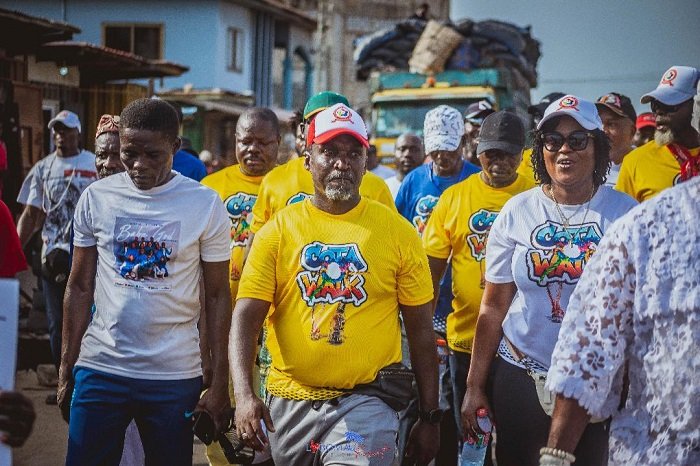
The announcement was made during a unity walk, organised in collaboration with COTA and Laboma Beach Resort, on Saturday in Accra. The event was sponsored by the Chief Executive Officer (CEO) of the Resort, Dr Albert Tetteh Kwarshie Botchway.
More than 2,000 participants joined the walk through the principal streets of Teshie, starting from the Laboma Beach Resort, to promote peace and highlight the need for harmony within the community.
Addressing the gathering, Dr Botchway said peace among the youth was essential for the development of the community. He noted that when young people embraced peace, it creates an enabling environment for development and improved social interventions in the area.
He also indicated that several activities had been planned to promote unity and harmony in the community ahead of the Homowo Festival in August 2026. These would include indoor and outdoor games, competitive sports among community groups, and weekly peace messages broadcast through the public address system.
In his remarks, the Chairman of COTA, Alfred Amarh Lienks, explained that the leadership disagreements among the various quarters had in the past created uncertainty for investors and organisations seeking to support development in Teshie. He, however, stated that the situation was not driven by ill intent but rather by the desire of different leaders to see development in the community.
According to him, the coalition was working to strengthen coordination among community leaders to create a more unified front for development initiatives. To address the situation, he revealed that the coalition was establishing a task force that would be stationed at key junctions in the community to enhance security and protect both residents and ride-hailing drivers.
Meanwhile, the Kpeshie Divisional Commander, ACP Emmanuel Odonkor Baah, urged the youth to stay away from violent activities and support efforts to maintain peace in the community.
By Stephanie Birikorang


The Office of the Special Prosecutor (OSP) has taken note of public allegations of extortion and related conduct made against the Minority Leader of Parliament, Alexander Afenyo-Markin.
The allegations were made by the Chief Executive of the Ghana Gold Board (GoldBod), Sammy Gyamfi.
In a brief statement, the OSP said it has also received a joint petition submitted by two persons, as well as two separate petitions from other persons, in relation to the same allegations.
“Given the nature of the allegations, the OSP will assess the case and determine whether it falls within its statutory mandate and whether further investigative action is warranted,” the statement said.
The development comes amid a heated public feud between the Minority in Parliament and the leadership of GoldBod over the operations of the Domestic Gold Purchase Programme.
The Minority, led by Afenyo-Markin, has accused GoldBod and the Bank of Ghana of causing a loss of over $1.7 billion, citing the International Monetary Fund’s August 2026 report. The Minority has vowed to pursue the matter as Parliament has reconvened for an emergency sitting.
GoldBod, on the other hand, has rejected claims by some NPP MPs, including Tano South MP Dr Gideon Boako, that it owes the Bank of Ghana GH¢1 billion in overdrafts, describing the claim as “false and malicious.”
In the latest twist, GoldBod CEO Sammy Gyamfi has accused the Minority Leader of extortion and related conduct, an allegation that has triggered petitions to the OSP.
The OSP is mandated under Act 959 to investigate and prosecute specific cases of alleged or suspected corruption and corruption-related offences involving public officers and politically exposed persons.
By Edem Mensah-Tsotorme

General Secretary of the New Patriotic Party (NPP), Justin Kodua Frimpong, has filed his nomination to contest the position of General Secretary again as the party begins its rebuilding efforts ahead of the 2028 general elections.
He was accompanied by party stalwarts and supporters who were in high spirits, expressing confidence that he is the right person to hold the position.
Speaking after filing his nomination, Mr Kodua Frimpong assured the rank and file of the party that he would not disappoint them.
“I can assure you that the faith the rank and file of the party have had in me, I will never disappoint them,” he said.
He also pledged to run a clean campaign devoid of personal attacks.
“I can assure you that our internal campaign will be devoid of personal attacks,” he told his fellow contestants and the rank and file of the party as he seeks to retain his position.
His tenure has seen the party through the 2024 general elections, where the NPP lost power to the National Democratic Congress (NDC) after eight years in government.
The party is currently in a rebuilding phase, with internal elections scheduled to elect new national executives to lead its reorganization towards the 2028 polls.
The General Secretary position is considered one of the most influential in the party’s administrative structure, responsible for the day-to-day running of the party secretariat and implementation of party decisions.
By Edem Mensah-Tsotorme