Features
Continuous sensitisation needed to end mob justice in Ghana


Mob justice remains a serious problem in Ghana, and there is an urgent need for sustained sensitisation to curb the menace. In many communities, when someone is suspected of wrongdoing, a crowd can quickly form and take the law into its own hands. Within minutes, the situation can turn violent, and in some cases, the person accused does not survive. This is why public education must be intensified and sustained if the country is to bring an end to these acts.
Mob justice is dangerous and unacceptable. No one should lose their life based on suspicion alone. People must be encouraged not to take the law into their own hands but rather to trust the justice system and allow the appropriate authorities to handle such matters.
The recent lynching of two scrap dealers at Ntensere in the Atwima Nwabiagya North District of the Ashanti Region shows how serious the issue has become. The two men were accused of attempting to abduct a three-year-old child, after which they were attacked and killed by a mob, and their motorbikes were set ablaze. The level of destruction shows how quickly anger can escalate when there is no control.
Painful incidents that reflect a national problem
Ghana has seen similar incidents in the past. In 2017, Major Maxwell Mahama was lynched after he was wrongly suspected to be an armed robber. His death shocked the nation, yet it did not completely stop mob justice.
In 2024, Wilberforce Appiah, a musician popularly known as Wylbee, was lynched at Tanoso in the Ashanti Region after he was accused of theft. Reports indicated he had stepped out at dawn when he was attacked.
More recently, on February 27, a 26-year-old Liberian national, Austin Tengeeh, was also lynched at Lashibi. The incident sparked outrage on social media, but like many others before it, it raises concerns about how such cases can be prevented.
The role of the National Commission for Civic Education (NCCE)
The National Commission for Civic Education (NCCE) must play a leading role in ending mob justice through continuous sensitisation.
The Commission needs to intensify its public education campaigns and make them consistent. Education should not be occasional; it must be ongoing and visible across communities.
The NCCE can organise regular engagements in markets, transport terminals, schools, and communities, using simple language to explain why mob justice is wrong and illegal. It should also make better use of community-based radio stations by introducing discussions, short dramas, and call-in programmes that address real-life situations.
Using local languages is critical to ensuring that the message reaches everyone, especially those in rural areas. The focus should be clear, any suspected offender must be handed over to the police, not attacked.
Influence of religious, traditional leaders and school authorities
Religious leaders, traditional rulers, and enlightened individuals have a strong influence on community behaviour and must be part of the solution.
Religious leaders should consistently speak against mob justice during sermons and emphasise the value of human life. Their messages can help shape attitudes and discourage violence.
Traditional rulers can support the effort by setting clear community rules that discourage mob action and promote peaceful reporting of suspected crimes to the authorities.
Educated and influential individuals must also take responsibility by speaking up when tensions rise. In many cases, mob attacks occur because no one intervenes early. Calm and informed voices can help prevent escalation.
The role of schools in shaping attitudes
Schools also have a critical role in addressing mob justice by shaping the mindset of young people. From the basic level to tertiary institutions, pupils and students should be taught the importance of respecting the rule of law and the dangers of taking matters into their own hands. Civic education lessons can include practical examples that show why mob justice is harmful and why due process must always be followed.
Teachers can also encourage discussions around real-life situations, helping students understand how to respond when they witness suspected wrongdoing in their communities. Through debates, role play, and guidance, young people can be groomed to value patience, fairness, and lawful behaviour. When children grow up with this understanding, they are less likely to participate in mob action and more likely to influence others to do the right thing.
What the police must do consistently
The Ghana Police Service has a central role in addressing mob justice, and its approach must be practical and consistent.
One key step is to strengthen community policing. When the police are visible and approachable, people are more likely to report suspected crimes instead of taking action themselves.
The police must also increase patrols in areas where mob justice is common and ensure a rapid response to distress calls. Delays often create room for mobs to act.
Public education should be part of regular police work. Officers should engage communities frequently, explaining the legal consequences of mob justice and assuring the public that due process will be followed.
Enforcement is equally important. Individuals involved in mob justice must be arrested and prosecuted consistently. This will serve as a deterrent and reinforce the rule of law.
Sustained sensitisation is the way forward
While arrests are sometimes made after such incidents, the focus must shift from reaction to prevention. Continuous sensitisation, strong community involvement, and effective policing are key to ending this problem.
Mob justice should not be accepted as normal in Ghana. Every individual deserves the right to a fair hearing, and the law must be allowed to work.
If sensitisation efforts are sustained and not relaxed, Ghana can gradually reduce and eventually eliminate mob justice. The goal is clear: to build a society where no one loses their life because of suspicion, and where justice is handled through the proper legal system.
BY RAISSA SAMBOU

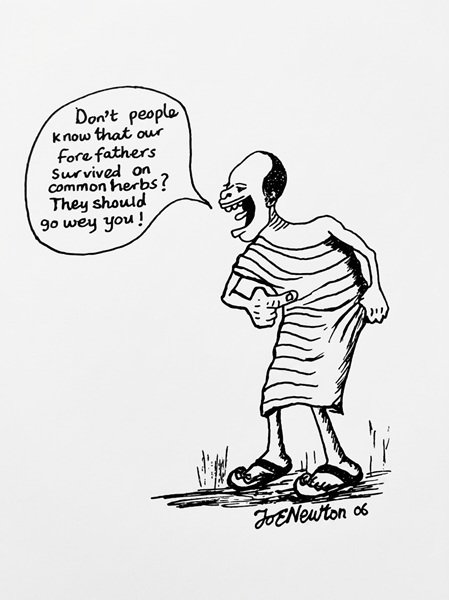
THE typical itinerant salesman in Sikaman is a herbalist. He is normally a slim macho with the capacity to perambulate the expanse of area covering the triangle of Accra-Tema-Ashiaman. In short, he can walk a total of 60 miles a day, marketing a product that cures every disease, including poverty. 
The door-to-door herbal pharmacist advertises his product by word of mouth. He has nothing to do with the Food and Drugs Board (FDB). After all, his concoctions do not feature on FM stations.
Those herbalists who cannot walk to propagate the herbal gospel, liaise with drivers of mass transportation and their mates. They are, therefore, given the chance to sell their products on Benz buses that ply the routes.
Normally, the herbalist starts his sales message with a prayer and Bible study. He asks the passengers to bow down their heads in supplication to God the father, the son, the Holy Spirit.
When a herbalist asks the passengers to close their eyes and bow their heads, Moslems on board naturally feel offended. They feel that the herbalist has no right to assume that every passenger is a Christian. They think such an assumption is an affront to Islam.
So a Moslem on board will raise the hand for a point of order. He’ll remind the herbalist that it would be in his own interest to mind his language.
“Be careful the way you address people in a public place. Not every person here is a Christian,” he’d state assertively.
Of course, the herbalist will promptly ignore him, but would all the same “watch” his tongue. Who knows whether or not the Moslem brother is inspired by Quoranic zeal to defend the tenets of Islam to the hilt?
When he starts saying, “Wallahi!” and “Inshallah!” it could be the beginning of proclaiming Islam as supreme, a point which must be driven home with talibanic precision.
So the herbalist must tread carefully lest he steps on fire.
The herbalist could even add a measure of mirth to it all, by announcing that Christians on board today have very interesting company on the journey, but that should not detract from the business of the day.
The Moslem brother will weigh the words carefully and offer a wry smile.
He must be careful the occasion does not degenerate into the use of semantics and proverbial oration to deride his conviction that public utterances must be mindful of religious sensibilities. He has made his point very clear and expects that it is taken in good faith in the interest of a peaceful journey.
The herbalist will now open the New Testament and preach salvation, stating clearly that salvation can come only through Jesus Christ and NOBODY else.
The Moslem brother will now start twitching his moustache. The visible and almost revolutionary reflexes of his upper lip can be an indication that sentiments have begun superseding reason, and the outcome could well be tragic now shift uneasily in his seat.
The time has come for him to also express his right to the religion of his fore-bears. He’ll put his hand into his pocket and rise to his feet. The time has indeed come!
This article was first published on Saturday, September 9, 2006
When the cause of a particular problem like sickness, disease, sudden illness, a social issue etc. are not known, it stands to reason that resolving it becomes a huge challenge.
Citizens would understand the government when public announcements are made to the effect that government is trying to find a solution to the issue, even though it is taking a while for it to be resolved because citizens are rational beings.
On the other hand, if the solution to a particular issue is known to everybody but the government for whatever reason, is dragging its feet in resolving it, citizens become frustrated and begin to lose trust in their leaders.
One such issue is the heavy traffic along a section of the Kasoa – Odokor road. A short stretch of bad road between the traffic light at the Weija Government Hospital and the entrance to the entrance of the overhead that leads to the N1, is the cause of the problem but nothing is being done about it, day after day, week after week, month after month. Thus is clearly unacceptable.
Another issue that requires urgent attention is the lack of pavements along a lot of streets in parts of the various Municipal Assemblies. Exercise is a prerequisite for long life and healthy living and for those of us who it has become a way of life, this issue of people putting up structures right to the edge of the drains beside the roads, are making life difficult for us.
We are compelled to walk along the roads, putting our lives at serious risk. Pedestrians should never be compelled to compete with vehicles on our streets and roads. Roads and streets are made for vehicles and pavements are made for pedestrians. That is the norm. Any attempt to normalise a situation where pedestrians are mingling with vehicles is insanity.
It is the road regulations that makes it so and therefore district or municipal assemblies are to take responsibility and ensure that spaces for pavements are not encroached upon. Citizens have rights that must be protected by their leaders and making pavements available to pedestrians, is one of them.
When we hear of teachers having sex with students, it appears it is something recent. It is not a new phenomenon. It has been there since Adam. Perhaps this issue is getting much attention due to the proliferation of social media. It was an open secret in times past when Teachers were in relationships with female students and some married them immediately after completion of school.
Some teachers were also known to be having unholy interactions with female pupils but due to the times that these acts occurred, human rights issues and the awareness around it, allowed such unscrupulous teachers to get away with their crimes.
Now we are in a different era and so a Headmaster is now in hot waters. He is alleged to have raped about 19 female students and as usual, some officials tried to cover it up and are also in hot waters and their actions or inactions in the matter are under investigation.
Why the man has been allowed to roam freely without being arrested is simply mind boggling. It appears that the law applies differently, depending on who you are. This issue came to public attention sometime in August this year, yet the police had not arrested or invited this man for question regarding the rape allegation.
It has come out that he is a Constituency Secretary of the ruling party and the question in the public domain is that, is it because he is a political figure that is why he is still walking around without questioning? I believe in the rule of law so let us hold our breadth and let the proper thing be done.
The police must however be seen to be active in this matter. God bless.
SKIP THE QUEUE, TAP THE NEWS
You can now read the Ghanaian Times and The Spectator newspapers from the comfort of your device via TimesNewsPlus.
Join our WhatsApp Channel: https://whatsapp.com/channel/0029VbBElzjInlqHhl1aTU27