Hot!
Collaborate and work together to Improve Intra-African Trade – Osinbanjo to African Countries

- /home/u249204778/domains/spectator.com.gh/public_html/wp-content/plugins/mvp-social-buttons/mvp-social-buttons.php on line 27
https://spectator.com.gh/wp-content/uploads/2024/07/WhatsApp-Image-2024-07-23-at-2.09.10-PM.jpeg&description=Collaborate and work together to Improve Intra-African Trade – Osinbanjo to African Countries', 'pinterestShare', 'width=750,height=350'); return false;" title="Pin This Post">
- Share
- Tweet /home/u249204778/domains/spectator.com.gh/public_html/wp-content/plugins/mvp-social-buttons/mvp-social-buttons.php on line 72
https://spectator.com.gh/wp-content/uploads/2024/07/WhatsApp-Image-2024-07-23-at-2.09.10-PM.jpeg&description=Collaborate and work together to Improve Intra-African Trade – Osinbanjo to African Countries', 'pinterestShare', 'width=750,height=350'); return false;" title="Pin This Post">
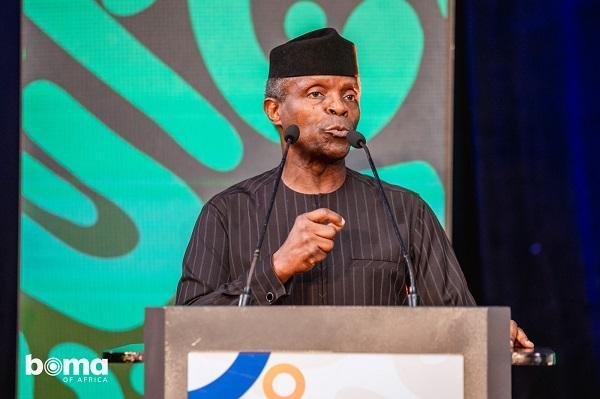
Prof. Oluyemi Oluleke Osinbajo, former Vice President of the Federal Republic of Nigeria has urged African countries to collaborate, work together to improve intra-African trade.
He said this could be done by building infrastructure that connect the countries both digitally and physically.
He noted some of Africa’s accomplishments at the level of intra-African trade, stating that as much as 41 per cent of Africa’s machinery exports were traded within the continent.
Prof. Osinbajo also noted that 35 per cent of biopharmaceutical products and 30 per cent of industrial chemicals were already being traded as a measure of intra-African trade.
Speaking at the BOMA of Africa event on the sidelines of the Africa Union’s Mid-Year Coordinating Meeting held in Accra last Saturday, Prof. Osinbajo said it is in the best interest of Africa to improve trade among its member countries.
This year’s theme for BOMA of Africa, “From the Africa We Want to the Africa We Build,” encapsulates the essence of Africa’s journey. Through focused discussions on health, wealth creation, development financing, and governance, BOMA 2024 aimed to ignite new momentum towards realizing Africa’s continental aspirations. By spotlighting major projects and initiatives, the event aimed to foster a spirit of collaboration and determination.
Touching on Africa’s rich biodiversity, Prof. Osinbajo said the continent had high biodiversity reserves and the scale of natural capital to preverse centuries of ecological erosion and the unbridled carbon-laden industrialisation of yesterday.
Noting that there is a wave of brain drain that has hit African countries, Prof. Yemi Osinbajo, who previously served as Attorney General of Lagos State from 1999 to 2007, said Africa must create an environment that rewards the talents of its people to prevent movement of African labour to other continents.
“Labour is always going to find the place where it is best rewarded. Anywhere in the world, wherever labour is best rewarded, that’s where it’ll go. That’s why there are lots of movements all across the world. It’s, therefore, best for Africa to create the environment for rewarding talent,” Prof. Osinbajo said.
He said according to experts, as much as one quarter of the planet’s workforce was likely to be of African origin and of the youthful workforce in particular, as much as 42 per cent may be in Africa by 2050.
“according to him, an energetic pool of youthful talent fortified with fast-advancing artificial intelligence and the geoengineering edge of a world that is desperately in need of a new economic growth paradigm is an edge that the rest of the world ignores at great risk.”
“Integrate trade, digital transaction and work together to build a resilient, rich, prosperous economy and then people will stay and people will come from everywhere in the world to Africa. There’s no other solution,” he said.
With regards to Africa’s health development readiness, Prof. Osinbajo noted that during the pandemic, Africa, through the collaboration of Panavirus and the Africa CDC, brokered by AfroChampions, built and deployed the world’s first vaccine passport.
“The Panavirus platform digitally connected labs and hospital facilities, as well as pathogen genomic centres in 20 countries of Africa,” he added.
AUDA-NEPAD and AfroChampions, alongside other strategic partners, have hosted the annual BOMA of Africa event during African Integration Week since 2019. This year’s BOMA was aligned with the AU Mid-Year Coordination Meeting, further cementing its significance on the continent’s commemorative calendar.
The BOMA of Africa has become a premier platform for showcasing the continent’s most inspirational achievements in unity and integration.
Convened at the highest level, the event aims to move beyond discussions to concrete actions, inspiring Africans across various fields such as science, technology, education, the creative arts, and entrepreneurship.
The 2024 BOMA of Africa is a strategic milestone on the path to achieving the Africa We Want. AUDA-NEPAD and AfroChampions reaffirm their unwavering commitment to the goals of Agenda 2063, setting a precedent for accountability, innovation, and unity across the continent.


The University of Ghana Medical Centre (UGMC) has disputed claims made on social media by comedian Michael Blackson concerning the treatment given to his late mother, saying a review found that the allegations did not accurately reflect what happened during her stay at the hospital.
In a statement issued in Accra on August 5, 2026, the management of UGMC expressed condolences to Mr. Blackson and his family over the death of his 83-year-old mother, who died at the facility on July 16, 2026.
The hospital said it had taken the concerns raised by Mr. Blackson seriously and conducted a thorough review in line with its clinical and administrative procedures.
According to the statement, the facts presented by Mr. Blackson on social media contained “numerous inaccuracies” and did not accurately reflect the medical care provided to his mother.
UGMC explained that she was referred to the facility from another hospital and received treatment there from May 27 to July 16, 2026, a period of about eight weeks.
The hospital stated that it would not release details of her diagnosis, treatment, medical records or other aspects of her care because it had a duty to protect patient confidentiality, even after death.
It said the decision was intended to respect the dignity of the deceased and the privacy of her family.
UGMC further stated that all clinical decisions at the facility are made by qualified healthcare professionals based on medical judgment, established standards of care and the best interests of the patient.
The statement added that such decisions are made in consultation with authorised family representatives where necessary and that billing and financial procedures are governed by institutional policies and are separate from clinical decision-making.
The hospital noted that it values feedback from patients and their families and considers both positive and negative comments important for improving the quality of care.
Mr. Blackson had earlier used social media to criticise the care his mother received at UGMC, prompting the hospital’s response.
By: Jacob Aggrey
The New Patriotic Party (NPP) has directed all aspirants campaigning in the Greater Accra Region to suspend their campaign activities on August 5 and 6 and instead mobilise supporters for the party’s planned “Democracy Under Attack” demonstration.
The directive was issued by the party’s National Steering Committee in a statement signed by the NPP General Secretary, Justin Kodua Frimpong, on Tuesday.
According to the statement, the decision forms part of efforts to ensure a strong turnout for the demonstration, which is scheduled for Thursday, August 6, 2026.
The party said the protest would begin at 5:00 a.m., with participants expected to gather at the Supreme Court in Accra.
It further directed Regional, Constituency and Polling Station Executives in Greater Accra to work closely to mobilise members and supporters for the event.
“The National Steering Committee is calling on all aspirants currently campaigning across the Greater Accra Region to temporarily suspend their campaign activities on the 5th and 6th of August and join in mobilising support for the upcoming demonstration,” the statement noted.
The NPP appealed to party members and supporters to remain peaceful, disciplined and orderly throughout the protest.
The demonstration forms part of the party’s response to concerns it has raised over issues relating to Ghana’s democratic governance and the justice system.
The NPP leadership expressed confidence that party members would cooperate fully to ensure a successful and peaceful event.
By: Jacob Aggrey