Fruitful Living
Christ our Lord

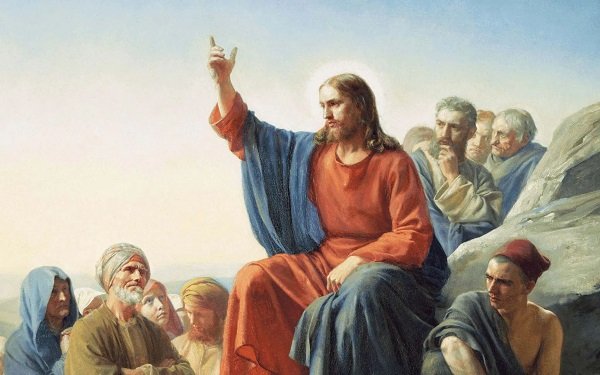
• The word of God
Dear Reader,
Tomorrow is Palm Sunday but instead of focusing on the usual story of the Triumphal Entry, important though it is, we would like to share with you how the gospel of Luke handles Jesus’ entry into Jerusalem and His actions thereafter.
The Triumphal Approach to Jerusalem: Luke 19:28-40
After Jesus said this, He went on in front of them toward Jerusalem. As He came near Bethphage and Bethany at the Mount of Olives, He sent two disciples ahead with these instructions: “Go to the village there ahead of you; as you go in, you will find a colt tied up that has never been ridden. Untie it and bring it here. If someone asks you why you are untying it, tell him that the Master needs it.” They went on their way and found everything just as Jesus had told them. As they were untying the colt, its owners said to them, “Why are you untying it?” “The Master needs it,” they answered, and they took the colt to Jesus. Then they threw their cloaks over the animal and helped Jesus get on. As He rode on, people spread their cloaks on the road. When He came near Jerusalem, at the place where the road went down the Mount of Olives, the large crowd of His disciples began to thank God and praise Him in loud voices for all the great things that they had seen: “God bless the king who comes in the name of the Lord! Peace in heaven and glory to God!” Then some of the Pharisees in the crowd spoke to Jesus. “Teacher,” they said, “command your disciples to be quiet!” Jesus answered, “I tell you that if they keep quiet, the stones themselves will start shouting.” – (Good News)
Let us now continue with why Christ died. The hymn writer, Henry Francis Lyte (1793 – 1847) puts it so appropriately in one of his hymns.
“PRAISE, my soul, the King of heaven, To His feet thy tribute bring;
Ransomed, healed, restored, forgiven, Who like thee His praise should sing?
Praise Him! Praise Him! Praise the everlasting King.” – MHB 12: Stanza 1
And it is true Christ died that we would be delivered from the bondage of sin – “For the wages of sin is death, but the gift of God is eternal life in Christ Jesus our Lord” – Rom. 6:23 (NIV). Christ died to Ransom us, Heal us, Restore us and Forgive us.
As you enjoy this article, please commit yourself again to the Lord Jesus Christ in whom is “Eternal Life.” Let Him ride into the “Jerusalem of your heart.” Weep over your sins and cleanse your heart which is the temple of the Holy Spirit from all that does not please our Holy, loving God.
WHY CHRIST DIED
When God first created mankind, He intended that an intimate relationship should exist between the Creator and His creatures. But the first man and woman chose to disobey God and, therefore, forfeited the privilege of this close friendship with God. Moreover, through their disobedience, sin made its entry into the world: ‘Sin came into the world through one man.’ – Romans 5:12
This sin gave Satan the firm foothold he had been looking for. Sin and Satan now held the world in a vice-like grip. God’s people now walked in darkness: oppressed by Satan. Spiritually speaking, they lived in a never-ending winter: rarely experiencing the warmth of God’s love. Enslaved by sin as they were, they were doomed to die both physically and spiritually. ‘(Adam’s) sin brought death with it. As a result, death has spread to the whole human race because everyone has sinned.’ – Romans 5:12
Who could rescue God’s creation from the curse of Satan, the enemy? Mankind’s rescuer would need to be someone strong enough to engage in battle against the power of Satan; someone who would fight compromise with evil, for evil cannot combat evil; only goodness can do that. There was only one person who could even attempt the rescue bid: God Himself. So God entered the world in the form of the perfect man: Jesus Christ. ‘God in Christ was reconciling the world to Himself.’ – 2 Corinthians 5:19
Jesus knew the solution to the sin-problem. He, the man-who-never-sinned, would need to take upon Himself every sin each individual in the world had ever committed and would ever commit. It would be as though He Himself had committed the crimes of the cosmos. He would, therefore, pay the penalty in person. He would die: ‘Without beauty, without majesty (we saw him), no looks to attract our eyes; a thing despised and rejected by men, a man of sorrows and familiar with suffering, a man to make people screen their faces He was despised and we took no account of Him.
And yet ours were the sufferings He bore, ours the sorrows He carried. But we, we thought of Him as someone punished, struck by God, and brought low. Yet He was pierced through for our faults, crushed for our sins. On Him lies a punishment that brings us peace, and through His wounds we are healed. We had all gone astray like sheep, each taking his own way, and Yahweh burdened Him with the sins of all of us.’ – Isaiah 53:2-6
PRAYER
Lord Jesus, help me to drink in these facts:
Mine were the sufferings you bore
Mine the sorrows you carried
You were pierced through for my faults
Crushed because of my sin
God laid on you the punishment that brought me
Peace
Joy
And a whole new start in life
Help me to say an adequate
Thank you.
RANSOMED
A man was once caught stealing from his employers. When the case was heard in court, the judge imposed a fine of GH¢50. Failure to pay the prescribed fine, he said, would result in imprisonment. The night of the court hearing, the man despaired. He had no money. That was why he had resorted to stealing in the first place. How was he to pay the fine? The thought of a period in prison filled him with horror. Next morning, a brown envelope fell through this man’s letter-box. It contained ten, crisp, new five Ghana Cedis notes and a hand-written explanation: To pay off the debt. The offender never discovered where the money had come from. The only information he could glean was that a member of the nearby church heard of his plight and decided to set him free from the threat of imprisonment.
When Jesus died on the cruel cross, He brought our release from the clutches of the evil one. He also set us free from the bondage to sin in which we had been trapped. And He delivered us from the effects of the sin-stained past and from the guilt that enshrouded us: The death of Christ ‘One act of perfect righteousness, presents all men freely acquitted in the sight of God.’ – Romans 5:18. ‘God loved the world so much that He gave his only Son, that everyone who has faith in Him may not die but have eternal life.’ – John 3:16
This article has been heavily inspired by Joyce Hugget in “Approaching Easter, Meditations for Lent.”
STAY BLESSED!
For further inquiries please contact us on Tel Nos. 0243588467 or 0268130615
Email: saltnlightministries@gmail.com
Website: saltandlightgh. org
Christ our Lord
By Dr. Joyce Aryee, the author

4. Correct the falsehood
If someone misrepresents Muhammad (pbuh), teach people who Muhammad (pbuh) really was.
Tell them about his mercy.
Tell them about his justice.
Tell them about his patience.
Tell them about his forgiveness.
5. Report genuine offences
Use lawful channels.
The Muslim does not become the police, prosecutor, judge and executioner.
6. Protect the innocent
If one Christian insults Islam, do not attack another Christian who knows nothing about it.
If one Muslim makes an offensive statement, do not blame all Muslims.
7. Restore peace
After the controversy, bring responsible Muslim and Christian leaders together.
Talk.
11 | P a g e
Clarify.
Forgive where forgiveness is appropriate.
And rebuild trust.
Ghana must not become a battlefield of religious provocation
My dear brothers and sisters in Islam,
Let us look around Ghana.
Muslims and Christians have lived together for generations.
We have Muslim fathers with Christian in-laws.
Christian mothers with Muslim sons-in-law.
Muslim and Christian business partners.
Muslim and Christian neighbours.
Muslim and Christian classmates.
Muslims and Christians serving together in the military, police, public service, universities, hospitals, markets and businesses.
This is Ghana.
We must protect this peace.
Religious freedom is precious.
But religious freedom comes with religious responsibility.
A microphone is not a weapon.
A pulpit is not a battlefield.
A smartphone is not a licence to spread hatred.
A viral video is not a fatwa (religious decree).
And anger is not evidence.
12 | P a g e
A word to Muslim scholars
To my fellow Imams and Islamic scholars:
Allah has placed a trust upon our shoulders. You are the best of generations selected for the guidance of mankind. Quran chapter 3:110.
When people are angry, we must calm them.
When people are confused, we must educate them.
When people want revenge, we must teach justice.
When people want violence, we must remind them of Allah.
Our microphone should extinguish fire—not pour petrol upon it.
The Prophet said:ِ
لَيْس َ الشَّدِيد ُ بِالصُّرَعَةِ، إِنَّمَا الشَّدِيد ُ الَّذِي يَمْلِك ُ نَفْسَه ُ عِنْد َ الْغَضَب
“The strong man is not the one who can overpower others; rather, the strong man is the one who controls himself when angry.” (Sahih al-Bukhari, 6114; Sahih Muslim, 2609)
This is strength.
Self-control is strength.
Restraint is strength.
Wisdom is strength.
Justice is strength.
A word to Christian preachers
And to our Christian brothers and sisters, especially those who preach:
We Muslims deeply revere Jesus (peace be upon him)
He is not an ordinary man in Islam.
He is ʿĪsā ibn Maryam عليه السالم, a mighty Messenger of Allah.
The author is the Chief Imam of Katamanso Municipal and Certified Counsellor and Governance Expert.
SKIP THE QUEUE, TAP THE NEWS
You can now read the Ghanaian Times and The Spectator newspapers from the comfort of your device via TimesNewsPlus.
Join our WhatsApp Channel: https://whatsapp.com/channel/0029VbBElzjInlqHhl1aTU27
When Paul tells us that our “attitude should be the same as that of Christ Jesus,” he had summarized in the previous two verses what such an attitude was: selflessness, humility, and service. “Do nothing out of selfish ambition or vain conceit, but in humility consider others better than yourselves. Each of you should look not only to your own interests, but also to the interests of others” – Philippians 2:3-4.
In other words, the attitude a Christian should reflect is one that focuses on the needs and interests of others. Without question, that does not come naturally to us. When Christ came into the world, He established a whole new attitude to relationships with others. One day when His disciples were arguing among themselves regarding who was to be greatest in His kingdom, Jesus said, “You know that the rulers of the Gentiles lord it over them, and their high officials exercise authority over them. Not so with you.
Instead, whoever wants to become great among you must be your servant, and whoever wants to be first must be your slave – just as the Son of Man did not come to be served, but to serve, and to give his life as a ransom for many” – Matthew 20:25-28. Jesus is teaching us that, when we become preoccupied with our own things, it can cause conflicts and other problems with people we know. Instead, God wants us to have an attitude of serious, caring involvement in the concerns of others.
Paul speaks more about this Christ-like attitude in his letter to the church in Ephesus: “that you put off, concerning your former conduct, the old man which grows corrupt according to the deceitful lusts, and be renewed in the spirit of your mind, and that you put on the new man which was created according to God, in true righteousness and holiness.– Ephesians 4:22-24. Many religions of today, including the New Age philosophies, promote the old lie that we are divine or that we can become gods. But the truth of the matter is that we will never become God, or even a god. Satan’s oldest lie was promising Adam and Eve that, if they followed his advice, “- and you will be like God, knowing good and evil.” Genesis 3:5, NKJV.
Each time we try to control our circumstances, our future, and the people around us, we’re only demonstrating that we want to be a god. But we must understand that, as creatures, we will never be the Creator. God doesn’t want us to try to become gods. Instead, He wants us to become like Him, taking on His values, His attitudes, and His character. We are meant to “be made new in the attitude of your minds; and to put on the new self, created to be like God in true righteousness and holiness” – Ephesians 4:23-24.
Finally, we must always keep in mind that God’s ultimate goal for His children is not our comfort, but the transformation of our minds into the attitude of godliness. He wants us to grow spiritually, to become like Christ. This doesn’t mean losing our personalities or becoming mindless clones. Christlikeness is all about transforming our minds. Again, Paul tells us, “Do not conform any longer to the pattern of this world, but be transformed by the renewing of your mind. Then you will be able to test and approve what God’s will is—his good, pleasing and perfect will” – Romans 12:2.
It is God’s will that we develop the kind of mindset described in the Beatitudes of Jesus – Matthew 5:1-12, that we exhibit the fruit of the Spirit – Galatians 5:22-23, that we emulate the principles in Paul’s great chapter on love – 1 Corinthians 13, and that we strive to pattern our lives after Peter’s characteristics of an effective and productive life – 2 Peter 1:5-8.
Establishing our actions in righteousness
Every person is commanded to live up to divine standards.
a. In the words of Jesus
“ For I say to you, that unless your righteousness exceeds the righteousness of the scribes and Pharisees, you will by no means enter the kingdom of heaven. Be ye, therefore, perfect, even as your Father, who is in heaven, is perfect” – Mt. 5:20, 48.
Every person in the world is required to live up to that standard. You say, “You’ve got to be kidding!” No, I’m not. You are obligated to live up to that standard with a pure inside as well as a right outside. But you say, “I can’t!” You are absolutely right. That’s why we are given the solution…
b. In the words of Paul
As it is written: “There is none righteous, no, not one; But now the righteousness of God apart from the law is revealed, being witnessed by the Law and the Prophets, even the righteousness of God, through faith in Jesus Christ, to all and on all who believe. For there is no difference;– Rom. 3:10, 21-22a.
Though you can’t obtain on your own the righteous standard Christ set, you can receive His righteousness if you are one of those who believe. Isn’t that great? God set the holy standard. And when you acknowledge that you can’t live up to it, He says, “My Son is not only the Lawgiver, but He is the Redeemer as well, who makes it possible for you to live on that level.” Beloved, it’s a fantastic thing! The standard is so high we can’t obtain it. But Christ met that standard and imputes to us His righteousness. Oh, what a blessed thing!
SKIP THE QUEUE, TAP THE NEWS
You can now read the Ghanaian Times and The Spectator newspapers from the comfort of your device via TimesNewsPlus.
Join our WhatsApp Channel: https://whatsapp.com/channel/0029VbBElzjInlqHhl1aTU27