Hot!
Childhood vaccine shortage: A Justification for Public Health Emergency Fund

- /home/u249204778/domains/spectator.com.gh/public_html/wp-content/plugins/mvp-social-buttons/mvp-social-buttons.php on line 27
https://spectator.com.gh/wp-content/uploads/2023/04/WhatsApp-Image-2023-04-21-at-11.53.05-AM.jpeg&description=Childhood vaccine shortage: A Justification for Public Health Emergency Fund', 'pinterestShare', 'width=750,height=350'); return false;" title="Pin This Post">
- Share
- Tweet /home/u249204778/domains/spectator.com.gh/public_html/wp-content/plugins/mvp-social-buttons/mvp-social-buttons.php on line 72
https://spectator.com.gh/wp-content/uploads/2023/04/WhatsApp-Image-2023-04-21-at-11.53.05-AM.jpeg&description=Childhood vaccine shortage: A Justification for Public Health Emergency Fund', 'pinterestShare', 'width=750,height=350'); return false;" title="Pin This Post">
Background
In February this year, there was uneasy calm among health workers and parents following reports of a widespread shortage of vaccines used for the routine immunisation of babies from birth to 18 months.
Vaccines said to be unavailable nationwide included Bacille Calmette-Guerin (BCG), which primarily prevents the occurrence of tuberculosis in babies, and OPV, which prevents polio infections. Others that prevent diseases such as whooping cough and measles were also in short supply.
Health workers said although there had been shortages in the past, it was not as pervasive as the scarcity recorded in 10 of 16 administrative regions of the country.
The President of the Paediatrics Society of Ghana, Dr. Hilda Mantebea Boye, had stated that the delay in the supply of the vaccine could lead to an outbreak of childhood diseases, including measles. And true to her words and other concerns expressed by many interest groups, about 100 cases of measles were detected in Northern Ghana by the time the first batch of vaccines had arrived.
Delay in the supply of vaccines was partly attributed to the depreciating Cedi but the Minister of Health Kwaku Agyeman Manu, at a press conference in Accra, explained that the situation was rather a “global challenge.” According to him, the shortage had nothing to do with the government owing suppliers but he gave the assurance that the situation would be resolved in due time.
To ease tension, the Health Minister indicated that no death was recorded as a result of the vaccine shortage.
Vaccination
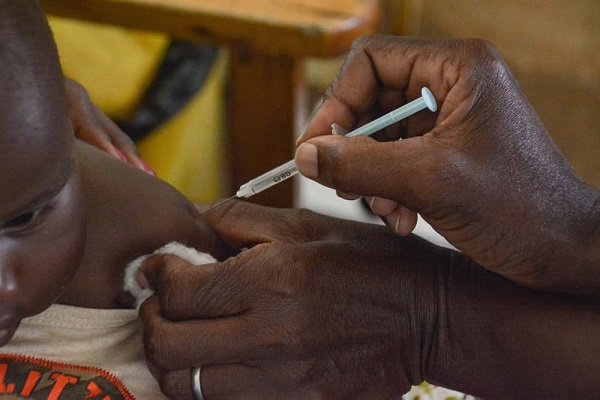
Be that as it may, health experts say gaps in vaccination could “reduce immunity and require children to start the series all over again” hence the need to comply with recommended vaccine schedules. This, perhaps, explains the anxiety expressed by parents and health practitioners when the vaccines were taking too long to arrive.
Children are exposed to thousands of germs every day due to the food they eat, the air they breathe, and the things they put in their mouths. Because their immune system is not fully developed at birth, they are susceptible to infections and serious illnesses. Vaccines, therefore, help build their natural defences and reduce the risk of contracting diseases.
It was, therefore, refreshing that good consignments were procured pending the delivery of additional supplies, as indicated by the government. Considering that it was the first time such a massive shortage was recorded, Dr. Kwaku Agyeman speaking on the floor of Parliament assured that the phenomenon would not occur again.
Shortage
During the period of the shortage, Private Health Practitioner, Dr. Amanda Nhyirah Biyeh, explained that facilities that did not have the vaccines relied on vitamins to “help sustain the children for some time.”
“Thirty percent of patients that come to our facility are pregnant women and children who come for vaccination. Sometimes there is an argument between nurses, doctors, and parents when we tell them there are no vaccines.”
“What we do is to give them vitamin B12, folic acid, and omega 3 fatty acids. These are the ones that help boost the immune system and help prevent some sickness until the children can go back and start their vaccination schedules again,” she noted.
Following the delivery of the first batch of vaccines on March 11, 2023, health workers are ensuring that parents who missed out on the routine vaccination would do the necessary “catch up”.
Donors
According to the Health Ministry, about $6.4 million had been paid to the United Nations Children’s Fund (UNICEF) which supplies the vaccines. Mr Agyeman, speaking on the floor of Parliament, did not indicate when the payments were made and what might have caused the delay.
As we await the delivery of the second batch of vaccines, the assurances and explanations given by the Health Ministry are an indication of the financial hurdle the country had to overcome to procure the vaccines.
To this extent, the government and health authorities cannot gloss over the fact that the availability of childhood vaccines in the future would require a more reliable source of funding.
The analysis presented by the Kaiser Family Foundation (KFF), a non-profit organisation focusing on national health issues indicated that the Global Alliance for Vaccines and Immunization (GAVI), since its launch in 2000, had disbursed over $18 billion to support immunization efforts in low and middle-income countries, including Ghana.
GAVI is an independent public-private partnership and multilateral funding mechanism that aims at expanding global access to and use of vaccines, particularly among vulnerable children.
In 2017, development partners funded at least 19% of the country’s health expenditure but stakeholders say Ghana’s shift from low-income to middle-income status implies that the country would be “ineligible to receive concessional aid in the future.”
Civil Society Organisations and other health agencies agree that the loss of support from donor agencies could negatively impact the health system, such as procurement of medical products, availability of human resources, and lack of technical capacity to continue activities formally led by donors.
This and many factors give credence to why the country must stop paying lip service to the establishment of a Public Health Emergency Fund (PHEF) as captured in Ghana’s (2022-2025) Medium Term Development Framework.
PHEF
The establishment of the fund would, undoubtedly, go a long way to help mobilise and disburse resources to respond effectively to potential health and humanitarian crisis in the future.
Although no casualty was recorded during the period of the shortage, one cannot imagine a future situation where children would not receive their recommended vaccines because there are no funds to procure same.
Again, a standby fund for health emergencies would have mitigated the recent inconveniences caused by the shortage of childhood vaccines. In the words of Dr. Biyeh, “We do not have to run out of vaccines.” According to her, the availability of funds would help in the procurement of enough cold chain facilities to store the vaccines.
“If the fund is established it would help the health centres a lot. The funds would ensure that we do not have to wait for a long time to raise funds or receive vaccines from elsewhere,” she said.
The government continues to play its part by raising domestic revenue to support the health budget. But to build a more resilient and responsive health system, we would have to look beyond external partners and fast-track the establishment of a Public Health Emergency Fund.
It would not only help us respond quickly to avoidable situations, such as the shortage of vaccines for childhood immunisation but would help provide adequate and sustained funding or backing for the country’s fragile public health system.
By Ernest Nutsugah


General Secretary of the New Patriotic Party (NPP), Justin Kodua Frimpong, has filed his nomination to contest the position of General Secretary again as the party begins its rebuilding efforts ahead of the 2028 general elections.
He was accompanied by party stalwarts and supporters who were in high spirits, expressing confidence that he is the right person to hold the position.
Speaking after filing his nomination, Mr Kodua Frimpong assured the rank and file of the party that he would not disappoint them.
“I can assure you that the faith the rank and file of the party have had in me, I will never disappoint them,” he said.
He also pledged to run a clean campaign devoid of personal attacks.
“I can assure you that our internal campaign will be devoid of personal attacks,” he told his fellow contestants and the rank and file of the party as he seeks to retain his position.
His tenure has seen the party through the 2024 general elections, where the NPP lost power to the National Democratic Congress (NDC) after eight years in government.
The party is currently in a rebuilding phase, with internal elections scheduled to elect new national executives to lead its reorganization towards the 2028 polls.
The General Secretary position is considered one of the most influential in the party’s administrative structure, responsible for the day-to-day running of the party secretariat and implementation of party decisions.
By Edem Mensah-Tsotorme

The University of Ghana Medical Centre (UGMC) has disputed claims made on social media by comedian Michael Blackson concerning the treatment given to his late mother, saying a review found that the allegations did not accurately reflect what happened during her stay at the hospital.
In a statement issued in Accra on August 5, 2026, the management of UGMC expressed condolences to Mr. Blackson and his family over the death of his 83-year-old mother, who died at the facility on July 16, 2026.
The hospital said it had taken the concerns raised by Mr. Blackson seriously and conducted a thorough review in line with its clinical and administrative procedures.
According to the statement, the facts presented by Mr. Blackson on social media contained “numerous inaccuracies” and did not accurately reflect the medical care provided to his mother.
UGMC explained that she was referred to the facility from another hospital and received treatment there from May 27 to July 16, 2026, a period of about eight weeks.
The hospital stated that it would not release details of her diagnosis, treatment, medical records or other aspects of her care because it had a duty to protect patient confidentiality, even after death.
It said the decision was intended to respect the dignity of the deceased and the privacy of her family.
UGMC further stated that all clinical decisions at the facility are made by qualified healthcare professionals based on medical judgment, established standards of care and the best interests of the patient.
The statement added that such decisions are made in consultation with authorised family representatives where necessary and that billing and financial procedures are governed by institutional policies and are separate from clinical decision-making.
The hospital noted that it values feedback from patients and their families and considers both positive and negative comments important for improving the quality of care.
Mr. Blackson had earlier used social media to criticise the care his mother received at UGMC, prompting the hospital’s response.
By: Jacob Aggrey