Editorial
A.M.E Zion School cries for help to fix fence, build new classrooms

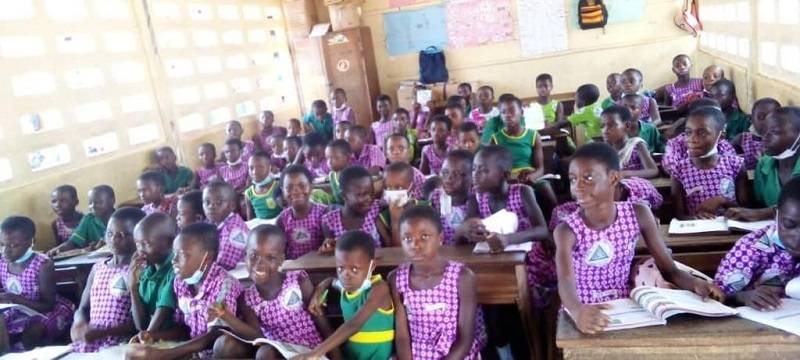
A section of students in the class
The Headmistress of the A.M.E Zion School in Koforidua Madam Salome, says that students, teaching staff and other workers feel unsecured in the school due to the lack of a fence on its boundaries.
She described an incident that occurred between a teacher and a boy in the area that belongs to a group referred to as ‘marijuana boys.’
She said that these boys have been using the classrooms as hostels, and sometimes they do not want to leave the classroom for students and teachers to start lessons.
This behaviour forced one of the teachers to confront these boys and if it had not been for God on the side of the teacher, they would have killed him.
The activities of these boys have become a nuisance in not just the school but the neighbouring parts of the town.
“Our school is not fenced, and that makes it susceptible for vehicles and motorcycles to use the campus as a road in order to avoid traffic and drive through as a shortcut route for them to reach their destination,” she added.
She said that some vehicles move with very disturbing and interrupting noise, which is very bad as it affects students’ ability to focus fully on what their teachers may be teaching at that particular time.
A student’s attention can be distracted from the lesson by the noise that comes from the moving vehicles, which can make them miss some key words or sentences that may be essential to understanding the lesson, and sometimes the teachers would have to pause for the moving vehicles to pass before they continue with the lesson.
It puts students at risk of being knocked down by the vehicles, which might result in death or deformation.
Another challenge she spoke about was the lack of chairs and tables for the students to sit on.
She said four students shares one mono desk. The classrooms are not spacious for more tables and chairs.
Talking to some of the students, they said the classrooms become very hot in the afternoon because they are many and the windows are small. This makes teaching and learning difficult for both the teachers and the students.
According to Madam Salome, this has been one major nightmare the school has been dealing with for some time now and would appreciate if the authorities treat the situation as urgent.
She said the school wishes to undertake the walling or fencing as its own project but lack the funds to do so.
She has asked for funds or any kind of support from non-governmental organisations, stakeholders, parents and concerned people to come to the aid of the school to help them put up a fence around the school.
“The wellbeing of the school children and the teachers must be paramount to all; that is why we are urging philanthropists and other organisations to come to our aid. Apart from the fence, we also need more classrooms to enable the student to learn in decent classrooms and provided with more tables and chairs.
Boakye Patricia
(Ghana Institute of Journalism)


Dear Editor,
I WRITE to draw the attention of NADMO and other related agencies to the recent prediction by the Ghana Meteorological Agency to expect a lot of rains this year, especially in the Southern sector of the country.
GMet issued the forecast to provide an early warning to protect lives and property.
Interestingly, the Southern sector happens to be one of the many trouble spots in the country when the rains start.
It predicted the season to start in March and continue until July or August with above-normal rainfall along the eastern coast and nearby inland areas, including Accra, Tema, Cape Coast, Saltpond, Asamankese, Akim Oda, Koforidua, and Kade.
Knowing the problems faced as a country, concerns have been raised in certain quarters about the aftermath flooding problems in low-lying areas.
These concerns are well placed because flooding has become an annual ritual associated with the season.
My appeal goes to NADMO as well as the district and metropolitan assemblies. They are responsible for activities before and after the season.
As we prepare, they must spearhead the campaign to desilt the drainages in order for water to flow freely.
The citizenry must also show some sense of responsibility by desisting from throwing rubbish into gutters to block the free flow of water.
Noah Musa,
Adabraka
Dear Editor,
I WOULD like to express my views on why some people abuse leaders on social media platforms.
In recent times, social media has become a powerful tool for communication and expression. Unfortunately, many people misuse this freedom by insulting and abusing leaders instead of engaging in constructive criticism.
One major reason for this behaviour is frustration. When citizens feel ignored, unemployed, or affected by poor policies, they sometimes turn their anger toward leaders online.
Another reason is anonymity. Social media allows users to hide behind fake names and profiles, which gives them the confidence to say things they would not dare say in public. This lack of accountability encourages abusive language and disrespectful comments.
Ignorance and misinformation also play a role. Some people abuse leaders based on false news or rumours without verifying facts. This leads to unnecessary attacks that can damage reputations and create tension in society.
While leaders should be held accountable, abuse and insults do not solve problems. Too many people are finding social media platforms as homes to hide and churn out untruths that goes a long way to damage the image and credibility of the victims.
Constructive criticism, dialogue, and lawful channels are better ways to express dissatisfaction. Citizens must remember that respect is essential for national unity and development.
I hope this letter will encourage people to use social media responsibly and promote respectful communication.
Eugene Ampiaw,
Takoradi