News
‘Varsity, industry collaboration key to national development’


- /home/u249204778/domains/spectator.com.gh/public_html/wp-content/plugins/mvp-social-buttons/mvp-social-buttons.php on line 27
https://spectator.com.gh/wp-content/uploads/2021/10/IMG_20211001_101813_558.jpg&description=‘Varsity, industry collaboration key to national development’', 'pinterestShare', 'width=750,height=350'); return false;" title="Pin This Post">
- Share
- Tweet /home/u249204778/domains/spectator.com.gh/public_html/wp-content/plugins/mvp-social-buttons/mvp-social-buttons.php on line 72
https://spectator.com.gh/wp-content/uploads/2021/10/IMG_20211001_101813_558.jpg&description=‘Varsity, industry collaboration key to national development’', 'pinterestShare', 'width=750,height=350'); return false;" title="Pin This Post">
To manufacture vaccines particularly COVID- 19 products requires huge doses of investment, the Vice Chancellor of the University of Health and Allied Sciences (UHAS), Prof. John Owusu Gyapong, has said.
He has established also the critical relationship between science and vaccine development.
Prof. Gyapong made the argument when he delivered a talk on ‘Impact of COVID-19 pandemic on higher education in Ghana: Threats and Opportunities’ at the just -ended 2021University Teachers Association of Ghana (UTAG) Congress at the University of Mines and Technology (UMaT),Tarkwa, in the Western Region.
He said, scientists in the universities needed huge investmnts to conduct researches for products,noting that, the United States of America spent huge dollars in such a venture.
This,he explained involved series of trials in communities to erase all reasonable doubts.
Again, Prof. Gyapong said, there was the need to provide protection to the communities,stressing “it’s about billion of dollars.”
To achieve this goal, he encouraged universities in Ghana to collaborate with one another in their research work in this era of science, in order to make the needed impact in the country.
“Many of us like to work in our small corners but this requires that we work together through consortia across the world and even in this country, there is no reason universities should not work closer”. he said.
Prof.Gyapong stated that the COVID-19 pandemic should be a wake -up call for research capabilities, science, technology and innovation systems, manufacturing capabilities, inter-institutional and interdisciplinary collaboration through existing consortia.
He said, “Despite innovations made in some universities the scale of collaboration with the industry that takes headline-making innovation beyond the walls of an institution, is conspicuously missing.
“This can provide an opportunity for further validation and a path to widespread adoption and commercialisation.” he told the delegates.
The UHAS Vice Chancellor explained that “When the pandemic broke in Ghana, we met leaders in the educational sector and they gave us all the promises but when the rubber hit the road, we were found wanting.
“We could have thrown our hands in the air and said, we don’t have it, so that is the end.But as university managers, administrators and academia, we have to do the teaching — to get things going.The digital dividehad been a very key transformational issue when it comes to managing COVID in the educational environment.”
According to Prof.Gyapong”even in the event that the COVID-19 pandemic should end, with the kind of infrastructure that we have developed, it would be very unwise to throw away all the online teaching platforms.This requires very good and effective policy.
“The policies that l have seen are not good enough and we need to collaborate as institutions to ensure that we are on top of the issues. Since we are the knowledge hub we can take advantage of the opportunities that come our way to develop science and make sure that we are on top of issues.”
Funding of research in universities, he believed, should not just be a talk it should be materialised and hoped that national research fund would be operationalised so hat researhers can access monies for research across various disciplines.
“The pandemic has really brought a major challenge to the educational institutions. We need to examine and re- consider how we would manage our digital educational system because it is now becoming part of us”
From Clement Adzei Boye, Tarkwa

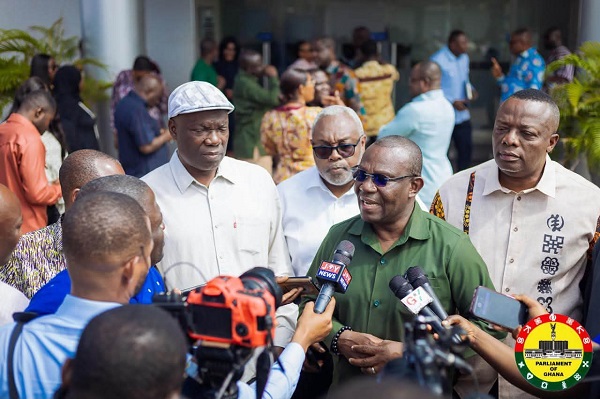
The Parliamentary Select Committee on Energy has appealed to the Ministry of Finance to release GH¢5.6 million to the Petroleum Commission to enable it to establish and operate a world-class data centre.
According to the Committee, access to the funds will strengthen the Commission’s capacity to manage critical upstream petroleum data and improve its operations.
Speaking during the appeal, Chairman of the Committee, Emmanuel Kwasi Bedzrah, said the move was crucial to efforts to revitalise Ghana’s upstream petroleum industry and increase oil production.
He noted that although investment and hydrocarbon production had declined in recent years, Parliament’s approval of an extension of the petroleum agreement to 2030 had attracted additional funding and contributed to an increase in production from about 80,000 to 120,000 barrels per day.
Meanwhile, concerns have been raised over repeated budget allocations for oil exploration in the Voltaian Basin.
Mr. Bedzrah stressed that funds approved for exploration must produce tangible results, adding that the Committee would require clear evidence of progress before supporting future budget allocations for the programme.
The appeal was made during a working visit to the Petroleum Commission as part of the Committee’s oversight activities to assess its operations and management procedures.
During the engagement, the Chief Executive Officer of the Petroleum Commission, Emeafa Hardcastle, took the Committee through the Commission’s working procedures and mandate, which includes regulating, managing and coordinating upstream petroleum activities.
She disclosed that since assuming office in 2025, government had pursued measures to reverse the decline in crude oil production, sustain output and reposition Ghana as an attractive destination for investment in Africa’s increasingly competitive petroleum sector.
In addition, she said government had secured fresh commitments of about US$35 billion to help revitalise the sector.
As part of the oversight exercise, the Committee is expected to conclude its monitoring visit with engagements at the National Petroleum Authority (NPA) and the Ghana Oil Company Limited (GOIL).
By Edem Mensah-Tsotorme
News
“No civilisation deserves to be annihilated” – Mahama calls for dialogue on global conflicts at UNGA 81

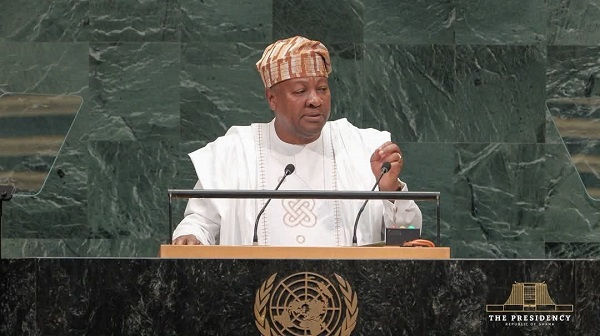
President John Dramani Mahama has called for solidarity and dialogue in resolving global conflicts, insisting that no civilisation deserves to be wiped out.
“No human civilisation deserves to be annihilated, certainly not a member state of the United Nations,” President Mahama stated in his address at the 81st United Nations General Assembly in New York.
He called for solidarity with nations facing terrorism, especially the Alliance of Sahel States (AES), and for a uniform approach to conflicts in Europe, the Middle East and Africa.
On the Middle East, the President called for a return to negotiations, saying “The current Middle East crisis is having a deleterious effect on the world economy.”
“I believe that dialogue can resolve even the most intractable of problems,” he added.
By Edem Mensah-Tsotorme