Editorial
Making precious lives safe on our roads

- /home/u249204778/domains/spectator.com.gh/public_html/wp-content/plugins/mvp-social-buttons/mvp-social-buttons.php on line 27
Warning: Trying to access array offset on false in /home/u249204778/domains/spectator.com.gh/public_html/wp-content/plugins/mvp-social-buttons/mvp-social-buttons.php on line 27
&description=Making precious lives safe on our roads', 'pinterestShare', 'width=750,height=350'); return false;" title="Pin This Post">
- Share
- Tweet /home/u249204778/domains/spectator.com.gh/public_html/wp-content/plugins/mvp-social-buttons/mvp-social-buttons.php on line 72
Warning: Trying to access array offset on false in /home/u249204778/domains/spectator.com.gh/public_html/wp-content/plugins/mvp-social-buttons/mvp-social-buttons.php on line 72
&description=Making precious lives safe on our roads', 'pinterestShare', 'width=750,height=350'); return false;" title="Pin This Post">
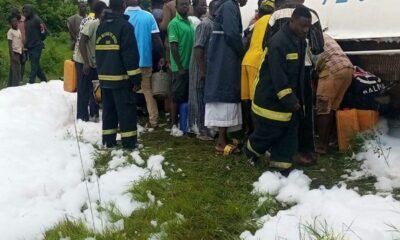
It is becoming clear that despite the numerous appeals to motorists in the country, road crashes and deaths continue to be on the rise, making it unsafe for road users whether as pedestrians or motorists.
It has been pointed out time and again that most of the causes of road accidents are as a result of human errors that could be prevented if motorists show a little more care.
Many a time, motorists get involved in accidents because of speeding, non- observance of traffic rules and being in a hurry to get to their destination in the shortest possible time. This together with impatience on the part of many drivers leads to road accidents.
Some road accidents also occur as a result of drunkenness. Again, there are times drivers have been found not to be conversant with the road signs. All these are contributory factors that should be dealt with.
As much as possible, motorists must be well educated on all these issues so that accidents can be reduced to the barest minimum instead of seeing them increasing year-in year-out.
This is the only way to make precious lives safe on our roads. According to data compiled by Motor Traffic and Transport Department (MTTD) of the Ghana Police Service, it has been revealed that the number of commuters killed in road traffic between January and June this year has risen to 1,454. This has resulted in 27.54 per cent increase in death compared with the number of people killed in the first six months of 2020.
Similarly, 423 pedestrians have also been killed within the same period, indicating that pedestrians killed rose from 305 in 2020 to 423 in the first six months of this year.
All these point to the fact that lives on our roads are not safe. It is, therefore, incumbent on the National Road Safety Authority (NRSA) to sit up and be stricter on the drivers on the roads.
Other law enforcement bodies such as the MTTD of the Ghana Police should also be very strict on the application of the road traffic regulations.
Again, while general education on road crashes is important and should be encouraged, our law courts must impose heavy punishments on those who flout traffic regulations.
The Spectator believes that, if these measures are strictly implemented they can go a long way to ensure that the roads are made safe for motorists, pedestrians and other users. The end result will be drastic reduction of injuries and fatalities on our roads.
Lives lost cannot be brought back just as harm caused by way of injuries cannot also be restored to its original form.
The call is, therefore, for everyone to play his/her part to make our roads safer than ever before.


Dear Editor,
I want to use this platform to create awareness on the growing safety challenge at some of our beaches, particularly the lack of adequate safety measures to prevent accidents.
Beaches are important recreational spaces that also contribute significantly to Ghana’s tourism industry. However, many beaches lack trained lifeguards, emergency equipment and proper supervision.
During weekends, holidays and sometimes weekdays, families visit these beaches to have fun and some, for relaxing, yet the necessary safety measures are often inadequate.
The situation becomes even more worrying when children and inexperienced swimmers enter the water without proper guidance; it can quickly turn a day meant for enjoyment into a tragedy for families.
I urge beach operators and local authorities to strengthen safety measures at our beaches, make trained lifeguards available at busy beaches, warning signs clearly displayed and emergency responses system established.
Public education is equally important as well. Visitors must be encouraged to obey safety instructions, avoid dangerous places and remain vigilant especially when children are around.
Ghana has beautiful beaches with enormous potentials that attract both local and international tourists, but we cannot promote beach tourism effectively whiles neglecting the safety of the people who visit these places.
I hope the authorities will treat beach safety as a national priority before it cause any tragedy.
From Elvis Amoako
Teshie-Nungua.
Dear Editor,
In Ghana, it appears that the moment a prominent politician is arrested or convicted, we fail to ask of the person’s offence but rather think of the person’s political affiliation.
Taking the recent 20-year imprisonment handed to New Patriotic Party (NPP) Ashanti regional chairman, Bernard Antwi-Boasiako, popularly known as Chairman Wontumi has once again exposed this troubling culture.
An Accra high court convicted him on illegal-mining related charges and sentenced him to 20 years in prison. The NPP has since announced its intention to appeal the conviction.
What concerns me is not whether one belongs to the NPP or the NDC, what concern me is our growing tendency to attach a political identity to every arrest, investigation or court judgment. If an NPP member is arrested, some immediately say the NDC government is targeting the opposition. If an NDC member faces legal trouble the same argument will easily be reversed when political circumstances change.
We must ask ourselves; Are we defending justice or are we simply depending on our political colours? Political affiliation should never determine whether we believe a person deserves investigation, prosecution or a fair trial. If someone is accused of wrongdoing the proper institution must investigate, the court must determine guilt and the accused must have the right to challenge the decision through legal process.
Ghana cannot build a strong democracy if every criminal investigation becomes a political battle. Let us learn to separate politics from justice, a wrongdoing does not become right because the accused belong to your party and an accusation does not become true simply because the person belong to the opposing party.
Our loyalty should first be Ghana, the rule of the law and justice not to political colors.
From Desmond Yaw Frimpong
Pentecost University