Hot!
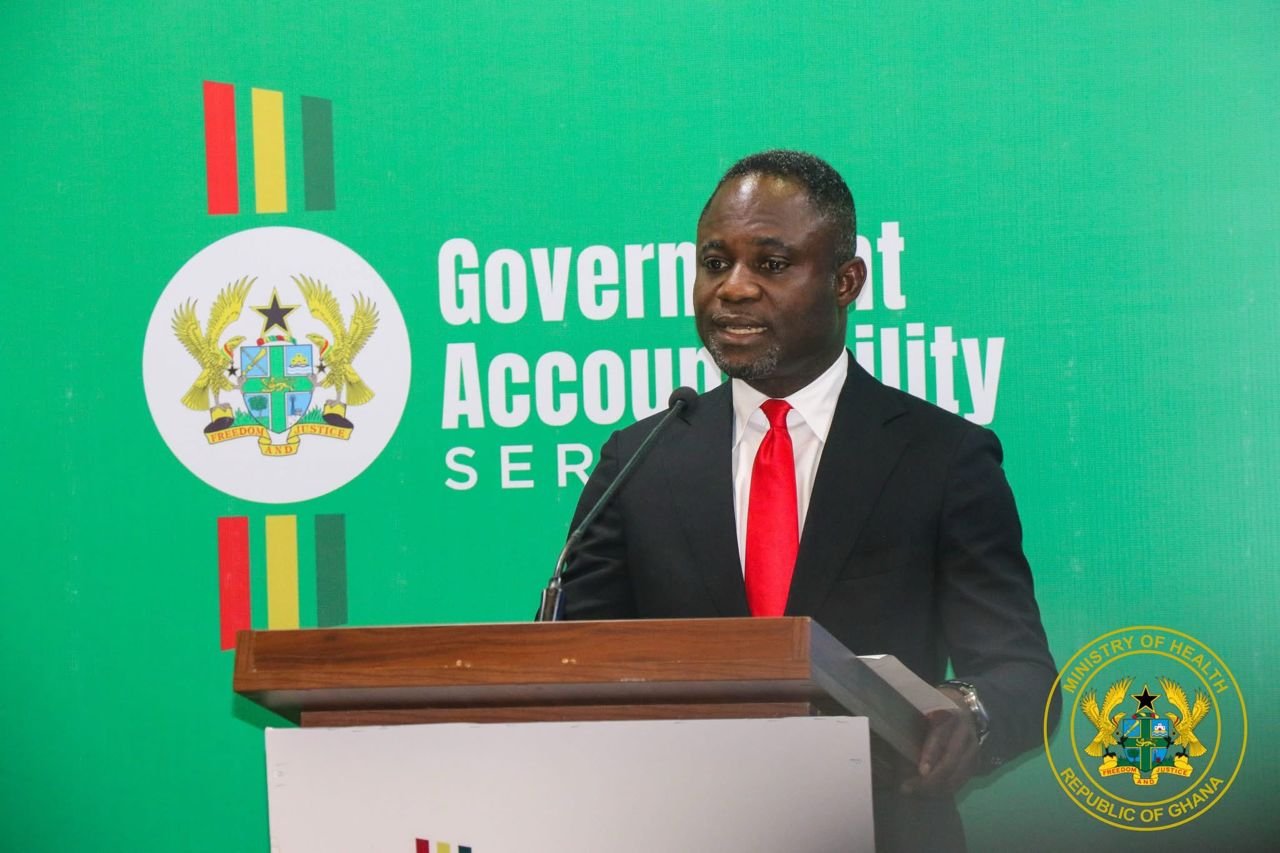
Health Minister introduces GHIMS to replace LHIMS and protect national health data

- /home/u249204778/domains/spectator.com.gh/public_html/wp-content/plugins/mvp-social-buttons/mvp-social-buttons.php on line 27
https://spectator.com.gh/wp-content/uploads/2025/10/WhatsApp-Image-2025-10-29-at-16.33.38-1000x600.jpeg&description=Health Minister introduces GHIMS to replace LHIMS and protect national health data', 'pinterestShare', 'width=750,height=350'); return false;" title="Pin This Post">
- Share
- Tweet /home/u249204778/domains/spectator.com.gh/public_html/wp-content/plugins/mvp-social-buttons/mvp-social-buttons.php on line 72
https://spectator.com.gh/wp-content/uploads/2025/10/WhatsApp-Image-2025-10-29-at-16.33.38-1000x600.jpeg&description=Health Minister introduces GHIMS to replace LHIMS and protect national health data', 'pinterestShare', 'width=750,height=350'); return false;" title="Pin This Post">
The Minister of Health, Kwabena Mintah Akandoh, has announced the introduction of a new digital health platform, the Ghana Health Information Management System (GHIMS), to replace the suspended Lightwave Health Information Management System (LHIMS).
He explained that the move marks the end of manual medical record-keeping in Ghana’s health facilities.
GHIMS, he said, is a fully state-owned and managed system designed to improve the security and accessibility of health information across the country.
Speaking at a media engagement at the Jubilee house, the Minister revealed that the decision followed forensic and technical audits that uncovered serious problems with the previous LHIMS project.
According to him, the $100 million LHIMS contract, awarded in 2019 to connect 950 health facilities, was expected to be completed by 2022. However, after two extensions, the contractor still failed to meet key targets.
“By the time the contract expired in December 2024, only 450 facilities had been connected less than half of the original target even though over $77 million had already been paid, representing more than 70 percent of the total cost,” he revealed.
“The audit also found shortages and poor-quality equipment, with an estimated $29 million worth of supplies either missing or below standard,” he added.
The Minister described the contractor’s refusal to hand over administrative access and Ghana’s health data as “pure blackmail,” saying it caused repeated service disruptions and data losses.
To fix these challenges, he noted that the Ministry has now developed GHIMS, a new national digital health system built entirely by the government.
The system he noted includes a National Health Information Exchange, a secure platform that allows different health service providers to connect under government regulation, preventing any single company from controlling national health data.
GHIMS he underscored also links directly with the National Health Insurance Authority database, making it possible for patients to access their medical records anywhere in the country.
“This means that a patient registered in Tamale can receive treatment in Accra without having to re-register,” he indicated.
Mr. Akandoh announced that GHIMS will be rolled out in phases over four weeks, starting with teaching and regional hospitals, followed by district hospitals, polyclinics, health centers, and CHPS compounds.
He added that the audit findings have been forwarded to the Attorney-General and other state security agencies for further investigation and appropriate action.
By: Jacob Aggrey


A 24-year-old tricycle (Pragyia) rider, has been jailed three months by the Nkawie Circuit Court in the Atwima Nwabiagya South Municipality of the Ashanti Region for biting a Community Police Assistant (CPA) at Nkawie.
Abdul Aziz pleaded guilty to the charge of negligently causing harm and was convicted on his own plea.
Police Inspector Kwaku Frimpong, prosecuting told the court presided by Mr Robert Addo that, complainants in the case were officers from the Nkawie Divisional Motor Traffic and Transport Department (MTTD) of the Ghana Police Service.
He said on September 3, at about 8:40am, the complainants led by Chief Inspector Abedi Larbi, were on their official patrol duty to ensure safety at Nkawie township and met the convict, who was in-charge of a Pragya tricycle with registration number M-25-A-3722.
He explained that, after a careful inspection, it was detected that the convict was without licence and other required documents, so Alhassan Seidu, the CPA, was instructed to lead him to the office for the next action.
On their way to the office, the convict took a different direction, so the CPA directed him to take the right route to the police station, but he disobeyed and attacked the CPA, resulting in a struggle between them.
In the process the convict bit the CPA on the chest, so he shouted for help and some nearby youth rushed to the scene and helped him to arrest the convict.
In his caution statement, he admitted the offence and after further investigations he was charged and brought before the court. –GNA
SKIP THE QUEUE, TAP THE NEWS
You can now read the Ghanaian Times and The Spectator newspapers from the comfort of your device via TimesNewsPlus.
Join our WhatsApp Channel: https://whatsapp.com/channel/0029VbBElzjInlqHhl1aTU27
The New Patriotic Party (NPP) has urged the government to place all 54,985 candidates affected by the 2026 Basic Education Certificate Examination (BECE) placement exercise in schools and publish the final outcome.
The party says the government must ensure that the affected candidates secure actual school places rather than merely being allowed to access the self-placement portal.
In a statement signed by the Chairman of the NPP Policy Co-ordination Committee, Kojo Oppong Nkrumah, the party expressed concern about the situation facing the candidates.
The NPP said the government had announced that 53,887 of the affected candidates could use the self-placement system after initially being told that they had not qualified for secondary school.
It, however, argued that access to the portal did not guarantee that candidates would secure their preferred schools or programmes.
“Ghanaian parents and candidates will judge the resolution of the challenge by one thing only: how many of the original 54,985 are sitting in a classroom, not how many were allowed to open a website,” the statement noted.
The party said the government’s own figures showed that the country had 859,828 declared vacancies for 623,072 BECE candidates.
It explained that the main challenge was the concentration of demand in a small number of highly subscribed schools.
The NPP noted that 313,283 candidates selected Category A schools as their first choice, while those schools had 76,417 declared vacancies.
It therefore called on the government to explore ways to improve schools with available spaces, including providing teachers, laboratories and better programmes.
The party urged the government to use the 85 private schools participating in the Free SHS programme to absorb candidates who remained without placements.
The NPP further called for clarification of the rule and pass mark used for this year’s placement exercise, saying parents were entitled to know the standard before their children sat the examination.
It urged the government to take urgent action to ensure that the affected candidates were not left behind in the transition to secondary education.
By: Jacob Aggrey