Sports
GFA budget versus Adams’ axe

- /home/u249204778/domains/spectator.com.gh/public_html/wp-content/plugins/mvp-social-buttons/mvp-social-buttons.php on line 27
https://spectator.com.gh/wp-content/uploads/2025/09/Kofi-Adams.jpg&description= GFA budget versus Adams’ axe', 'pinterestShare', 'width=750,height=350'); return false;" title="Pin This Post">
- Share
- Tweet /home/u249204778/domains/spectator.com.gh/public_html/wp-content/plugins/mvp-social-buttons/mvp-social-buttons.php on line 72
https://spectator.com.gh/wp-content/uploads/2025/09/Kofi-Adams.jpg&description= GFA budget versus Adams’ axe', 'pinterestShare', 'width=750,height=350'); return false;" title="Pin This Post">
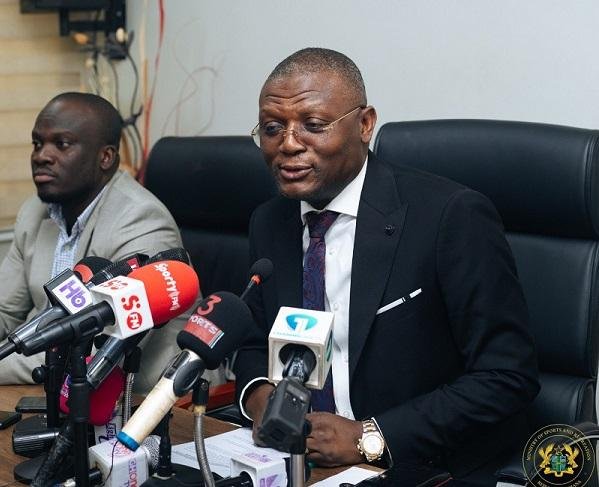
Anyone interested in how the public purse is disbursed and applied would surely applaud the Minister of Sports and Recreation, Mr Kofi Adams, for the measures taken to protect it.
Mr Adams slightly took the shine off the Black Stars’ preparation for the FIFA World Cup qualifiers against Chad and Mali with the disclosure of a budget submitted by the Ghana Football Association (GFA) for the two matches.
Additionally, he announced drastic cuts to the said budget, a move he indicated was to ensure fiscal discipline as directed by the President, John Dramani Mahama.
By the information made available, the GFA submitted a budget of $2,053,240 for the organisation and preparation of the team for the two matches.
The amount was to also pay mouthwatering bonuses and allowances that makes one wonder how certain amounts have been made to look like ‘chicken change’ or ‘coins.’
In certain quarters, the Sports and Recreation Minister has been hailed for the decision that is explained to have saved the nation an amount of $732,750.00.
“The Ministry subjected the estimates to a detailed internal review and identified line items that required adjustment, clarification, and removal, guided by government’s current fiscal posture and the need for prudent spending,” the Minister was reported to have said.
That was obviously a great move although some aspects and postures of the Ministry has not gone down well with the FA, and the public would wait rather impatiently to know the content of its promised reaction after the double-header.
Football, indeed, remains an expensive venture and any participant must be ready to meet it demands if the dream is to reap its full benefits.
From the provision of infrastructure, acquisition of logistics to per diem and bonus payment, one would need to break the bank to stay at a level considered as standard.
This becomes a headache for countries with smaller economies like Ghana that struggles to provide infrastructure like schools, hospitals, roads, provision of water, shelter and many other basic needs.
It, therefore, beats the imagination of many how Ghana is able to pay huge bonuses and allowances, some of which can be compared to other national teams at their best.
Interestingly, some of the line items were deemed untouchable. For example, the chartered flight that cost the tax payer $300,000, players’ per diem of $150, and $200 for technical staff and officials escaped the ‘Adams axe.’
Expenses like bonuses for players couldn’t swerve the chopping board, suffering 50 per cent cuts – meaning players would take $5,000 instead of $10,000 as winning bonuses.
Coach Otto Addo would still smile to the bank with $10,000 although he would be happier with the $20,000 the FA wanted to pay.
Additionally, the bonus for the assistant coaches were reduced from $10,000 to $5,000, those of the team doctor, physiotherapist, video analyst, and psychologist were reduced from $10,000 to $4,000, with the kit officers, media officer, masseur, welfare officer, and dietician taking $4,000 instead of $8,000 with the $10,000 bonus for management officials cancelled.
The team’s imprest was also reduced from $60,000 to $20,000, while facility user fees of $2,000 and internal transport (fuel) of $5,000 were removed.
What is assuring is that the development will not affect the team’s psyche in anyway as players and officials remain greatly motivated to secure Ghana’s qualification.
But the chapter is not closed until the FA releases its promised response to bring clarity on issues it appears uncomfortable with.
By Andrew Nortey

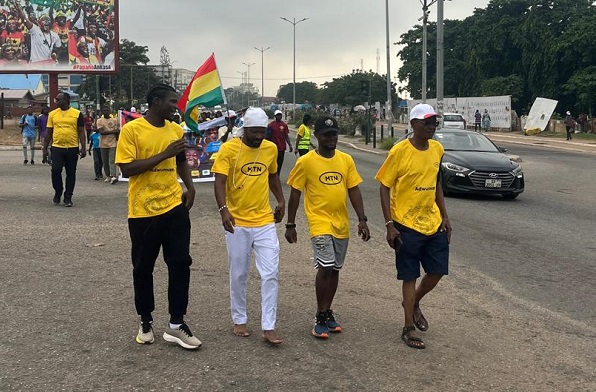
Students and management staff were joined by keep fit enthusiasts to partake in the 2026 edition of the Street Academy annual health walk held last Saturday.
It was held on the theme: “Feet on the Street, Hope in Motion.”
The event also brought opinion leaders from some of the Ga communities, sports men and women including former world boxing champion, Joseph Agbeko, and children from the academy and neighbouring communities.
The event was originally slated for July 18 but postponed due to President John Dramani Mahama’s declaration of July 17-18 as National Clean-up Day.
That development did not affect the event in any way as participants, mostly cladded in yellow outfits, turned up in their numbers.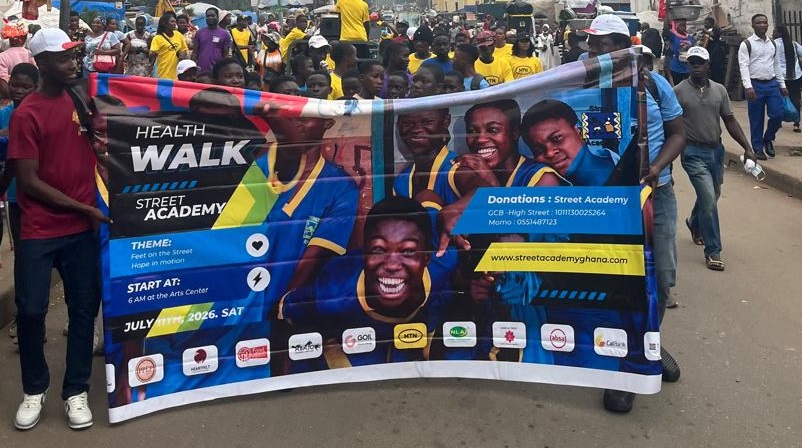
Spurred on by brass band music, the walk went through some of the principal streets of the capital, drawing more crowds from the communities it went through before returning to the Accra Arts Centre, the starting point.
Participants then went through another exhaustive aerobic session before they were refreshed.
Addressing the participants, Dr Ataa Lartey, the Founder and Executive Director of the Academy, commended them for turning out in their numbers for the walk, which he described as an event to enable the children and other guests to exercise.
Secondly, the event, he stated, was also to raise awareness about the plight of needy and underprivileged children, promote healthy living, and advocate the importance of basic education.
By Spectator Sports Reporter
Usually, when a coach is tasked to build a formidable national team for a major tournament, he does so with the best players available to him, with a special focus on local talents.
But where such local talents are not available or are unconvincing, the coach is allowed to supplement with foreign based players.
In this case, these players scouted beyond the borders of the country must be in top form and prove beyond reasonable doubt that they are far better than the locals.
Again, such players must also show some commitment and dedication to the national call.
A coach can however, decide to ignore this system in cases where there is insufficient time for the exercise, when there is a policy that forbids him from inviting certain crop of players, or if he finds himself in a position where he has no say on the players selected for him to use.
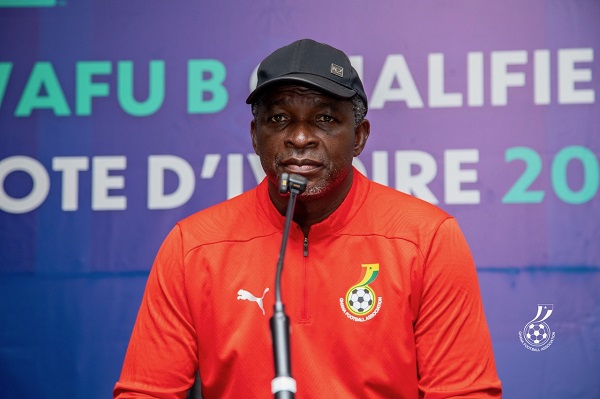
Recently, Coach Maxwell Konadu was tasked to build a Black Satellites team for the ongoing WAFU B U-20 championship in Cote d’Ivoire, a tournament which also serves as a qualifier for the 2027 Africa U-20 Championship which Ghana is hosting.
With that status, the Black Satellites become automatic candidates and rightfully, the focus should have been on a team to be groomed for the ultimate.
The sub-regional tournament did not actually oblige Konadu to rely on foreign based players, most of who are on pre-season assignments with their respective clubs.
Also, Konadu was under no misperception about quotas to allot local or foreign based players. It was very clear that the tourney was for the locals.
With this background, he is believed to have selected the players that formed the team that represented Ghana at the championship.
Sadly, Konadu and his boys disappointed woefully at the championship, failing to march his words against performance on the field.
Exiting just after the group stage came with little surprise. That has been the pattern for the national juvenile teams in their respective championships for now.
What left tongues wagging, however, was Konadu’s claim that lessons from the championship would help build a “stronger and more competitive squad for next year’s TotalEnergies CAF U-20 Africa Cup of Nations.”
The confusion lied in his admission that “the squad which competed in Côte d’Ivoire is unlikely to be the same one that represents Ghana at the 2027 TotalEnergies CAF U-20 Africa Cup of Nations.”
It would have made a lot of sense to rather build a team that uses the WAFU B Championships as a platform to prepare for the main championship next year, than selecting a team that in his own words is unlikely to compete.
This is a very common feature in other jurisdictions. The English FA, for instance, would have used an Under-18 team for the WAFU B, knowing the impact that experience would have on the team.
So clearly, the experience and lessons Konadu spoke about would be non-existent and would not help the team in anyway because if he happened to be in charge of the Ghana 2027 championship team, he would be supervising an entirely new team.
From where I sit, Konadu and whoever played any role in assembling this team got everything wrong and must be reminded that there would be no assurances that the next team would excel in the championship.
By Andrew Nortey