Sports
Grace Adjoa Bayor: From scoring goals to dressing Ghana’s Black Queens


- /home/u249204778/domains/spectator.com.gh/public_html/wp-content/plugins/mvp-social-buttons/mvp-social-buttons.php on line 27
https://spectator.com.gh/wp-content/uploads/2025/08/Wearing-the-national-colours-of-the-team-was-always-a-moment-of-pride-668x600.webp&description= Grace Adjoa Bayor: From scoring goals to dressing Ghana’s Black Queens', 'pinterestShare', 'width=750,height=350'); return false;" title="Pin This Post">
- Share
- Tweet /home/u249204778/domains/spectator.com.gh/public_html/wp-content/plugins/mvp-social-buttons/mvp-social-buttons.php on line 72
https://spectator.com.gh/wp-content/uploads/2025/08/Wearing-the-national-colours-of-the-team-was-always-a-moment-of-pride-668x600.webp&description= Grace Adjoa Bayor: From scoring goals to dressing Ghana’s Black Queens', 'pinterestShare', 'width=750,height=350'); return false;" title="Pin This Post">
At the heart of the Ghana squad that competed in the just ended TotalEnergies Women’s Africa Cup of Nations (WAFCON) 2024 in Morocco is the understanding that the current generation stands on the shoulders of giants.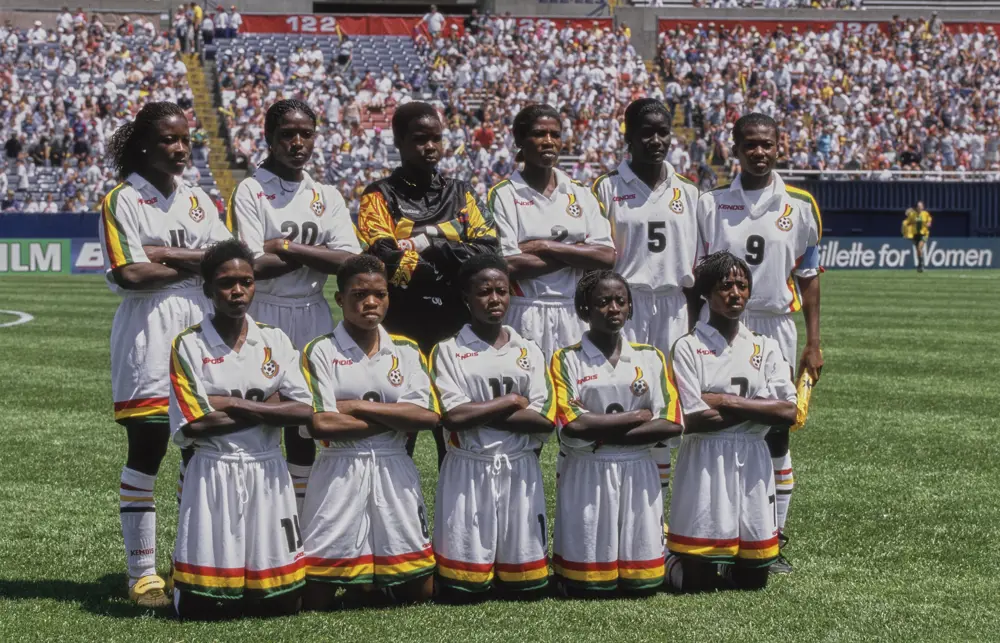
The Ghanaians are one of the most recognisable nations at the helm of African Football.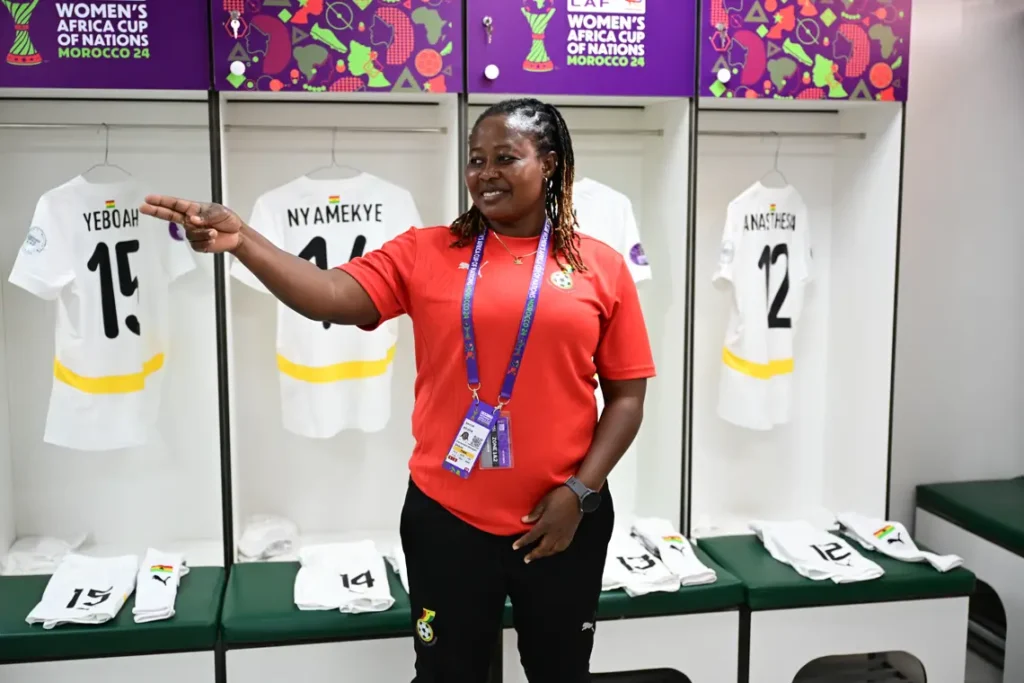
As far back as the 1990s, Ghana was vying for a place on the global stage when FIFA introduced the Women’s World Cup. A generation of strong-willed women across Ghana came together to wear the famous red, yellow and green and start the chronicles of the Black Queens.
Memories from the 90s
This section of history cannot be written without documenting the tale of one of Ghana’s finest footballers to ever wear national colours – Grace Adjoa Bayor. A name that exudes excellence, longevity and overall success in Ghana, Africa and across the world.
“When I was younger, I used to play football with men and then someone saw me and encouraged me to join Ghana Telecom. This was in 1990,” Adjoa reminscences in an exclusive interview with CAFOnline. “At Ghana Telecom, we enjoyed playing small-sided games from around 1pm in the afternoon at the iconic Mamprobi Indafa Park at Mamprobi, Accra.
This was together with some eventual Ghanaian greats in the skin of Genevieve Clottey, Lydia Ankrah and Sheilla Okine. “These games helped to improve our skills. This organized football surprised me in a good way and excited me. Honestly, I was happy to be playing football. I was very small, very little. I was around 11 years at the time.”
Bayor’s quick growth ensured that she competed in the inter-regional gala competition whilst featuring for Greater Accra. This was organized by the Ghana Football Association and it involved teams from across the country like Kumasi in the Ashanti Region, Takoradi to mention but a few. It is from this competition that the first Black Queens side was formed.
Of WAFCON and World Cup feats
Bayor was on the first ever Ghana squad that featured at the first edition of the Women’s Africa Cup of Nations (WAFCON) in 1998 hosted in Nigeria.
Ghana opened their WAFCON book with a 4-0 victory over South Africa and went on to reach the final losing to Nigeria 0-2. Bayor remembers coming off the bench to score for the Black Queens at the continental competition that brought together Africa’s top eight teams.
The tournament was also a qualifier for the now iconic FIFA Women’s World Cup 1999 in the USA. The Black Queens came up against Australia, China and Sweden in Group D.
“I was happy to be there, especially with that group of players. Singing the national anthem at the world stage was fulfilling considering where we come from and how far we had come to get to that level,” she reminisced.
Playing at the World Cup in 1999 opened up opportunities for Bayor and her teammates. She went on to play in North Virginia, Rochester, Germany, China while continuing to shine in national team colours. Her exploits saw her named as the African Player of the Year in 2003 and was in contention for the 2004 and 2006 awards.
At the 2007 World Cup, she captained Ghana and wearing the armband meant everything to her, her family, friends and the entire country. It was a display of confidence in her abilities on and off the pitch. For the young girl who grew up in Accra, it was a wild dream come true.
Decades later
Bayor retired from playing the beautiful game in 2011 but has remained at the core of the Black Queens – this time behind the scenes and as an Equipment Manager. Her role entails making sure that the team has everything that they need from an equipment point of view.
“I make sure that everything from official match jerseys, training kits, cones…everything is ready and good to go at training as well as on match day. Planning is very important in this kind of job and there is no room for error whatsoever,” Bayor told CAFOnline.
On training days, Bayor is seen setting up the necessary equipment onto the field of play exquisitely with grace – like her name. She lets her work speak for itself – a woman of very few words. Those who know her, know that her shy personality transforms into a commitment to deliver whenever she gets the call up to be part of the national team.
She locks in, gets her checklist going and ensures that there is nothing that has been forgotten. In fact, within the Black Queens setup, there are heavy fines for anyone that forgets something or comes late for that matter.
Black Queens now
For Bayor who has been part of the team for decades, donning the national team colours at the just ended TotalEnergies Women’s Africa Cup of Nations (WAFCON) 2024 is an absolute honour – yet again even though in a different role.
She reflects on the journey to this tournament and current generation; “We opened the way for them. We crawled so that they can run. They have everything that they need to perform at this level. The WAFCON has grown in leaps and bounds from what it was in 1998 on and off the pitch. It has been incredible to experience the growth.”
“There is a big difference from an organization point of view as well as financing. The prize money is now up to $1m. That is massive from CAF,” Bayor added with a smile.
Ghana was in Group C with the reigning champions South Africa whom they lost to 0-2 in their opening fixture, Mali and Tanzania.


There couldn’t have been a more challenging moment for Black Stars coach, Carlos Queiroz than the situation he faced ahead of the commencement of the 2027 African Cup of Nations (AFCON) Group C qualifiers.
Apart from opening the qualifying campaign with two high-profile encounters against The Elephants of La Cote d’Ivoire, and following up with The Gambia, Queiroz has been hit hard by several player withdrawals.
As of press time, seven top players of the team had announced their withdrawals with just about two days to the Bouake ‘clasico’ where the Ivorians engaged Ghana in a tough clash that reminded fans of their historic meeting in the finals of the 1992 edition of the championship that was decided after a marathon penalty shoot-out.
Queiroz was forced to make late changes to his side as Mohammed Kudus, Thomas Partey, Antoine Semenyo, Captain Jordan Ayew, Prince Adu Kwabena, Alidu Seidu indicated their unreadiness to serve.
This group of players can be considered as the spine of the team, and without them, the team is weak, timid, putting their ability to face the Elephants in their own habitat in doubt.
From the players, several excuses –mostly on injuries and fitness, have been given for the decision and they expect Ghanaians to just accept that and move forward.
Before the withdrawals, Atletic Bilbao’s Inaki Williams also announced his retirement from international football. Fact is, what he actually wanted to tell Ghanaians is that he would not play for the Black Stars again.
Others like Kevin Prince Boateng have walked on this path with the Black Stars before, turning his back on Ghana after enjoying his World Cup experience.
For the two, there would have been no World Cup experience without the opportunities presented by the Black Stars.
All of these are pointing to a particular trajectory which the Ghana Football Association (GFA) must be seen to be finding solutions to.
Clearly, it is showing a pattern where either players are becoming selective with the games they play or beginning to see the AFCON as an inferior championship.
Maybe what every Black Stars player must be reminded about is the fact that Ghana’s credentials at senior level were achieved through efforts at the AFCONs and not the World Cup which Ghana’s maiden qualification came in 2006.
At the AFCON, Ghana boasts of four trophies and considered heavyweights although recent history shows otherwise. For the World Cup, all the Black Stars have to show for is the quadrennial $100,000 appearance fee bonanza.
And if they don’t know, they must be told that those paydays don’t affect Ghana’s position on the FIFA rankings.
Maybe, the recent withdrawals should spark the conversation to let the Black Stars understand that just as they strive to make a name for themselves at the World Cup, fans back home equally demand same for the AFCON that presents a better chance for silverware than the World.
The FA must not entertain these excuses on the face value. They must verify some of the claims and excuses to ensure future withdrawals can be controlled. What is needed for the team to thrive is commitment and dedication at all platforms. Anything less will spell doom for the Black Stars.
By Andrew Nortey
The driver stopped the vehicle at the gate of the big fenced property along the Nsawam Highway, and Kakraba stepped out to meet the several workers who had gathered to wait for him. He greeted them and went to straight to the point. ‘Gentlemen, I am glad to see that you have almost completed the clearing of the land. I’m happy to report that we have concluded all arrangements with Nana Serebour, and construction of the palace will start in a few days.
I will need you to go and level the ground, and come back to start this project. Some workers from a construction company will come and join us to start the project. My plan is to build twenty houses in four months, then we will do twenty more until we reach two hundred.
I am relying on you to help me deliver good quality work to satisfy our clients, and as I have already indicated to you, I will reward you for your work’. After an hour’s discussion, he closed the meeting and moved to drive away. Wofa Yaw drew closer.
‘Director, can you please spare me five minutes? I would like to discuss a small issue’. ‘Why Wofa Yaw, your wife has threatened to leave you?’ ‘No, Director’. My wife will never leave me. This concerns a young niece of mine’.
‘I hope it’s something I can help with. Please sit in the car and let me hear you’. ‘Boss, my niece Beesiwa is a polytechnic graduate, very beautiful and with very good character.
Unfortunately, her parents virtually forced her into a relationship with an idiot based in the US, which impacted her badly. She has now recovered from that experience, and boss, I am respectfully asking if you would find a job for her.
I promise you that you will never regret it’. ‘Well, Wofa Yaw, let me meet her and speak with her. I may be able to help, maybe not in the way you will expect, but let me meet her. I will not be back here till after a week, but I will be at the office the whole of next week. You can come with her’.
‘On Monday morning, Wofa Yaw and Beesiwa were seated at the office by nine. Three young ladies welcomed them warmly, offered them soft drinks, and assured them that Kakraba would be there shortly, and got seated behind computers with large screens showing various building designs. Kakraba walked in and greeted them warmly, and after chatting with the three ladies, he ushered Wofa Yaw to his office’. ‘Director, this is my niece, Beesiwa. I mentioned her to you when you came to Nsawam’. ‘Yes indeed. Madam Beesiwa, you are very beautiful, as your uncle said. Wofa Yaw is my colleague.
We have just started a building project that will take about three to four years. He mentioned that you have a very small problem, so I said I would like to meet you, and see how I can help. So Beesiwa, please tell me a little about yourself’.
Beesiwa described her childhood, her school experience, her brief work at the bank, and the nasty episode with Sammy Abrokwa which shattered her peaceful life, and how she had been recovering’.
‘I am really sorry to hear this. Now, here is what we are going to do. We are a small but very busy company. The three ladies over there spend most of the day on site, and come back to report on their work in the morning.
I have three main projects. The big one is an estate project in Nsawam, where your uncle is one of my main colleagues. I need a personal assistant who can take care of my activities, especially when I am not in town.
Now, we will have to start with trust. Based on what I know about Wofa Yaw, and based on what you yourself have told me, I think we can start on a sound basis. So, Wofa Yaw will take you to my home. You can move into one of the four guest rooms. I will give you a good phone and a laptop. I will arrange computer lessons for you’. ‘Sir, I have taken some computer lessons, and I have even done graphics and web design’. ‘Fantastic! Now, Wofa Yaw, take her home. My sister Kuukuwa will meet you and show you round, and you can return to Koforidua. When would you like to start work?’ ‘Sir, I would like to start today, but I would need to go and bring my things’. ‘No problem. Take a taxi to my house, meet my sister, and let me know what you decide’.
Kakraba and the three ladies met with some bank officials to conclude on the sale of the three buildings at Adabraka.
They closed at five-thirty, and after rewarding the ladies for their hard work, he got home just after dark. He was surprised to find Kuukuwa and Beesiwa sitting at table enjoying supper. ‘What’s happening here?’ her said. ‘Beesiwa, I thought you would return to Koforidua?’ ‘She changed her mind’, Kuukuwa said. ‘We went to the Mall and bought a few things for her, and we came back to cook. She has made some nice changes to your bedroom. And she cooked a couple of interesting things. Sit down, we will serve you’.
‘Well, I certainly can’t refuse that. It’s been a busy day. So what’s the plan now? Will Beesiwa go to Koforidua tomorrow, gather her stuff together and come down? ‘No, I will stay here for a while. Kuukuwa bought me things that I need, so I may go back next week. I’m ready to start work. What would you like me to start with?’
‘Well, you can come to the office tomorrow morning, meet the three girls and get a feel of what we do. Since you are living here, at least for now, we can discuss the plans for the next few weeks. Sometimes there are gaps when I travel up north. You can take care of things from now. I think the girls would like having someone like you around’.
SKIP THE QUEUE, TAP THE NEWS
You can now read the Ghanaian Times and The Spectator newspapers from the comfort of your device via TimesNewsPlus.
Join our WhatsApp Channel: https://whatsapp.com/channel/0029VbBElzjInlqHhl1aTU27