News
Moaning in labour facilitates delivery-Health Expert

Labour pains are very unbearable for many women and so they impulsively and uncontrollably resort to screaming as a response to the extreme pain that is associated with contractions during labour.
But does a woman in labour know that if she wants to make some noise during labour to help her feel better, she can moan instead? When she moans instead of screams, she directs the pressure she is exerting downward (to the diaphragm) and helps the labour process to continue.
In an interview with Dr. Dixie Constantini a Specialist Obstetrician Gynaecologist of the Women’s Health Obstetrics and Gynaecology, she said “it is important to save as much energy as possible for the type of noise that will help with labour progression”.
She explained that screaming during labour usually made a woman tired even before she got to the point where she had to push and some education which was usually given at Pregnancy Schools should be taken seriously or one could also learn it online if that was preferable.
She said when a woman screamed especially when she was supposed to push, almost all the energy she needed for pushing rather came out as noise “and if you are not left with enough energy to push your baby out it delays the delivery process and you will not be able to push.”
Dr. Constatini said when a woman in labour was screaming it also made it difficult for her to concentrate on the labour process and listen to the instructions of the Midwife helping her.
She was emphatic that, screaming did not make the labour process faster and that labour could sometimes be very long.
Dr. Constantini said there had been instances where some women thought that they would have short labour because of screaming but that was not true.
She said with every added child, labour was usually shorter. “So a first time mother usually has longer period of labour than a fourth time mother.”
The Specialist Obstetrician Gynaecologist further explained that even though it was usually the case, the cervix was a very special part of the womb which did what it liked to do.
“It sometimes dilates very quickly when it likes or stays closed when it doesn’t want to dilate. Thus you might find some first time mothers having very short labour and others not.
We cannot control the process of dilation sometimes. Other times we are unable to tell if someone will be able to dilate fully or not. The cervix can be very tricky. “she said.
She advised that “if you are in extreme pain and epidural anaesthesia isn’t available, you can ask for pain meds that can be injected into your butt or thigh muscle to help with the pain, that’s if those are available as well”.
“We know it is extremely difficult for most people not to scream, everyone feels pain differently and we do understand this but it is also important to listen to your Midwife or Obgyn” she said.
From Dzifa Tetteh, Kpone


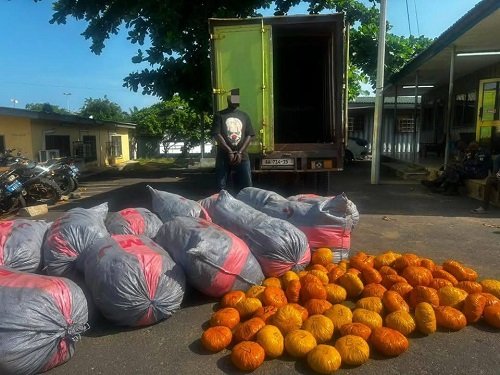
The Tema Regional Police Command has arrested a 30-year-old driver, Bismark Kpormeno, for possession of a large quantity of compressed plant materials suspected to be Indian hemp.
The arrest was made on Sunday, 31 May 2026 by officers of the Tema Highway Patrol Unit during an operation along the Tema-Ada road.
According to police, the suspect was driving a Hyundai Mighty I container truck and failed to stop when signaled. He attempted to evade arrest but was pursued and apprehended at Bondase.
A search of the vehicle revealed twelve 12 sacks and eighty 80 parcels of compressed plant materials concealed in a container and wrapped in sellotape.
Preliminary investigations show the narcotics were allegedly loaded at Kpeve in the Volta Region and were being transported to Ada.
The suspect is currently in police custody assisting with investigations. The truck and exhibits have been impounded for evidential purposes.
The Tema Regional Police Command says it remains committed to combating drug trafficking and other criminal activities.
They also urged the public to support law enforcement by providing timely and credible information on suspicious activities.
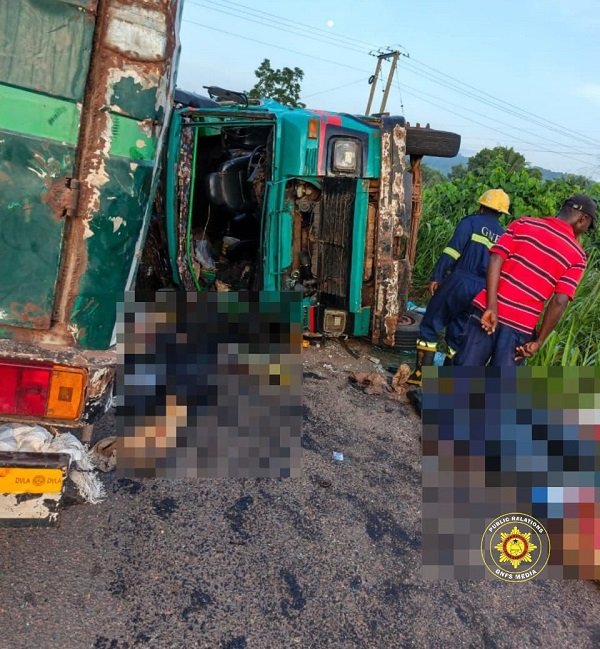
Firefighters from the Peki Fire Station of the Ghana National Fire Service (GNFS) responded swiftly to a fatal head-on collision involving a Mercedes-Benz container truck (WR 1553-C) travelling from Nkwanta to Accra and a Mercedes-Benz passenger bus (GR 3215-E) travelling from Battor to Kabiti in the Oti Region.
The crash occurred at Peki-Tsame near Peki Senior High School in the early hours of Tuesday, 2nd June 2026.
A total of forty (40) persons were involved, comprising twenty-one (21) males, fifteen (15) females, and four (4) children.
Through a coordinated rescue operation, firefighters extricated 25 injured casualties, including 23 adults and two children.
Sadly, 15 persons lost their lives, made up of nine males and 6 females.
The injured were conveyed to the Peki Government Hospital for treatment, while the deceased were handed over to the Police, who conveyed them to the hospital mortuary for preservation and further investigation. The cause of the accident remains under investigation.
The Ghana National Fire Service has extended its deepest condolences to the bereaved families and urges all motorists to observe road traffic regulations, avoid dangerous driving practices, and exercise maximum caution on the roads to help prevent accidents and save lives.

 Entertainment1 week ago
Big Ghun and Doreen Avio record massive turnout as Scarlett Unveiled auditions draw over 300 actors
- News5 days ago
University of Ghana launches UGA Network App to reconnect global alumni community
- News5 days ago
UG professor calls for responsible behavior from Ghanaians during the rainy season to prevent malaria