Features
Innovative business strategies to tackle Ghana’s growing plastic menace

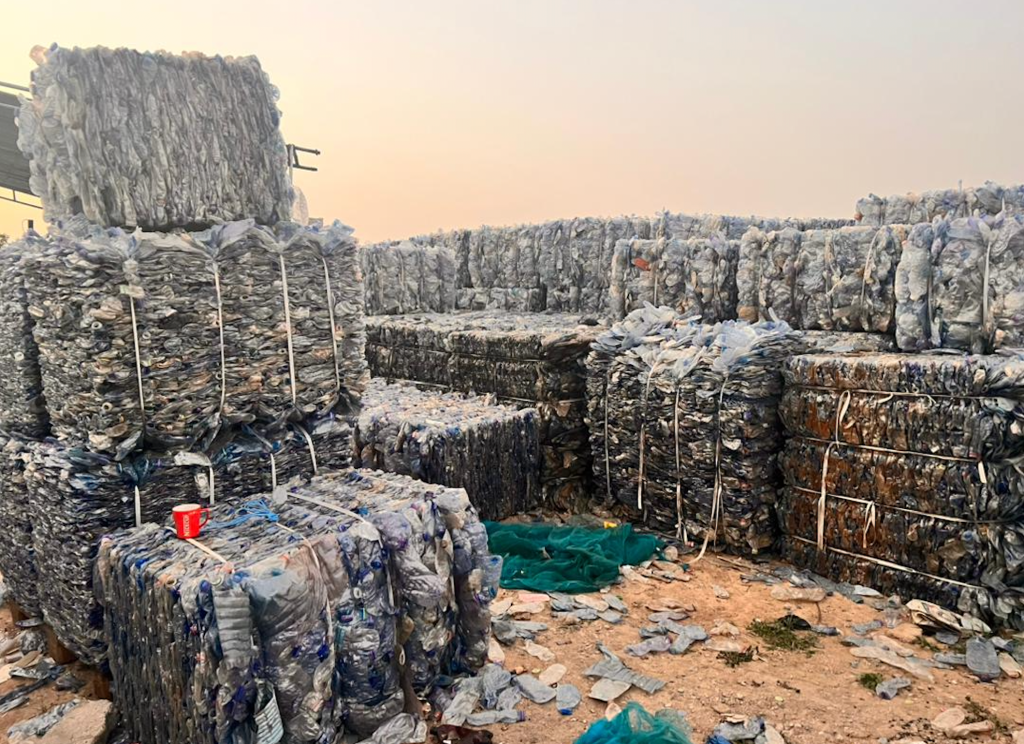
Plastic waste
This time of the year has always been a nightmare for Mavis Adjare.
Seasonal floods have been disruptive for the 45-year-old who makes her living collecting plastic waste and selling it to recyclers.
This year that has changed. Mavis picks 100 kilogramme bags of plastic waste easily at the confluence of the Kpeshieriver and the Atlantic Ocean.
Until mid-2022, the mother of three says, the onset of rain or hot weather threatened her livelihood and the future of her children. Mavis used to comb lorry stations and Accra suburbs -Tseaddo and Teshie – for plastic waste. Now she picks the plastics with ease.
“All I see is plastic waste of different shades, colours and sizes, swimming through the Kpeshie Lagoon into the sea,” Mavis says with joy.
The task of clearing the vast amounts of plastics and other waste that wash onto beaches here has been a major concern for operators of some of Accra’s most popular leisure facilities – theLabadi Beach Hotel and the Labomah Beach – located along the shore.
The waste, 80 per cent of it plastic, is often collected and set ablaze at the shore- a major worry for the Environmental Protection Agency (EPA), which says the practice is a growing source of air pollution in Ghana’s capital. The Kpeshie Lagoon is just one of the many lagoons along Ghana’s 550-kilometer coast through which tonnes of waste plastic leaks into the sea.
Nine per cent of the nearly one million metric tonnes of plastic waste generated in Ghana annually leaks into the ocean, according to the Ministry of Environment, Science, Technology and Innovation (MESTI). It leaks because so much of Ghana’s plastic waste – nearly 90 per cent – is not properly disposed, clogging up stormwater drains, rivers, and streams and ending up in the oceans, according to a 2020 report by the World Bank.
Many collectors, including Mavis, have joined associations that coordinate their activities to turn ‘waste’ to cash to enhance their livelihoods.
But plastics in the oceans and rivers are impossible for collectors to reach, meaning they miss out on income. They also miss out on income when plastics are burned.
Elvis Oppong, president of the Plastic Waste Collectors Association, says only 20 per cent of plastic bottles and 70 per cent of water sachets are retrieved by the Association.
“Due to lack of space, the majority of the bottle plastics waste are burnt while others go into the marine bodies,” Oppong says.
Plastic waste is now a major global problem. A recent analysis by charity Tearfund found that plastic waste is spiraling out of control across Africa.
It predicts that Africans will discard 116 million tonnes of waste annually by 2060 – a six fold increase from 2019. This is driven by demand for plastic within sub-Saharan Africa.
Plastic waste destroys drainage systems and adds to air pollution but it also threatens food supplies. It has killed so much fish and sea life that many fisheries are on the brink of collapse.
The United Nation Environmental Programme estimates that Ghana’s contribution to global marine debris is as much as 260,000 metric tonnes every year, or one to three per cent of the global total.
UNESCO’s International Oceanography Commission pegs plastic and micro plastics in the ocean at about 50-75 trillion pieces.
The yearly economic costs of plastic in the ocean are estimated to be between $US6-19 billion globally.
A new pilot project launched here in Kpeshie seeks to help solve the problem. River recycle, a Finland-based organisation, is working to remove plastic waste from the world’s waterways while enabling the most affected communities to prosper in a circular economy.
In January 2022, the company and its partners – Beach Clean Up Ghana Limited and Ambitious Africa – began collecting plastic waste from the Kpeshie Lagoon.
The organisation created a ‘trash boom’ — a floating barge stretched across a river – to capture plastic waste as the currents take it downstream. The boom consists of floats made from standard plastic piping, attached to wire mesh barriers that resemble fencing.
The mesh barrier extends into the water to capture pieces of plastic floating below the surface. It is anchored by ropes to the bank of the river.
Mr John Adelegan, who leads the implementation, explains that every river is unique. The team must first gather information to specifically design the plastic recovery system for this river. There have been setbacks – the system was damaged by large floating logs and stumps – but the team redesigned it and has seen improved results.
The changes include the use of steel piles and concrete blocks to make the system more resistant to erosion, high-density polythylene pipe instead of polyvinyl chloride and a second floater to ensure float even if one floater is damaged,” Mr Adelegan explains.
For the first three months, the system collected 30 tonnes of low value (single use) plastics and polyethylene terephthalate (PET). The low value plastics are recycled into boards, which are used to produce furniture, a substitute for wood while the PET is shredded into flakes for export.
With a broad smile, MrAdelegan says already two leading beverage companies have placed orders to buy plastic boards for that.
Finding alternatives for discarded plastic is becoming crucial in countries like Ghana. A visit to communities like Kpong land fill site, Agbobloshie, Mamprobi, Kanashie, Dansoman, Adentan and Jamestown that are becoming overwhelmed with plastic waste makes it obvious how much of a burden it is becoming.
Experts in waste management and environment protection applaud recycling efforts such as the one in Kpeshie. Mr Henrique Pacini, Economic Affairs Officer at the United Nations Conference on Trade and Development, says embracing the concept of “circularity” – where resources, particularly plastics, are reused and recycled repeatedly – will help fast track development in lower income countries like Ghana.
According to Dr Henry K. Kokofu, Executive Director of the Environmental Protection Agency, the revised policy will focus on prevention and other innovative strategies, including issuing producers who package products in plastic with unique codes, which they will be required to retrieve or face sanctions.
DrKokufo rules out a total ban of single used plastics saying it will be too big a burden on Ghanaian companies and the economy.
The massive work of cleaning plastics from the ocean is not on the agenda for now but at least for people like Mavis and those living around the Kpeshie Lagoon River recyle’s efforts offer relief from the seasonal onslaught of plastic waste and a hope for a cleaner environment for her children. –GNA


Attention-Deficit or Hyperactivity Disorder (ADHD) is often mistaken for laziness or indiscipline. In consulting rooms across Accra and in reports from school teachers, the pattern repeats: children who are bright but forgetful, parents who feel helpless, teachers who see incompleteness.
Research is clear-Barkley (2015) and others describe ADHD as a difference in the brain’s regulation of alertness, impulse and working memory, not a lack of effort.
The family’s role begins with structure. Regular sleep, predictable meal and homework times, and a simple visual list (uniform → books → water → corridor) provide the external scaffolding of these children need. Praise what is completed—“You opened the book and wrote the first sentence”-instead of rebuking what is missing.
Schools can help by seating the child front-row and centre, giving short written plus verbal instructions, allowing brief movement breaks, using quiet nonverbal cues and, where possible, grading effort and method as well as neatness. These adjustments reduce conflict and raise submission rates without lowering standards.
Couples and caregivers should share roles: one grounds, one pivots, and both protect rest. Shame-“bad parenting, bad child”-needs replacing with fact: different wiring, needs scaffolding.
Outcomes improve not by promises of perfection but by daily routines, clear limits and warmed connection. One homework slot kept, one instruction chunked, one calm repair after blurting-these small wins shift the family climate and let the child be seen beyond the label.
Resource
• CPAC (award-winning Mental Health and Counselling Facility): 0559850604 / 0551428486
Source: REV. COUNSELLOR PRINCE OFFEI’s insights on special needs support, relationships, and mental health in Ghana. He is a leading mental health professional, lecturer, ADR Expert/Arbitrator, renowned author, and marriage counsellor at COUNSELLOR PRINCE & ASSOCIATES CONSULT (CPAC COUNSELLOR TRAINING INSTITUTE) – 0551428486 /0559850604.
WEBSITES:
https://princeoffei22.wixsite.com/author
https://princeoffei22.wixsite.com/website
After two weeks of hectic activity up north, I drove to the Tamale airport, parked the car at the Civil Aviation car park as usual, paid the usual parking fee and boarded the plane for Accra.
Over the last two weeks, I had shuffled between three sites where work was close to completion.
One was a seed warehouse, where farmers would come and pick up good quality maize, sorghum and other planting material.
The other was a health facility for new mothers, where they were given basic training on good nutrition and small scale business.
And the third was a set of big boreholes for three farming communities.
The projects usually ran on schedule, but a good deal of time was spent building rapport with the local people, to ensure that they would be well patronised and maintained.
It was great to be working in a situation where one’s work was well appreciated. But it certainly involved a lot of work, and proactivity. And I made sure that I recorded updates online before going to bed in the evening.
When the plane took off, my mind shifted to issues in Accra, the big city. The young guys at my office had done some good work. They had secured five or six houses on a row in a good part of the city, and were close to securing the last.
When we got this property, unusually, Abena greeted them casually, and appeared to be comfortable in the guy’s company.
I was quite disappointed to hear that, because until the last few weeks, it seemed as if Abena and I were heading in a good direction. Apart from the affection I had for her, I liked her family. I decided to take it easy, and allow things to fall in whatever direction.
Normally I would take a taxi to her house from the airport, and pick her up to my place. This time I went to my sisters’ joint, where they sat by me while I enjoyed a drink and a good meal.
“So Little Brother,” Sister Beesiwa said, “what is it we are hearing about our wife-to-be?”
“When did you conclude that she was your wife-to-be? And what have you heard? I’ve only heard a couple of whispers. Ebo and Nana Kwame called to say that they have seen her in the company of—”
“Well said Little Brother,” Sister Baaba said. “By the way, Nana Kwame called an hour ago to ask if you had arrived because he could not reach you. Someone had told him that Jennifer had boasted to someone that she had connected Abena to a wealthy guy who would take care of her.”
I was beginning to understand. For some time, Abena had been asking me what work I was doing up north, and after I had explained it to her, she kept asking. So I think Jennifer fed her with false stories about me in order to get her to move to the Ampadu guy. Jennifer must have been well compensated for her efforts.
“In that case,” Sister Beesiwa said, “you should be glad that Abena is out of your way. She is easily swayed. Anyone who would make a relationship decision based on a friend’s instigation lacks good sense. I hope the guy is as wealthy as they say?”
“Who gets wealthy running a supermarket chain in Ghana?” Sister Baaba said. “Our supermarkets sell mostly imported products. Look at the foreign exchange rate. And remember that Ghanaians buy second-hand shoes and clothes. Supermarkets are not good business here. Perhaps they are showing off that they are wealthy, but in reality they are not doing so well.”
“Amen to that,” I said. “I’m beginning to understand. For some time, Abena had been asking me what work I was doing up north, and after I had explained it to her, she kept asking. So I think Jennifer fed her with false stories about me in order to get her to move to the Ampadu guy. Jennifer must have been well compensated for her efforts.”
She said that David Forson was only an agricultural extension worker in the north who did not have the resources to take care of a beautiful girl like her. And apart from being wealthy, the guy comes from an influential family, so Abena had done much better leaving a miserable civil servant like you for him.
“Amen to that,” I said. “I’m beginning to understand. For some time, Abena had been asking me what work I was doing up north, and after I had explained it to her, she kept asking. We would be able to sell all five houses to one big corporate customer, and we had already spoken to a property dealer who was trying to find a buyer in order to get a good commission.
That was going to be my biggest break. I had asked the boys to look for a large tract of land on the outskirts of the city where we could develop our own set of buildings, blocks of storey houses and upscale apartments. Things were going according to plan, and I was quietly excited. However, things were not going so well regarding my relationship with Abena.
My buddies Ebo and Nana Kwame had called to say that they met Abena and her friend Jennifer enjoying lunch with a guy, and Ebo believed that Jennifer was ‘promoting’ an affair between Jennifer and the guy. They were of the view that the promotion seemed to be going in the guy’s favour, because only an agricultural extension worker in the north who did not have the resources to take care of a beautiful girl like her.
And apart from being wealthy, the guy comes from an influential family, so Abena had done much better leaving a miserable civil servant like you for him.
“As I’ve already said, I will stop by her place, but I will mind my own business from now. Hey, let’s talk family. How are our parents? And my brothers-in-law? And my nephews and nieces? Why don’t we meet on Sunday? I’m going to drop my bags at my place, and go to see Mama and Dad.”