Hot!
AMA ‘de-rats’ major markets in Accra

- /home/u249204778/domains/spectator.com.gh/public_html/wp-content/plugins/mvp-social-buttons/mvp-social-buttons.php on line 27
https://spectator.com.gh/wp-content/uploads/2023/11/A-staff-of-AMA-spraying-the-market.jpe&description=AMA ‘de-rats’ major markets in Accra', 'pinterestShare', 'width=750,height=350'); return false;" title="Pin This Post">
- Share
- Tweet /home/u249204778/domains/spectator.com.gh/public_html/wp-content/plugins/mvp-social-buttons/mvp-social-buttons.php on line 72
https://spectator.com.gh/wp-content/uploads/2023/11/A-staff-of-AMA-spraying-the-market.jpe&description=AMA ‘de-rats’ major markets in Accra', 'pinterestShare', 'width=750,height=350'); return false;" title="Pin This Post">
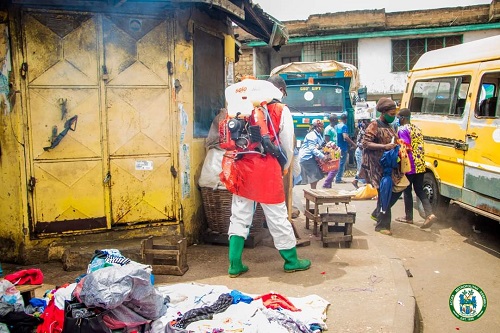
A staff of AMA spraying the market
As part of measures to control rodent infestation in some major markets in the capital city, the Accra Metropolitan Assembly (AMA) has conducted a ‘de-ratting exercise’ to ensure a safer and healthier environment.
The exercise was conducted at the 31st December Market, Agbogbloshie and Makola No 2. markets.
Speaking to the Spectator in Accra, the Head of Public Affairs of the AMA, Gilbert Nii Ankrah said some of the health risk associated with rodent infested markets were food contamination, leptospirosis (a bacterial disease spread through the urine of infected animals), hantavirus (a family of viruses spread mainly by rodents and can cause varied disease syndromes in people) and allergies.
He said rodents also gnaw on structures, wiring, and packaging materials, potentially causing damage to buildings and creating fire hazards if they chew on electrical wiring,” he added.
According to Mr Ankrah, rodent were highly adaptable creatures that often carry bait to their nests located far from where they originally encounter it and making it challenging to control their population effectively, hence the use of the systemic and gradual killing,” Mr Ankrah said.
He said before the operation, Public Health Officers conducted a comprehensive assessment of each market to identify rat-infested areas, entry points, and potential breeding grounds, adding that despite awareness campaigns, achieving universal compliance with hygiene practices among vendors proved challenging.
He pointed out that the assembly, as part of measures to address factors that may cause the increase in rodent population in the market, had established a routine de-ratting schedule to prevent infestation and was redeveloping the markets to eliminate entry points for rats.
He added that the assembly was educating traders on proper waste disposal and hygiene practices, emphasising that the success of the initiative does not only hinge on the efficacy of the gradual poisoning method, but on the collaborative efforts of the community.
By Jemima Esinam Kuatsinu



The Tema Regional Police Command has arrested a 32-year-old man for allegedly posing as a soldier and extorting money from unsuspecting members of the public at Ashaiman.
The suspect, identified as Bright Atsu Kudiabor, was arrested by the Ashaiman Police on Wednesday, September 16, 2026, at about 7:00 a.m.
According to the Police, he was arrested at an area known as “I Shall Return”, where he was allegedly parading himself as a soldier and demanding money from people.
The Police said Kudiabor, who is an ex-convict, was initially arrested by personnel of the Ghana National Fire Service in Ashaiman with assistance from other members of the public.
A search conducted on him after he was handed over to the Police reportedly led to the recovery of a set of military camouflage uniform.
The suspect is currently in Police custody and assisting with investigations.
The Tema Regional Police Command said he would be processed for court after investigations are completed.
The Police urged the public to remain vigilant and report anyone who falsely presents themselves as a soldier or a member of another security agency to deceive or extort money from the public.
By: Jacob Aggrey

Volta Regional Minister, James Gunu, says the Volta Region holds enormous agricultural potential and efforts must be geared towards connecting farmers to the needed resources to unlock that potential.
He said focus must be on linking farmers to resources, technology, financing and markets to increase production, create jobs and build sustainable livelihoods.
Hon. Gunu made the remarks at the national launch of the Ghana Tomato Self-Sufficiency Initiative (GHATSI) held at Anloga in the Volta Region on Tuesday, September 15.
The initiative, under the theme “Produce at Home. Feed the Nation. Export the Surplus,” seeks to boost local tomato production, processing and marketing while reducing Ghana’s heavy reliance on imported tomatoes.
The launch was attended by the Minister for Food and Agriculture, Eric Opoku, his Deputy, John Setor Dumelo, Feed Ghana Coordinator, Bright Demordzi, Members of Parliament, traditional leaders, MMDCEs, farmers and other stakeholders.
Mr.Gunu expressed appreciation to the Minister for Food and Agriculture for the support announced for the region, including two excavators, 200 cartons of organic fertiliser, and GH¢200,000 for Ms. Kuatudzo Esther Dela, a tomato farmer and processor from Ziope.
He described the initiative as an important step towards making agriculture a stronger driver of food security, job creation and economic growth in the Volta Region.
By Edem Mensah-Tsotorme